

What's changed: Initial version
3.4Business use of AI & data
Covers data-driven management (deciding by data, not hunch or experience), the judgment of which business problems to apply AI/machine learning to so as to create real business value, the use of big data, the digital twin that mirrors the physical into virtual space, and data utilization and value creation that turns data itself into value. The point is to invest AI where it links to a concrete management indicator (KPI), separating it from hype—not doing AI "just because it is AI."
AI and data utilization are now among management's most critical themes. But the pitfall for an IT strategist is introducing AI "because a competitor did" or "because it is trendy" and piling up investment without linking to concrete business results. The role here is not to talk about AI or machine-learning technology but to discern which management indicator (KPI) improves by how much when which AI method is applied to which business problem with which data, and to separate hype from real value. This section covers data-driven management, AI-application judgment, big data, and the digital twin as material for judging value that links to a KPI.
3.4.1Data-driven management and judging AI application
- Data-driven management: management that decides based on facts (data), not on hunch, experience, and nerve alone. But collecting data as an end in itself is meaningless; it is essential to first define which decision is improved, with which data, and how.
- AI/machine learning tends to create business value where pattern recognition, prediction, classification, or anomaly detection from large data is at the core of the problem (demand forecasting, failure prediction, credit scoring, recommendation, fraud detection). Conversely, value is hard to obtain where accountability for the basis of judgment is heavy, data is scarce, or handling a few exceptions is the essence.
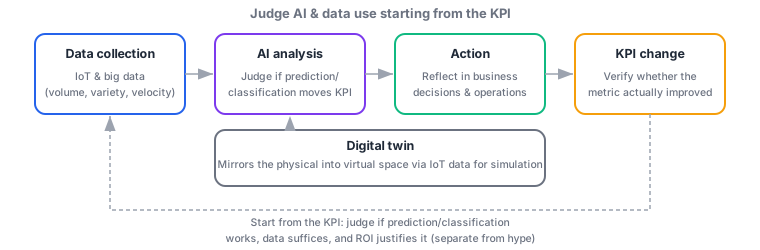
- The essence of application judgment: do not make "using AI" the goal; start from the management indicator (KPI) to improve, and evaluate whether AI's prediction/classification truly moves that KPI, whether the needed data is sufficient, and whether the return justifies the investment. AI investment where it does not work becomes a failure swept along by hype.
3.4.2Big data and the digital twin
- Big data: data with large Volume, Variety, and Velocity, including not only structured data but unstructured data such as images, text, and sensors. Data utilization and value creation: analyzing and combining collected data to turn it into value (revenue) in the form of decisions, new services, or even data provision.
- The digital twin: a mechanism that faithfully reproduces a real facility, product, or process in virtual space based on IoT-acquired data, and predicts and optimizes behavior via simulation. It reduces prototyping and real-machine trials and creates value combined with demand forecasting and predictive maintenance.
Most-tested: "data-driven management = fact-based decisions (collecting data as an end is wrong)", "judge AI application from the KPI, evaluating value (do not make introducing AI the goal)", and "AI works where pattern recognition, prediction, or anomaly detection is at the core." Watch for making the means an end—"introduce AI because a competitor did," "just collect data." A digital twin's point is mirroring the physical into virtual for simulation.
At a retailer's management meeting, an order goes out—"a competitor introduced AI and it is making waves; introduce AI company-wide here too"—and the IT strategist is tasked with making it concrete. What the strategist must not do is make "introducing AI" the goal and hand out trendy generative AI or chatbots to every department for now. That only piles up investment without linking to business results. The path the strategist should take is to first place the management indicator (KPI) to improve at the start, and evaluate per problem whether AI's prediction/classification can truly move that KPI, whether the needed data is sufficient, and whether the return justifies the investment. Analysis surfaces two promising areas. First, inventory optimization: ample data on past sales, weather, events, and prices is accumulated, and raising demand-forecast accuracy with AI promises to improve the clear KPIs of "stockout rate" and "disposal-loss rate" at once—here, prediction from patterns is the core of the problem, the data exists, and it links directly to KPIs, so AI's value is real. Second, fraud detection: detecting abnormal patterns in payment data can lower the KPI of "fraud loss amount." On the other hand, management's initial hope of "AI auto-generating new-business ideas" carries heavy accountability for the basis of judgment, has a vague KPI for success, and lacks the needed data, so the strategist discerns it as an area where investing now yields little value (close to hype). The strategist therefore proposes to management to concentrate AI investment on inventory optimization and fraud detection—areas linked directly to KPIs where value is real—and defer investment in areas with vague KPIs and scarce data (or verify small via a PoC). The essence here is not to be swept along by the glamour of the AI technology but to return to the causality of business value—"which KPI can be moved, by how much, with which data"—and separate real value from hype.
| Viewpoint | Value tends to be real | Close to hype (be cautious) |
|---|---|---|
| Core of the problem | Pattern recognition, prediction, anomaly detection | Heavy accountability, handling few exceptions is the essence |
| Link to KPI | Directly linked to clear KPIs (stockout rate, loss amount) | The KPI to measure success is vague |
| Data | Sufficient quantity/quality of data accumulated | The needed data is scarce |
Trap: "Since a competitor introduced it / it is trendy, we should roll out AI company-wide at once too" is wrong—making AI introduction itself the goal becomes a hype failure that piles up investment without linking to a KPI. Judge the application area from the KPI to improve: whether AI's prediction/classification truly moves that KPI, whether the data is sufficient, and whether the return justifies the investment. Also wrong: "just collecting a lot of data creates value"—collecting data as an end is meaningless; defining which decision is improved and how, first, is data-driven management.
3.4.3Section summary
- Data-driven management decides on facts; collecting data as an end is wrong—define the decision to improve first
- Judge AI application from the KPI to improve—whether prediction/classification works, data is sufficient, and the return justifies it (do not make introducing AI an end)
- Turn data into value with big data (volume, variety, velocity) and the digital twin (mirroring physical into virtual for simulation), separating real value from hype
Sign in to track progress — Log in.
Quick check
(just a quick review)Q1. At a management meeting, an order goes out: "a competitor introduced AI and it is making waves; roll out AI company-wide at once here too." Which is the most appropriate way for the IT strategist to proceed?
Q2. A manufacturer is troubled by the cost and duration of repeated real-machine prototyping and testing. It wants to leverage IoT-acquired operational data to verify, in advance via simulation, the impact of design changes and maintenance timing. Which mechanism is most suitable?
Q3. A firm, "to realize data-driven management," first began accumulating vast amounts of all internal and external data in a data lake, but after a year no management decisions had changed. Which is the most appropriate point for the IT strategist to raise?
Keep track of your progress
The full study guide is free to read. Sign up free to practice with the question bank, track what you have read, review your mistakes, and highlight passages.