

What's changed: Initial version
3.3Industry solutions & enterprise systems
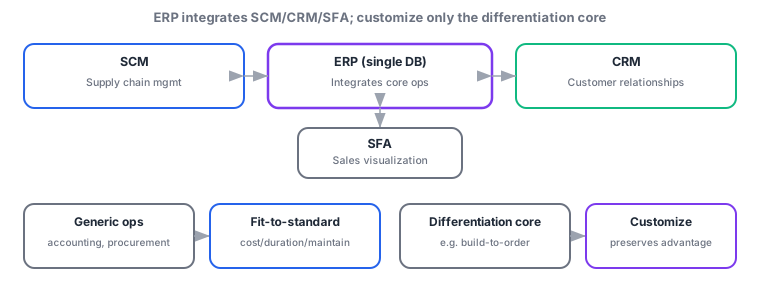
Covers SCM (optimizing the whole supply chain), CRM (deepening customer relationships), ERP (integrating core operations on a single foundation), SFA (supporting sales), industry-specific industry solutions (finance, distribution, manufacturing, public), and demand forecasting, from the viewpoint of an IT strategist choosing against the firm's strategy. A key point is judging whether fit-to-standard (fitting operations to ERP standard functions) or bespoke customization suits the firm's differentiation strategy.
Introducing an enterprise system or industry solution is, for many firms, a multi-year, large-scale IT investment. An IT strategist's role is not to compare feature lists of packages but to judge, against the firm's management strategy, business processes, and source of differentiation, which scope to fit to the standard and where to build the firm's own bespoke work. The most common ERP-introduction failure is trying to custom-build every process as-is, thereby losing the very benefits of fitting operations to standard functions (cost, duration, maintainability). This section covers SCM/CRM/ERP/SFA and industry solutions as material for strategy-fit judgment.
3.3.1Enterprise systems and industry solutions
- ERP (integrated enterprise resource planning): integrates accounting, HR, production, sales, procurement, etc. on a single database foundation, managing company-wide information centrally for overall optimization. Many ERPs embody industry best practices as standard functions.
- SCM (supply chain management): optimizes the whole supply chain from procurement through manufacturing, logistics, and sales via information sharing, cutting inventory and stockouts together. Information sharing curbs the bullwhip effect, where demand information is distorted as it propagates upstream.
- CRM (customer relationship management): integrates customer information, analyzes purchase history and touchpoints to deepen relationships, and raises customer lifetime value (LTV) and retention. SFA (sales force automation): visualizes deals, negotiations, and activities to standardize and streamline the sales process.
- Industry solutions: packages specialized for industry-specific requirements—finance (core banking, risk management), distribution (POS, inventory), manufacturing (production control, MES), public (municipal, social security). They efficiently cover industry requirements hard to meet with a generic ERP.
3.3.2The fit-to-standard judgment
- Fit-to-standard: the idea of fitting the firm's business processes to the standard functions (best practices) of an ERP, etc. By minimizing bespoke customization, it secures introduction cost, duration, and future upgrade maintainability.
- Customization is judged cautiously only where that process is a source of competitive advantage (the core of differentiation). Building bespoke work even for generic processes that do not contribute to differentiation swells cost and duration and blocks keeping up with standard upgrades (technical debt).
Most-tested: "ERP integrates core operations on a single DB foundation for overall optimization", "fit-to-standard fits operations to standard functions, avoiding over-customization", and "customization is limited to the core of differentiation". Watch for the error that "fully customizing the ERP without changing any current process is correct," and confusing the roles of SCM/CRM/SFA.
An IT strategist at a mid-sized manufacturer is considering an integrated ERP to replace aging point systems. The front line strongly requests: "our current way of working was honed over many years, so please fully customize the ERP to that way without changing anything." Management, meanwhile, is deeply concerned about cost, duration, and future upgrade maintainability. What the strategist must judge is the line of which operations to fit to standard functions (fit-to-standard) and which alone to customize. The key is the strategic view of whether that operation is a source of the firm's competitive advantage (the core of differentiation). Analysis shows that accounting, procurement, HR, and generic inventory management are not elements that differentiate the firm from rivals—it is more efficient to align them to the industry-standard way, fitting the process side to the ERP's standard functions (best practices). Custom-building these as-is would swell introduction cost and duration and, every time the ERP is later upgraded, force rework of the customized parts—technical debt that immobilizes the firm. On the other hand, the firm's long-cultivated build-to-order, short-lead-time operation is precisely the core of differentiation that wins customers, and since standard functions cannot fully express it, it is worth carefully customizing (or adding on) there. The strategist therefore judges—not "full customization or wholesale standard" as either/or—but to fit the majority of operations that do not contribute to differentiation to the standard (fit-to-standard), and concentrate customization only on the few that are the core of differentiation. This reconciles overall introduction cost, duration, and maintainability with maintaining competitive advantage. The front line's "we do not want to change the current way" is information to respect, but the strategist's skill lies in not letting it substitute for the strategic judgment of whether something is the core of differentiation.
| Nature of the operation | Policy | Reason |
|---|---|---|
| Generic ops not aiding differentiation (accounting, procurement) | Fit-to-standard (align to standard) | Secures cost, duration, maintainability |
| Core operations that are the source of advantage | Limited customization / add-on | The standard cannot fully express the differentiation |
| Complex industry-specific requirements | Consider using an industry solution | Hard to meet with a generic ERP |
Trap: "Fully customizing the ERP without changing any current operation is the kindest, correct introduction for the front line" is wrong—custom-building even operations that do not aid differentiation swells cost and duration and becomes technical debt that cannot keep up with future upgrades. Fit non-core operations to the standard (fit-to-standard) and limit customization to the source of competitive advantage. Conversely, "everything should always follow the standard" is also wrong—flattening even the core differentiating operations to the standard loses competitive advantage.
3.3.3Section summary
- ERP integrates core operations on a single DB foundation for overall optimization; SCM covers the supply chain, and CRM/SFA support customers and sales
- Fit non-differentiating operations to the standard via fit-to-standard, securing cost, duration, and maintainability
- Limit customization to the source of competitive advantage (the differentiation core), avoiding technical debt from over-customization
Sign in to track progress — Log in.
Quick check
(just a quick review)Q1. A mid-sized manufacturer is introducing an integrated ERP. The front line requests "full customization without changing any current operation," while management worries about cost, duration, and future maintainability. Which is the most appropriate judgment by the IT strategist?
Q2. A retailer is troubled by order-quantity swings amplifying as demand information propagates to upstream suppliers, causing repeated over- and under-stocking. Which solution direction should the IT strategist propose?
Q3. In the sales division, deal progress and negotiation status exist only in each rep's head, so lost-deal analysis and handovers are impossible. Which system should the IT strategist first consider introducing?
Keep track of your progress
The full study guide is free to read. Sign up free to practice with the question bank, track what you have read, review your mistakes, and highlight passages.