

What's changed: Initial version
3.1e-business & digital business models
Covers digital business models—EC, the long tail, omnichannel, the sharing economy, platform business (two-sided markets and network effects), fintech, and subscription—as tools an IT strategist uses to judge "how the firm enters which market." The point is not term memorization but discerning which model fits according to the source of value (selling one's own product vs connecting two user groups).
Digital technology has rewritten the very "business models" by which firms create value and earn revenue. An IT strategist's job is not to memorize the names of these models but to judge, against the firm's strengths, the market's structure, and the source of revenue, which model to enter and win with. For the same goods, whether the firm makes and sells the product directly or provides a venue (platform) connecting sellers and buyers demands entirely different resources and paths to winning. This section covers the representative digital business models from the viewpoint of their source of value and fit conditions, as material for market-entry judgment.
3.1.1Key digital business models and their source of value
- The long tail: in EC where physical shelf constraints vanish, a firm can stock a huge "tail" of niche items that each sell in small numbers, whose sum contributes greatly to revenue. Contrary to the traditional idea of focusing on best-sellers (the head), it is an assortment strategy that works precisely because the cost of dormant inventory is small in the digital realm.
- Omnichannel: the idea of integrating every touchpoint—physical stores, EC, apps, SNS—and unifying inventory and customer information to offer a consistent buying experience over any route. Unlike multichannel, which runs channels separately, its essence is making one seamless experience from the customer's viewpoint.
- The sharing economy: an economy where idle assets held by individuals or firms (spare rooms, cars, skills) are shared or lent to others via a platform. Its source of value is the idea of using rather than owning, and the venue that intermediates lenders and borrowers.
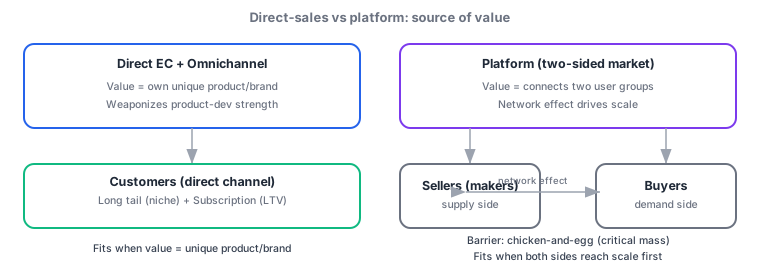
- Platform business: a business that provides a "venue" connecting two user groups of differing nature, such as sellers and buyers. Network effects operate—especially cross-group indirect network effects, where the more users on one side, the higher the value to the other side—so scale begets scale and the market tends toward winner-take-all.
- Fintech (finance x IT): a model that reconstructs financial services with IT—cashless payment, online lending, robo-advisors, and so on. Subscription: a model that, rather than selling a product outright, provides usage rights for a flat recurring fee, building revenue around churn rate and customer lifetime value (LTV).
Most-tested: "a platform connects two user groups and generates value from scale via network effects", "omnichannel integrates all touchpoints into a consistent experience from the customer's view (multichannel keeps them separate)", and "the long tail: the sum of the niche tail matters". Watch for mistaking a platform's essence for "just the firm's own EC site," and the omnichannel-vs-multichannel distinction (integrated vs separate).
A maker of handmade goods is considering a full-scale entry into the online market and asks an IT strategist for strategic advice. Management initially leans toward "launching a platform (marketplace) that gathers many makers and intermediates trades, so network effects capture share at once." What the strategist must judge is where this firm's source of value lies and which model fits its resources and competitive environment. A platform model's strength is the network effect by which sellers (makers) and buyers attract each other. But this model must first clear the chicken-and-egg problem (the critical-mass barrier)—"without sellers no buyers come, and without buyers no sellers gather"—and in a market where large marketplaces already exist, it is extremely hard for a late entrant to gather both sides at once and reach critical scale. This firm's real strength, on the other hand, is that it can plan and manufacture its own uniquely designed products that others lack. If so, rather than a platform intermediating others' goods, it is clearer to sell its own products directly via EC (and omnichannel integrating physical stores and SNS), capture broad niche demand as a long tail, and raise LTV for core fans with a subscription (regular delivery)—this weaponizes the firm's resources (product-development capability, brand). The crux of the judgment is not to jump at a platform merely "because network effects are attractive," but to discern whether the firm's source of value is "connecting two groups" or "the unique product itself." The former fits a platform, the latter a direct-sales model, and its resources and competitive environment bear that out. Should the firm's brand later reach a stage of attracting many fans and makers, a two-stage move to open its ecosystem into a platform then becomes an option.
| Model | Source of value | Conditions where it fits |
|---|---|---|
| Platform (two-sided market) | Network effects connecting two user groups | Can gather both sides to critical mass (first-mover or rapid) |
| Direct EC + omnichannel | Unique product, brand, consistent customer experience | The firm has product-development capability and differentiation |
| Long tail | Aggregate sales of the niche tail | Digital channels with low inventory/shelf cost |
| Subscription | Stable recurring revenue and LTV | Ongoing use has value and churn can be contained |
Trap: "Because network effects are powerful, any business will surely win if it becomes a platform" is wrong—a platform faces the chicken-and-egg (critical-mass) barrier, and it is extremely hard for a late entrant to gather two groups at once in a market where a giant platform already exists. If the firm's source of value is a unique product, a direct-sales model fits. Also wrong: "omnichannel = having multiple channels"—merely having several is multichannel; omnichannel's essence is integrating inventory and customer information into one seamless experience from the customer's view.
3.1.2Section summary
- A platform connects two user groups and creates value via network effects, but faces the chicken-and-egg (critical-mass) barrier
- If value is in a unique product, direct EC + omnichannel fits; for breadth of niches the long tail; for ongoing value, subscription
- An IT strategist judges the entry model by fit to the firm's source of value, resources, and competitive environment, not by a model's popularity
Sign in to track progress — Log in.
Quick check
(just a quick review)Q1. A maker able to plan and manufacture its own uniquely designed products is entering the online market. Management thinks "launching a platform that gathers many makers and intermediates trades will win via network effects." Which is the most appropriate advice from the IT strategist?
Q2. A retailer with physical stores has strengthened its EC, app, SNS, and store touchpoints, but inventory and customer information are siloed per touchpoint, causing complaints such as an item seen in-store not being reflected in the app's stock. Which direction should the strategist aim for?
Q3. An EC operator of books and goods is weighing whether to narrow its assortment to only top-selling staples. Given the long-tail concept for digital channels, which advice is most appropriate?
Keep track of your progress
The full study guide is free to read. Sign up free to practice with the question bank, track what you have read, review your mistakes, and highlight passages.