

What's changed: Initial version
2.4Design thinking & new business development
Covers design thinking, which discovers problems from empathy with users and iterates prototyping and testing; lean startup / MVP, which quickly validates hypotheses with a minimal product; the business model canvas, which visualizes a business's elements in nine blocks; and organizational ambidexterity (exploration and exploitation of knowledge), which reconciles deepening the existing business with exploring new domains—and judging, in a new business of high market uncertainty, between "build it out fully, then launch" and "test small and learn."
A new business is a lump of uncertainty—"what customers truly want" and "whether the business holds up" are unknown until tried. Modern new-business development meets this uncertainty not by building it out big and betting once to hit, but with an iterative approach: unearthing problems through empathy with users (design thinking) and learning by quickly validating hypotheses with a minimal product (lean startup / MVP). This section covers these methods, the business model canvas that visualizes the whole picture of a business, and the organizational stance of exploring the new while running the existing business (ambidexterity), from the viewpoint of how an IT strategist makes investment judgments under uncertainty.
2.4.1Design thinking and lean startup / MVP
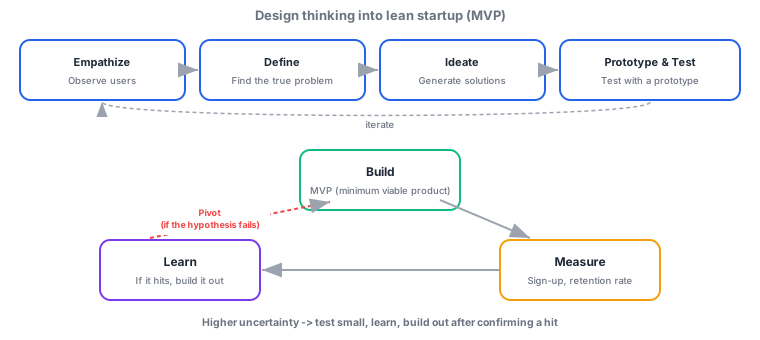
- Design thinking is a human-centered approach that discovers the true problem from observing and empathizing with users rather than the maker's assumptions, and iterates ideation -> prototype -> testing to approach a solution. It does not aim for a finished product from the outset but tests early and learns early.
- Lean startup is a methodology that spins the "Build-Measure-Learn" loop fast to validate business hypotheses at minimal cost. Its core is the MVP (minimum viable product)—a product with only the minimum features needed to test a hypothesis, put in front of real customers to measure their reaction.
- The aim of the MVP is to "build small and learn early." Building out big before launching makes the loss (time, funds) enormous if the hypothesis was wrong. The higher the uncertainty, the more rational it is to validate direction with an MVP first and build out only after confirming a hit (if it misses, correct course—pivot).
2.4.2The business model canvas and ambidexterity
- The business model canvas visualizes a business's mechanism on one sheet with nine elements—customer segments, value proposition, channels, customer relationships, revenue streams, key resources, key activities, partners, and cost structure. It verifies the consistency among elements (to whom, what value, delivered how, earning how) and is shared and discussed among stakeholders.
- Organizational ambidexterity simultaneously pursues exploitation (of knowledge)—polishing the existing business and raising efficiency—and exploration (of knowledge)—stepping into new domains to seek new opportunities. Leaning solely on exploitation cannot adapt to environmental change (the competency trap), while exploration alone crumbles the near-term earnings base. The balance and the mechanism to reconcile the two decide competitiveness.
Most-tested: "design thinking = discover problems from empathy with users and iterate prototyping and testing", "MVP = a product with the minimum features needed to test a hypothesis, to learn early", and "ambidexterity = reconciling exploitation (existing) and exploration (new)." Watch for the reductive misconceptions "MVP = selling a low-quality unfinished product" and "design thinking = making the visual design look nice." Do not confuse ambidexterity's "exploration" and "exploitation."
A maker's IT strategist is weighing how to launch a new subscription service proposed internally. The service targets general consumers, whom the firm has never served, and the demand hypothesis—"will users really pay this price for these features"—is entirely unvalidated. The business unit argues, "if we're doing it, avoid half-measures: spend a year and a half building out full features and launch big; budget, several hundred million yen." It looks like a serious, solid plan, but in this situation of extremely high market uncertainty it is a risky call. If the demand hypothesis (acceptance of price and features) is wrong, then after sinking a year and a half and hundreds of millions it turns out "nobody wanted it," and the loss is unrecoverable. What the strategist should take here is the lean-startup idea: first, identify the riskiest hypothesis to test ("is there demand at this price for this core feature"), build an MVP with only the minimum features needed to check it in a short time on a small budget, put it in front of real prospects, and measure their reaction—sign-up rate, retention, willingness to pay (Build-Measure-Learn). If the reaction is good, judge the hypothesis supported and build out features in stages with thicker investment; if poor, correct the price, target, or value proposition (pivot), or withdraw to avoid a big loss. In this process, design thinking—observing users and unearthing the true problem from empathy—raises the quality of the hypothesis, and the business model canvas verifies the consistency among "to whom, what value, delivered how, earning how" to expose holes in the hypothesis. Two misconceptions to avoid here: first, an MVP is not "selling a corners-cut, low-quality product" but a product for learning narrowed to the minimum features needed for validation, and the core-value part it targets must actually work. Second, running this new business company-wide on the same structure and same short-term profit criteria as the existing business will always defer the uncertain exploration under the logic of existing-business efficiency (exploitation of knowledge)—which is exactly why, as ambidexterity reconciling existing exploitation with new exploration, the exploratory new business needs an organizational design that grants criteria different from the existing (speed of learning, progress of hypothesis validation) and a degree of discretion. Overall, the higher the uncertainty, the more "test small and learn, and build out only after confirming a hit" is the rational judgment that curbs expected loss while raising the probability of success, compared with "build out big and bet once to hit."
| Aspect | Build out, then launch | Test small with an MVP |
|---|---|---|
| Uncertainty of premise | Bets big with the demand hypothesis unvalidated | Validates the riskiest hypothesis first |
| Loss if wrong | Enormous, hard-to-recover loss of time and funds | Learns small and can correct course (pivot) |
| Fits when | Demand/requirements are certain, uncertainty low | Market uncertainty is high |
Trap: "A new business should avoid half-measures and be built out to full features and launched at once from the start" is wrong when the demand hypothesis is unvalidated and uncertainty is high—the higher the uncertainty, the more validating the riskiest hypothesis with an MVP first and building out only after confirming a hit curbs expected loss. Also wrong: "MVP = selling a low-quality unfinished product cheaply"—an MVP is a product for learning narrowed to the minimum features needed for validation, with its targeted core value actually working. Note, too, that evaluating "exploration (the new)" by the same criteria as "exploitation (existing efficiency)" in ambidexterity always defers the uncertain exploration.
2.4.3Section summary
- Design thinking is a human-centered approach that discovers problems from empathy with users and iterates prototyping and testing
- Lean startup / MVP validates hypotheses early with a minimum-feature product; the higher the uncertainty, the more one "tests small and learns"
- Ambidexterity reconciles exploitation (existing) and exploration (new), granting exploration different criteria and discretion
Sign in to track progress — Log in.
Quick check
(just a quick review)Q1. For a new consumer subscription business the firm has never served, the hypothesis "is there demand at this price and features" is unvalidated. The business unit argues for building full features over 18 months and several hundred million yen and launching all at once. Which judgment by the IT strategist is most appropriate?
Q2. A firm is eager to improve and streamline its existing mainstay business but is weak at exploring new domains, and its response to environmental change is starting to lag. Which management direction proposed by the IT strategist is most appropriate?
Q3. Which description of the aim of incorporating design thinking into new-business development is most appropriate?
Keep track of your progress
The full study guide is free to read. Sign up free to practice with the question bank, track what you have read, review your mistakes, and highlight passages.