

What's changed: Initial version
2.2Innovator's dilemma & technology diffusion
Covers the structure of the innovator's dilemma, whereby the more established a firm is, the more its focus on existing customers and sustaining technology delays its response to disruptive technology; the chasm that frames the diffusion process by the gap between early adopters and the early majority; the diffusion of innovations (adoption curve) that sorts adopters into five types; the hype cycle that traces the wave of expectation and disillusionment; and the two barriers from research to commercialization, the valley of death and the Darwinian sea—and the judgment of how a leading firm responds to disruptive technology without being bound by existing customers.
Why does a dominant, well-run firm get its legs cut out from under it by an emerging technology and lose its position? The innovator's dilemma explains this paradox. The very firms that have rationally listened to existing customers and invested in improving sustaining technology dismiss the initially low-performing disruptive technology as "insignificant" and fall fatally behind. This section adds to that structure how a new technology diffuses into the market (diffusion of innovations, the chasm, the hype cycle) and the barriers a research result must clear to blossom into a business (the valley of death, the Darwinian sea). The aim is not to memorize terms but the strategic judgment of how a leading firm's strategist avoids the "trap of being bound by existing customers" and positions itself toward disruptive technology.
2.2.1The structure of the innovator's dilemma
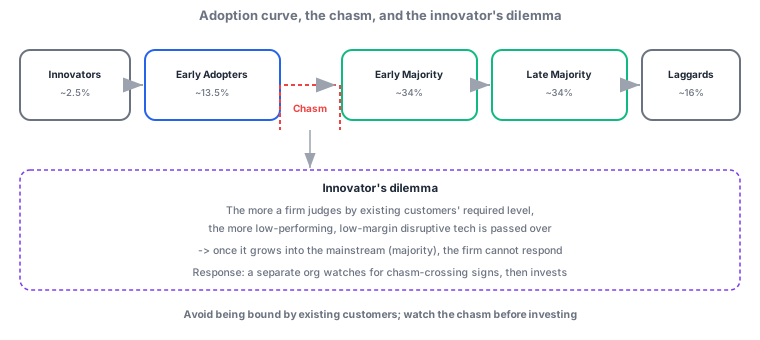
- The innovator's dilemma is the structure whereby, the more rationally an established firm keeps meeting the demands of its good existing customers and improving sustaining technology, the more it slights the initially low-performing, low-margin disruptive technology—and cannot respond when it grows, losing leadership.
- The essence of the trap is that "fidelity to existing customers' voices" itself blocks the response to disruptive technology. Judged by the same profit criteria and the same customer base as the mainstay business, the small, low-margin new market is always passed over.
- The recommended response is to separate the disruptive business from the mainstay business's evaluation criteria and the pull of its customers, and to grow it as an independent small organization (a separate unit, a "dejima" outpost) with an economics that works even in a small new market.
2.2.2The diffusion process—adoption curve, chasm, hype cycle
- The diffusion of innovations (adoption curve) sorts the market into five types by adoption speed: innovators (about 2.5%) -> early adopters (about 13.5%) -> early majority (about 34%) -> late majority (about 34%) -> laggards (about 16%).
- The chasm is a deep gap in demand between the early adopters and the early majority. Many products sell to the novelty-sensitive early segment but stall, failing to cross to the majority that values practical benefit and track record. Crossing it is the watershed of diffusion.
- The hype cycle traces the wave of expectation and disillusionment toward a new technology: innovation trigger -> peak of inflated expectations -> trough of disillusionment -> slope of enlightenment -> plateau of productivity. It gives the perspective of judging investment with an eye on the plateau where the technology settles into practical use, undistracted by the overheated peak or the disillusionment.
Most-tested: "the innovator's dilemma = the more faithful an established firm is to existing customers and sustaining technology, the more it lags on disruptive technology", "the chasm = the gap between early adopters and the early majority", and "the hype cycle = peak of expectations -> disillusionment -> plateau." Do not confuse the adoption-curve order (innovators -> early adopters -> ... -> laggards) or the chasm's position (between early adopters and the early majority). Watch for the misconceptions that "disruptive technology is high-performance from the start" and "the dilemma is caused by management negligence."
The IT strategist of the industry-leading business-software company faces a hard call in the management meeting. A cheap cloud service has appeared whose features fall far short of the firm's high-function package, but which costs a few thousand yen a month and deploys same-day. Interviews with existing large customers (big enterprises) yield only "we don't need such a low-function thing; what we want is our current product made even higher-function," and sales, too, wants to prioritize the profitable existing customers. Faithfully following existing customers and investing only in sustaining higher-function development looks eminently rational here—but this is precisely the trap of the innovator's dilemma. The cheap cloud service is opening a new market of small businesses and individuals who could not afford software before, and if it accumulates a track record there while improving its features, it will eventually encroach even on the firm's core mid-to-large-enterprise market (the classic path of disruptive innovation). The strategist's judgment has two points. First, do not dismiss this disruptive technology on the grounds that "the existing large customers say they don't need it"—as long as it is evaluated by existing customers' required level, disruptive technology always looks inferior and keeps being passed over. Second, is the answer then to simply have the mainstay division build the cheap cloud version? That, too, tends to fail: the mainstay division runs on high-margin, high-unit-price criteria, and a low-unit-price, thin-margin new market will always be deprioritized internally as "not worth our economics." The recommended move is therefore to separate the disruptive business from the mainstay's evaluation criteria and the pull of its customers, and to launch and grow it as an independent, self-accounting small organization with an economics that works even in a small, thin-margin new market. Further, from the diffusion viewpoint, it is effective to discern whether this new service stalls at early adopters and fails to cross the chasm, or spreads to the early majority (the mainstream of benefit-focused small businesses), and to thicken investment once signs of crossing the chasm appear (deployment track record, word of mouth, becoming a standard). The greatest error is trying to reconcile fidelity to existing customers and a hedge on disruptive technology within the same business and the same criteria.
| Adopter type | Trait | Position in diffusion |
|---|---|---|
| Innovators / early adopters | React to novelty and potential (about 16% combined) | Form the early market |
| Chasm | Deep gap between early adopters and the early majority | Watershed of diffusion (products may stall here) |
| Early / late majority | Value practical benefit and track record (about 68% combined) | Mainstream market (diffusion means reaching here) |
Trap: "The innovator's dilemma is caused by management negligence in ignoring existing customers' voices" is wrong—it is a structure that ensnares precisely the well-run firms faithful to good existing customers and rationally investing in sustaining improvement; the cause is not negligence but a "side effect of rational management." That is why, judged by the same criteria and same customers as the existing business, disruptive technology is always passed over, and responding requires separating it into a distinct organization. "Disruptive technology is high-performance from the start" is also wrong—it is initially inferior on the existing axis but captures a new market on a different value axis (cheapness, simplicity). Placing the chasm "between innovators and early adopters" is also wrong (correctly, between early adopters and the early majority).
2.2.3Section summary
- The innovator's dilemma: the more faithful an established firm is to existing customers and sustaining technology, the more it lags on disruptive technology; the response is separation into a distinct organization
- The chasm is the gap between early adopters and the early majority, the watershed of diffusion; the hype cycle is the wave of expectation peak -> disillusionment -> plateau
- A business emerges only after crossing the valley of death (the funding/commercialization wall from research to product) and the Darwinian sea (the market-competition wall from product to business)
Sign in to track progress — Log in.
Quick check
(just a quick review)Q1. A cloud service that is lower in features but cheap and deployable same-day appears as a rival to the industry-leading business-software firm. Large existing customers say "it is low-function and unneeded; we want the current product made higher-function." Which judgment by the IT strategist is most appropriate?
Q2. A new-technology service sold smoothly to novelty-sensitive early adopters, but sales then suddenly stalled, with no spread to the early majority. Which explanation and response for this situation is most appropriate?
Q3. A firm's research division has established a promising base technology but has not reached commercialization. Which description of the barriers in turning technology into a business is most appropriate?
Keep track of your progress
The full study guide is free to read. Sign up free to practice with the question bank, track what you have read, review your mistakes, and highlight passages.