

What's changed: Initial version
2.3Technology roadmap & R&D strategy
Covers the technology roadmap that links market, product, and technology on a time axis to chart the development path; the technology portfolio that evaluates the attractiveness of technologies to hold or acquire and the firm's own position; the technology S-curve that traces a technology's growth and its maturity limit, together with the judgment of switching to a next-generation technology; the patent strategy that defends and attacks differentiation; industry-academia collaboration that brings in external knowledge; and the core technology to lock up—and judging where and how to allocate limited R&D resources.
R&D resources are finite, and deciding "which technology, when, and how much to invest in" ad hoc will not win the competition. The technology roadmap links market demand, product plans, and technology development into one on a time axis, making the path visible. And evaluating each technology by "attractiveness" and "the firm's relative strength" to decide resource allocation is the idea of the technology portfolio. Beyond these, this section builds on the technology S-curve, which shows that a technology's growth always reaches a limit, to cover the hardest R&D judgment an IT strategist faces: whether to keep investing in a matured current technology or switch to a next-generation one.
2.3.1Technology roadmap and technology portfolio
- The technology roadmap places time on the horizontal axis and market, product, and technology (elemental technologies) on the vertical, linking on one sheet "when the market changes how, which products to release, and by when to establish which technologies for them." It prevents mismatches between technology development and the business plan and shares the priorities of long-term investment.
- The technology portfolio classifies held and candidate technologies on two axes—"technology attractiveness (future potential, market impact)" and "the firm's technical strength / relative position"—to judge whether to strengthen, maintain, exit, or acquire (via partnership/M&A). It applies the idea of the business PPM to technology.
- The core technology is the central technology that is a source of competitive advantage and can be deployed across multiple products and businesses. Identifying the core technology in the roadmap and portfolio, concentrating resources there, and locking it up while avoiding external dependence is the crux of strategy.
2.3.2The technology S-curve, patents, and industry-academia collaboration
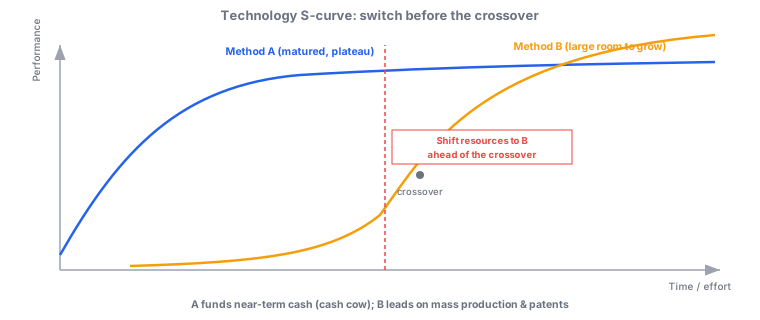
- The technology S-curve shows that a technology's performance traces an S shape against the development effort invested (time, resources): gradual at first -> steep in the middle -> plateauing at maturity. Continuing to invest in a matured technology whose growth has slowed yields small marginal utility, while a next-generation technology—even if lower in performance—begins to trace a separate new S-curve with large room to grow.
- The key to switching: even while the current technology is still superior, moving R&D resources to the next generation ahead of the crossover—before the current one, having matured, has its growth slow and the next generation's S-curve rises—decides competitive advantage. Switching too late lets a rival that pre-empted the next generation overtake (connecting to the previous section's dilemma).
- The patent strategy protects the core technology with patents (defense), checks rivals (offense), and mutually uses via cross-licensing. Industry-academia collaboration takes in the basic-research strength of universities and institutes to supplement advanced knowledge and talent the firm lacks—an open means. Both avoid "everything in-house" and make resources go further.
Most-tested: "the technology roadmap links market, product, and technology on a time axis", "the technology portfolio allocates resources by attractiveness x the firm's position", and "the S-curve plateaus at maturity, the next generation traces a separate new S-curve -> switch before the crossover." Watch for the misconceptions "never switch while the current technology is superior" and "the more matured a technology, the higher its investment efficiency." That the patent strategy includes not only defense but also offense and cross-licensing is tested too.
The IT strategist of an electronic-components maker is weighing next term's R&D portfolio. The mainstay is the current method A, refined over many years and still boasting the market's top performance, but for the past few years even large R&D spending has yielded only slight performance gains—it has clearly entered the S-curve's maturity (plateau). Meanwhile, next-generation method B, advanced by an internal division and a partner university (industry-academia collaboration), falls short of method A in present performance and has immature mass-production technology, but its inherent performance ceiling is far higher than method A's, with steep early growth expected—the rise of a separate new S-curve. The error-prone point here is the seemingly prudent thought "method A still earns with top performance, so concentrate resources on improving A for now, and invest seriously in B only after it catches up in performance." But by the logic of the S-curve, additional investment in the matured method A yields small marginal utility, and scrambling to switch around the time B rises and the two S-curves cross is too late—by then a rival that pre-empted B leads in mass-production technology, patents, and customer base, and cannot be caught. The optimal answer is therefore to secure near-term cash with method A's earnings (maintain it as a cash cow) while not waiting for the crossover—shifting R&D resources into method B now, in stages, getting ahead on establishing mass-production technology and acquiring basic patents. The technology-portfolio viewpoint helps here: position A as "declining attractiveness but strong own position (maintain/harvest)" and B as "high attractiveness but still weak own position (strengthen/acquire)," concentrate the firm's core technology (e.g., fine material processing) into B to lock it up, supplement the lacking basic-research strength via industry-academia collaboration, and defend the established elemental technologies with patents. On the technology roadmap, working backward from the target "mount method B on the flagship product N years out," allocate the timing of establishing mass-production technology, patents, and talent to each fiscal year. In short, R&D resource allocation is a time-axis judgment of reading the S-curve's maturity and the next generation's room to grow, and switching ahead of the crossover—not "which is higher-performance now."
| Phase | Current technology (method A) | Next-gen technology (method B) |
|---|---|---|
| Position on S-curve | Maturity/plateau (added investment has thin effect) | Rising phase, large room to grow |
| Portfolio judgment | Declining attractiveness, strong own position = maintain/harvest | High attractiveness, weak own position = strengthen/acquire |
| Resource-allocation key | Secure near-term cash as the breadwinner | Shift R&D resources ahead of the crossover |
Trap: "While the current technology earns with top performance, serious investment in the next generation is unnecessary; just switch once caught up in performance" is wrong—additional investment in a matured technology yields small marginal utility, and scrambling to switch only after the S-curves cross leaves you unable to catch a rival that pre-empted the next generation and leads in mass-production technology, patents, and customer base. The key is to shift resources to the next generation ahead of, not after, the crossover. Also wrong: "the technology portfolio is about technology, not business, so it is unrelated to resource-allocation judgments like exit or maintain"—it is precisely a framework for judging strengthen/maintain/exit/acquire by attractiveness and own position.
2.3.3Section summary
- The technology roadmap links market, product, and technology on a time axis and makes long-term investment priorities visible
- The technology portfolio judges strengthen/maintain/exit/acquire by attractiveness x own position (the technology version of the PPM)
- The technology S-curve plateaus at maturity; since the next generation traces a separate new S-curve, switch ahead of, not after, the crossover
Sign in to track progress — Log in.
Quick check
(just a quick review)Q1. The mainstay current technology A has the market's top performance but has matured, with only slight gains despite large R&D spending. Next-gen technology B is inferior to A now but has a higher performance ceiling and is expected to grow steeply. Which R&D resource allocation by the IT strategist is most appropriate?
Q2. The firm wants to supplement the advanced basic-research strength it lacks while locking up the core technology that is its source of competitive advantage in-house. Which combination of technology strategies by the IT strategist is most appropriate?
Q3. Which description of the aim of drawing up a technology roadmap is most appropriate?
Keep track of your progress
The full study guide is free to read. Sign up free to practice with the question bank, track what you have read, review your mistakes, and highlight passages.