

What's changed: Initial version
2.1MOT & types of innovation
Covers management of technology (MOT), which ties technology to business value, and the four axes of innovation—product innovation that changes the product itself vs process innovation that changes how it is made; sustaining innovation that extends the existing performance axis vs disruptive innovation that redraws the market on a new value axis; and self-reliant closed innovation vs open innovation that draws in external resources—and judging which policy to choose under a firm's capability and speed constraints.
Possessing excellent technology and succeeding in business with it are not the same thing. Managing technology coherently from R&D through commercialization and business development, and tying it to competitive advantage and profit—this is the perspective of MOT (Management of Technology). As the bridge between corporate strategy and technology, the IT strategist judges "which technology, what form of innovation, done in-house or with partners." This section frames innovation on three axes (product/process, sustaining/disruptive, open/closed) and covers, as strategic choices rather than memorized definitions, which policy is optimal under constraints of a firm's technical capability, funds, and speed.
2.1.1Product innovation and process innovation
- Product innovation renews the product or service itself, delivering value customers have not had before. It is a source of differentiation and can create new markets, but carries large uncertainty over market acceptance.
- Process innovation renews the processes, manufacturing methods, and workflows that produce a product, improving cost, quality, and speed. It underpins the competitiveness (cost leadership) of existing products but alone rarely creates new customer value.
- The two are complementary. A typical sequence is to open a market with a new product (product innovation), then secure profit through mass production and efficiency (process innovation), with the emphasis shifting over the business life cycle.
2.1.2Sustaining/disruptive, closed/open
- Sustaining innovation continuously improves a product along the performance axis existing customers value (speed, capacity, accuracy, etc.). It is the domain established firms excel at, but once performance exceeds customers' required level it can become over-engineering.
- Disruptive innovation is initially inferior on the existing performance axis, but captures a new customer segment on a different value axis (cheaper, smaller, simpler) and, as its performance improves, encroaches on the mainstream market. Established firms tend to overlook it (the innovator's dilemma, next section).
- Closed innovation completes R&D entirely in-house and locks up the results and IP. It excels at control and secrecy but is slow and confined to the firm's own knowledge. Open innovation takes in external technology, ideas, and talent (and lets its own technology out), accelerating development and supplementing capabilities the firm lacks.
Most-tested: the paired framing—"product = the product itself / process = how it is made", "sustaining = improving the existing performance axis / disruptive = encroaching from a new market on a different value axis", and "closed = self-reliance / open = accelerating and supplementing via external resources." Watch for reducing open innovation to "mere outsourcing (cost cutting)" and the misconception that "disruptive innovation = a high-performance technology from the start."
The IT strategist of a mid-sized industrial-equipment maker is about to propose a technology strategy for a new IoT-sensor business to the management meeting. The market is expanding rapidly and a large overseas rival has already launched a product. The firm is strong in embedded control but weak in cloud-side data-analytics platforms and AI-model development; building these from scratch in-house is estimated to take over two years to market. Here the strategist judges the innovation policy as "build everything in-house (closed) vs partner via open innovation to take in external resources." The axes of judgment are the firm's technical capability (weak in cloud/AI) and market speed (rival ahead, rapid growth = a short first-mover window). Building the cloud-analytics platform and AI models from scratch in-house has the merit of locking up IP and control in-house, but a two-year delay risks missing the market window, and since it would grow capabilities the firm lacks, the failure probability is high too—being dragged along by the assumption that "self-reliance is superior" is a strategic error here. By contrast, if the firm partners with external platform companies or startups in the cloud-analytics and AI domain (technology licensing, joint development) and concentrates on crafting the embedded sensor body that is its strength—open innovation—it can cut time-to-market by more than half and supplement, from outside, the capabilities it lacks. Yet open innovation has its price: depending on outsiders even for the core differentiating technology (such as the sensor's measurement algorithms) makes it easy to imitate and forfeits long-term advantage. The optimal answer is therefore the separation "lock up the core technology—the embedded sensor body—in a closed way, and go open, partnering externally, for the non-core complementary domain of cloud/AI." Open vs closed is thus not a two-way creed but a resource-allocation judgment against capability and speed constraints: which technology is core (a differentiation source to lock up) and where should the firm buy speed by borrowing outside strength.
| Axis | One side | Other side |
|---|---|---|
| Object | Product = renews the product itself | Process = renews the method/process |
| Performance axis | Sustaining = keeps improving the existing axis (established firms excel) | Disruptive = encroaches from a new market on a different axis (easily overlooked) |
| Development mode | Closed = self-contained, locks up IP | Open = accelerates and supplements weaknesses via external resources |
Trap: "To protect its technical strength, closed innovation (self-reliance) is always best" is wrong—where the market moves fast and capabilities the firm lacks are needed, partnering via open innovation to gain speed and complementary capability is more rational, and clinging to self-reliance even for non-core technology misses the market window. Conversely, depending externally even for the core technology that is the source of differentiation makes imitation easy and forfeits long-term advantage, so the key is the separation "lock up the core, open the non-core." Treating open innovation as mere cost-cutting outsourcing is also wrong.
2.1.3Section summary
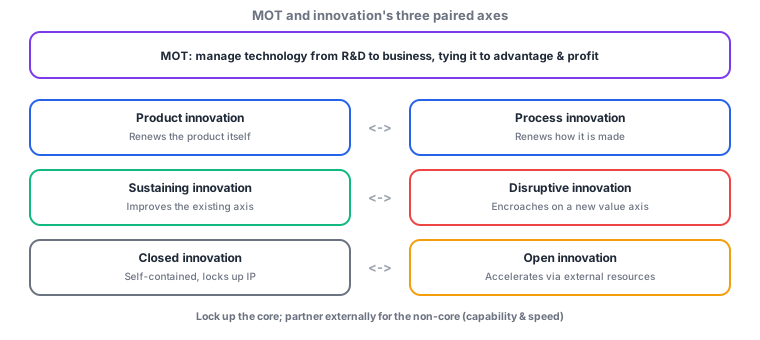
- MOT is the perspective of managing technology from R&D to commercialization and tying it to advantage and profit
- Innovation is framed on three paired axes: product/process, sustaining/disruptive, closed/open
- Open vs closed is not a creed but a resource-allocation judgment against capability and speed: lock up the core, partner externally for the non-core
Sign in to track progress — Log in.
Quick check
(just a quick review)Q1. A device maker is strong in embedded control but weak in the cloud-analytics and AI development its new IoT business needs. The market is expanding fast and an overseas rival is ahead. Which technology strategy by the IT strategist is most appropriate?
Q2. A product is established in the market and has entered mass production, but its cost is high and it is losing the price competition. Its quality and features are rated as sufficient. Which direction of innovation should the IT strategist prioritize?
Q3. Which is the most appropriate point for an IT strategist to bear in mind when pursuing open innovation?
Keep track of your progress
The full study guide is free to read. Sign up free to practice with the question bank, track what you have read, review your mistakes, and highlight passages.