

What's changed: Initial version
1.4Marketing strategy
Covers STP (segmentation/targeting/positioning) for carving up the market and setting the aim, the seller-side 4P and buyer-side 4C, the product life cycle, channels and pricing, CRM and LTV, and brand—as the judgment skill of "keeping the marketing mix consistent with the constraints of the target customer segment."
The key to marketing strategy is keeping "to whom, what value, and how to deliver it" consistent. First, STP carves up the market to set the target customer segment, and the marketing mix such as the 4P (product, price, place, promotion) is assembled to fit that aim. In planning digital marketing or CRM systems, an IT strategist judges "whether the measure is consistent with the target customer segment and positioning." This section covers STP, 4P/4C, the product life cycle, channels, pricing, CRM/LTV, and brand—not as rote definitions, but as the ability to judge the consistency of the mix against the target's constraints.
1.4.1STP and the marketing mix (4P/4C)
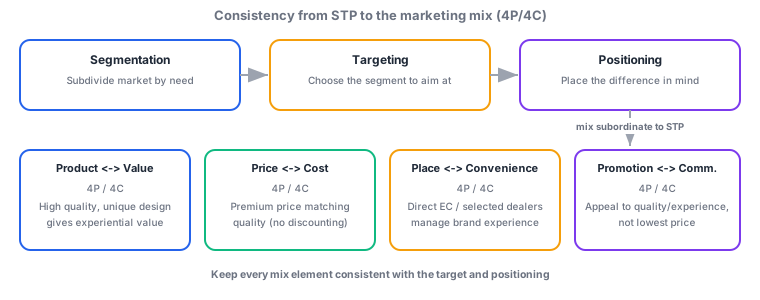
- STP sets "to whom and what unique value to appeal" in the order segmentation (subdivide the market by attributes or needs) -> targeting (choose the segment to aim at) -> positioning (clearly place the difference from rivals in the customer's mind). The marketing mix is designed subordinate to this STP.
- 4P is the seller-side combination of measures: Product, Price, Place, Promotion. Recast to the buyer's view, it becomes 4C: Customer value, the customer's total Cost, Convenience of obtaining, and two-way Communication. 4P and 4C correspond—Price <-> Cost, Place <-> Convenience—recast from the customer's side.
1.4.2Product life cycle, channels, pricing, CRM/LTV
- The product life cycle views a product as passing through introduction -> growth -> maturity -> decline, with priority measures changing by stage (introduction: expand awareness; growth: gain share; maturity: differentiate and lock in; decline: withdraw or harvest). Channels (distribution routes) and pricing (cost-based, demand-based, competition-based; skimming vs. penetration, etc.) are also chosen to fit the life cycle and target.
- CRM (Customer Relationship Management) is the idea and mechanism of continuously deepening customer relationships to retain and cultivate valuable customers. Its effect is measured by LTV (Customer Lifetime Value)—the profit a customer brings over their lifetime. In businesses with high acquisition cost, the key is to judge profitability by LTV from retention and continuation, not by the margin of a one-off transaction. A brand is built by repeated good experiences and becomes a source of price premium and switching cost.
Most-tested: STP is in the order segmentation -> targeting -> positioning; 4P (seller) <-> 4C (buyer) with Price <-> Cost and Place <-> Convenience; the product life cycle changes emphasis across introduction/growth/maturity/decline; and LTV is measured by retention/continuation and weighed against acquisition cost for a profitability judgment. Practice being able to judge whether the mix is consistent with the target and positioning.
As an IT strategist, you are supporting the marketing measures and the e-commerce/CRM planning for a home-appliance maker's new product. After examining STP, the target was set to "an upper segment valuing quality, design, and brand experience over price," and the positioning was decided as "high-quality, premium." Here the sales department proposes: "we want to sell volume fast, so let us cut the price sharply, distribute widely to mass retailers and discount EC sites, and put 'industry's lowest price' front and center in advertising." It seems to boost sales at a glance, but this contradicts the marketing mix against the target and positioning. For an upper segment aiming at premium, a sharp price cut (Price), indiscriminate mass-retail channels (Place), and lowest-price advertising (Promotion) each undermine the "high-quality, premium" positioning by one's own hand, damaging brand value and driving away target customers. The judgment an IT strategist should make is to keep the marketing mix consistent with the target and positioning: price at a premium commensurate with quality; channels of direct-sales EC or selected dealers (limited channels) where the brand experience can be managed; promotion appealing to the value of quality, design, and use experience rather than lowest price; and CRM designed to raise LTV through post-purchase relationship deepening, not one-off discounting. "First fix, via STP, to whom and what to appeal, then align every element of the 4P/4C with that target and positioning—if even one element contradicts, the whole mix's effect is undermined"—this consistency judgment separates success from failure in marketing measures.
| 4P (seller view) | 4C (buyer view) | Consistent example for a premium target |
|---|---|---|
| Product | Customer value | Provide experiential value via high quality and unique design |
| Price | The customer's total Cost | A premium price matching quality (no discounting) |
| Place | Convenience of obtaining | Direct-sales EC and selected dealers that manage the brand experience |
| Promotion | Two-way Communication | Appeal to the value of quality and experience, not lowest price |
Trap: "Even for a product positioned as high-quality and premium, sharp price cuts, mass-retail channels, and lowest-price ads are effective for growing sales fast" is wrong—against the target (a quality-focused upper segment) and positioning (premium), price cuts, indiscriminate channels, and lowest-price appeals contradict, damaging brand value and driving away target customers. As a rule, keep the marketing mix consistent with STP. Also wrong: "4C is a framework where the seller manages product, price, place, and promotion"—that is the 4P; 4C is the recasting to the buyer's view (customer value, total cost, convenience, communication).
1.4.3Section summary
- Set "to whom, what" via STP (segmentation -> targeting -> positioning), and design the mix such as the 4P/4C subordinate to it
- Choose channels and pricing per the product life cycle stage and target, and keep every mix element consistent with the positioning
- Deepen customer relationships via CRM, and judge profitability by LTV (customer lifetime value) rather than a one-off margin (weighed against acquisition cost)
Sign in to track progress — Log in.
Quick check
(just a quick review)Q1. A new home-appliance product whose STP set the target as "an upper segment valuing quality and brand experience over price" and positioning as "high-quality, premium." Which marketing mix is most appropriate for an IT strategist to plan?
Q2. Which statement about the 4C, which recasts the marketing mix from the customer's (buyer's) viewpoint, is most appropriate?
Q3. In a subscription business with high new-customer acquisition cost, how should the profitability of marketing investment be judged? Which judgment based on the concepts of CRM and LTV is most appropriate?
Keep track of your progress
The full study guide is free to read. Sign up free to practice with the question bank, track what you have read, review your mistakes, and highlight passages.