

What's changed: Initial version
1.1Corporate strategy overview and competitive strategy
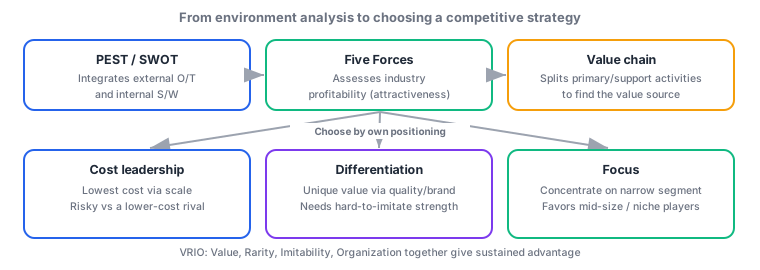
Covers external-environment analysis (PEST) and the integrating SWOT, Porter's Five Forces for gauging industry attractiveness, the value chain for decomposing sources of value, Porter's three generic strategies (cost leadership, differentiation, focus), and VRIO—all as the judgment skill of choosing which competitive strategy fits the firm's own position.
ST's exam A-2 specialty tests not rote definitions such as "what is SWOT analysis" or "what are the Five Forces," but the ability to judge which competitive strategy is rational to choose under the constraints of the firm's resources, its position in the industry, and its balance of power against rivals. Corporate strategy is the decision of where to concentrate limited management resources and how to win on which battleground, by matching the external environment (opportunities, threats) with internal resources (strengths, weaknesses); frameworks are merely tools that support that judgment. This section works through the flow—environment analysis (PEST, SWOT), grasping industry structure (Five Forces), decomposing sources of value (value chain), and choosing how to win (three generic strategies, VRIO)—from the viewpoint of "how would our firm judge."
1.1.1External analysis (PEST) and internal-external integration (SWOT)
- The PEST analysis identifies changes in the macro external environment—Political, Economic, Social, and Technological—to discern opportunities and threats for the firm. It reads large tides a single company cannot move (regulation, the economy, demographics, technological innovation).
- The SWOT analysis integrates internal Strengths and Weaknesses with external Opportunities and Threats on one sheet. The practical key is not to stop at listing but to cross them—strengths x opportunities (offense), weaknesses x threats (defense)—to derive strategic direction (cross-SWOT).
1.1.2The Five Forces and the value chain
- The Five Forces analysis reads industry structure via the five competitive forces that determine an industry's profitability (attractiveness): rivalry among existing competitors, threat of new entrants, threat of substitutes, bargaining power of buyers, and bargaining power of suppliers. The stronger a force, the more the industry's profit is squeezed. It is used to judge entry and choose a business position.
- The value chain decomposes business activities into primary activities (inbound logistics, operations, outbound logistics, marketing/sales, service) and support activities (firm infrastructure, HR, technology development, procurement) to pinpoint which activities generate added value and competitive advantage (the source of differentiation or cost advantage).
1.1.3The three generic strategies and VRIO
- Porter's three generic strategies: cost leadership (achieve the lowest cost via scale economies, etc., to prevail in price competition), differentiation (build unique value through quality, brand, technology, etc., to earn a price premium), and focus (concentrate resources on a specific narrow segment, pursuing cost or differentiation within it). Pursuing all three half-heartedly—being stuck in the middle—loses competitive advantage.
- The VRIO analysis evaluates whether a resource is a source of sustained competitive advantage via four questions: Value, Rarity, Imitability (difficulty of imitation), and Organization. Only a resource satisfying all four yields sustained advantage; one that is valuable but easily imitated gives only temporary advantage; one without value stays at a competitive disadvantage.
Most-tested: the three generic strategies are cost leadership / differentiation / focus (being half-hearted—stuck in the middle—is dangerous); the Five Forces are the five factors determining an industry's profitability; and VRIO gives sustained advantage only when Value, Rarity, Imitability, and Organization are all met. Practice being able to judge, from the firm's scale, resources, and industry position, which generic strategy is rational.
Suppose you are an IT strategist supporting a mid-size maker competing in a market where the industry giant has established cost leadership with overwhelming production scale and a logistics network. At a management meeting, a proposal arises: "to counter the giant, let us slash prices boldly and win back share." But carelessly plunging into a price war is dangerous. Thanks to economies of scale, the giant has structurally lower unit costs; if both cut prices on the same battleground, the giant—superior in staying power (margin x scale)—is favored, and the mid-size firm wears out first in a war of attrition. Challenging a lower-cost rival with cost leadership is a losing way to fight. What the IT strategist should propose is to decompose the value chain to identify activities where the firm can add value (design, after-sales service, short-lead-time response), and pivot to a differentiation strategy or a focus strategy targeting a specific customer segment. From the VRIO view, too, sustained advantage arises only by standing on the firm's own resources the giant cannot easily imitate (skilled techniques, deep customer relationships, proprietary know-how for specific uses). Rather than a scale-disadvantaged mid-size firm colliding head-on with the giant on cost, re-choosing the battleground (segment) and the way to win (differentiation/focus) to fit the firm's resources—this positioning judgment is the heart of competitive strategy and the key to avoiding "stuck in the middle" by chasing all three generic strategies half-heartedly.
| Generic strategy | How it wins (source of advantage) | Fitting firm / caution |
|---|---|---|
| Cost leadership | Lowest cost via scale economies, prevailing on price | Favors scale/share leaders; challenging a lower-cost rival is disadvantageous |
| Differentiation | Unique value via quality, brand, technology, earning a premium | Needs a hard-to-imitate strength; fails if the value is not conveyed |
| Focus | Concentrate resources on a narrow segment, pursuing cost or differentiation | Favors mid-size/niche players; risk of the segment shrinking |
Trap: "Even a scale-disadvantaged mid-size firm can win by challenging the giant to cost competition with price cuts" is wrong—challenging a giant that is structurally low-cost through economies of scale with the same cost leadership is disadvantageous in a war of attrition; the mid-size firm should re-choose its battleground with differentiation or focus. Also wrong: "pursuing all three generic strategies at once makes you stronger"—aiming half-heartedly at all of them lets none be thorough, losing advantage by being stuck in the middle. In VRIO, too, "if it is valuable it gives sustained advantage even if easily imitated" is wrong; sustainment requires imitability difficulty and organization as well.
1.1.4Section summary
- Use PEST for the macro external environment, SWOT to integrate internal and external, Five Forces for industry profitability, and the value chain to read sources of value
- Choose among Porter's three generic strategies (cost leadership/differentiation/focus) by the firm's scale, resources, and position, avoiding a half-hearted "stuck in the middle"
- VRIO yields sustained competitive advantage only when all four conditions—Value, Rarity, Imitability, Organization—are met
Sign in to track progress — Log in.
Quick check
(just a quick review)Q1. In a market where the industry giant achieves overwhelmingly low cost via economies of scale, which competitive strategy is most appropriate for an IT strategist supporting a mid-size maker inferior in production scale?
Q2. An IT strategist wants to evaluate the firm's resources and identify what could be a source of sustained competitive advantage. From the VRIO perspective, which resource is most appropriate as a source of sustained competitive advantage?
Q3. A firm evaluating the profitability of an industry it is considering entering as a new business via Five Forces analysis. Which factor most strongly squeezes this industry's profitability (attractiveness) and calls for caution about entry?
Keep track of your progress
The full study guide is free to read. Sign up free to practice with the question bank, track what you have read, review your mistakes, and highlight passages.