

What's changed: Initial version
1.2Business portfolio and growth strategy
Covers PPM (the BCG matrix) (star / cash cow / question mark / dog) for judging resource allocation across businesses by market growth x relative share, Ansoff's growth matrix for choosing growth direction by product x market, and M&A / alliances, core competence, and diversification—as the judgment skill of "which business to allocate limited funds to."
For a firm with multiple businesses, the firm-level judgment of resource allocation—which business to invest funds in, which to harvest funds from, and which to withdraw from—is central to management. An IT strategist, beyond streamlining individual businesses, takes a bird's-eye view of the whole business portfolio and proposes to management where to concentrate resources, including IT investment. This section covers reading business positions and fund flows with PPM (the BCG matrix), choosing growth direction with Ansoff's growth matrix, and the merits of M&A / alliances, concentrating on core competence, and diversification—all as the judgment of "how to allocate limited funds and time."
1.2.1PPM (the BCG matrix) and resource allocation
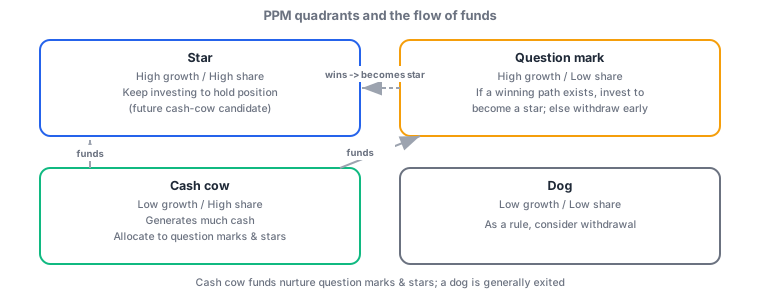
- The PPM classifies each business into four quadrants on two axes: market growth rate (vertical) x relative market share (horizontal). Star (high growth, high share = keep investing to sustain growth), cash cow (low growth, high share = a fund source generating much cash), question mark (high growth, low share = selective investment toward becoming a star, or withdrawal), and dog (low growth, low share = consider withdrawal/downsizing).
- The basic fund flow is to allocate the cash generated by the cash cow to question marks and stars to nurture future earnings sources. A question mark cannot win if left alone; the judgment required is to concentrate funds to grow it into a star if there is a path to winning, or to withdraw before resources are locked in if there is no prospect. A dog is, as a rule, a target for withdrawal/downsizing.
1.2.2Ansoff's growth matrix and means of growth
- Ansoff's growth matrix organizes growth direction into four by product (existing/new) x market (existing/new): market penetration (grow share with existing products in existing markets), market development (take existing products to new markets, regions, or customer segments), product development (introduce new products into existing markets), and diversification (new products x new markets = highest risk).
- In choosing means of growth, judge—centered on the firm's core competence (a central capability rivals cannot copy)—whether to strengthen it in-house, buy time via M&A (acquisition/merger), or complement each other via alliances. Because unrestricted diversification into low-relatedness businesses has scant synergy and disperses resources, selection and concentration centered on the core is the basic approach.
Most-tested: PPM is market growth x relative share (star/cash cow/question mark/dog); allocate the cash cow's funds to question marks and stars; a question mark is either selective investment toward a star or withdrawal; and Ansoff gives growth direction by product x market (diversification being highest risk). Practice being able to judge fund allocation (invest/harvest/withdraw) from a business's position.
Suppose you are an IT strategist at a multi-business firm, supporting a review of the business portfolio. A new cloud-service business is growing rapidly at over 20% a year in market terms, but the firm's share is still small and it is in the red—a textbook question mark in PPM. The management meeting split between "since it is loss-making, we should withdraw quickly" and "since the market is growing, it will expand even if left alone." Both are simplistic. A question mark, if left alone, falls into a dog stuck at low share when the market matures; conversely, aimlessly continuing to invest without a path to winning merely bleeds funds. The axis of judgment here is: "Is there a realistic path to pushing this business up to a star (high growth, high share) by concentrating investment of the funds the cash cow generates?" If the firm's core competence (the customer base and technology cultivated in existing businesses) can be leveraged, and investment could aim for top-tier share, then boldly concentrating the cash cow's funds to pursue star status is the rational judgment. On the other hand, if a strong first mover already exists and additional investment is unlikely to overturn share, the firm should withdraw/downsize early before resources are locked in, and redirect those funds to a winnable question mark or a star. Rather than judging by a single year's red-or-black alone, deciding allocation by the whole-portfolio optimum among market growth, the firm's share, and the fund provider (the cash cow)—this is the heart of business-portfolio management judgment.
| Quadrant | Traits (growth x share) | Basic fund-allocation judgment |
|---|---|---|
| Star | High growth, high share | Keep investing to hold position (future cash-cow candidate) |
| Cash cow | Low growth, high share | A fund source generating much cash; allocate to question marks and stars |
| Question mark | High growth, low share | If a path to winning exists, concentrate investment toward a star; otherwise withdraw |
| Dog | Low growth, low share | As a rule, consider withdrawal/downsizing |
Trap: "Since a question mark is loss-making, immediate withdrawal is always correct" is wrong—a question mark sits in a high-growth market, and if there is a path to winning, one option is to concentrate the cash cow's funds to grow it into a star; blanket immediate withdrawal throws away a future earnings source (immediate withdrawal is the rule for a dog). Also wrong: "since a cash cow has high share, invest heavily to grow it further"—a cash cow is in a low-growth market where additional investment is inefficient, so the basic move is to channel the cash it generates to question marks and stars.
1.2.3Section summary
- The PPM divides businesses into four quadrants by market growth x relative share, and allocates the cash cow's funds to question marks and stars to nurture earnings sources
- A question mark is grown into a star by concentrated investment if a path to winning exists, or withdrawn early otherwise—not judged by a single year's loss alone
- Ansoff chooses growth direction by product x market (diversification being highest risk), and selection-and-concentration—including M&A and alliances—is judged centered on core competence
Sign in to track progress — Log in.
Quick check
(just a quick review)Q1. For a new business (a PPM question mark) that has entered a market growing at over 20% a year but still has small share and is loss-making, which resource-allocation judgment is most appropriate for an IT strategist to propose?
Q2. A firm wants to grow by taking an existing product established in the domestic market, as is, into a new overseas regional market. In Ansoff's growth matrix, which growth strategy does this correspond to?
Q3. A firm with limited resources is considering how to broaden its business scope for growth. Which growth-strategy judgment based on the concept of core competence is most appropriate?
Keep track of your progress
The full study guide is free to read. Sign up free to practice with the question bank, track what you have read, review your mistakes, and highlight passages.