

What's changed: Initial version
3.2IoT, embedded applications & engineering systems
Covers the business use of IoT, production-management methods (MRP, JIT / kanban, cell production), the smart factory (Industrie 4.0), CAD/CAM/CAE, and predictive maintenance, from the viewpoint of how an IT strategist judges manufacturing efficiency. A key point is trade-off judgment—such as whether to favor JIT or safety (buffer) stock under demand-variability constraints.
In manufacturing, IoT and engineering systems offer large room to raise production efficiency, quality, and flexibility, and an IT strategist must discern which method to use in which situation. The point here is not to memorize definitions but to judge which production or maintenance method best reconciles efficiency and effectiveness under constraints such as demand variability, supply stability, and product variety. For instance, JIT—which cuts inventory to the extreme—is not universal, and in situations of unstable demand or supply it can instead invite stockout risk. This section covers the representative methods as material for situation-dependent judgment.
3.2.1Production-management and maintenance methods
- MRP (Material Requirements Planning): a plan-driven (push) method that computes required material quantities and order timing from the production plan (master production schedule), bill of materials (BOM), and inventory. It arranges materials in advance based on demand forecasts.
- JIT (Just In Time): a demand-driven (pull) method that makes only what is needed, when needed, in the needed quantity, minimizing inventory. The kanban method, in which the downstream process signals the upstream to withdraw, is the tool that realizes it. Since it holds no inventory, it presupposes stable demand and supply.
- Cell production: a method where a small team or a single worker handles a series of steps together, flexible for high-mix low-volume and spec changes. It suits different situations than conveyor-belt line production, which fits mass production.
- Predictive maintenance: maintenance that acquires equipment condition data via sensors and IoT, detects signs of failure, and acts in advance. Unlike preventive maintenance (periodic time-based replacement) and breakdown (reactive) maintenance (fixing after failure), it services only when needed, avoiding over- and under-maintenance.
3.2.2Smart factory and engineering systems
- The smart factory / Industrie 4.0: a vision of connecting equipment, products, and systems via IoT, optimizing production with collected data, and efficiently producing high variety close to individual orders (mass customization). It is at the core of the German-originated fourth industrial revolution.
- CAD (design) / CAM (manufacturing, NC-data generation) / CAE (analysis, simulation): engineering systems that computer-aid from design through manufacturing and verification. They analyze strength, fluid behavior, etc. before prototyping, cutting design rework and cost.
Most-tested: "JIT = pull-based, minimal inventory, realized by kanban (presupposes stable demand/supply)", "MRP = plan-driven push", "cell production = flexible for high-mix low-volume", and "predictive maintenance = detects signs from condition data (preventive = time-based, reactive = after failure)". Watch for treating JIT as "always best," confusing kanban with MRP, and mixing up predictive and preventive maintenance.
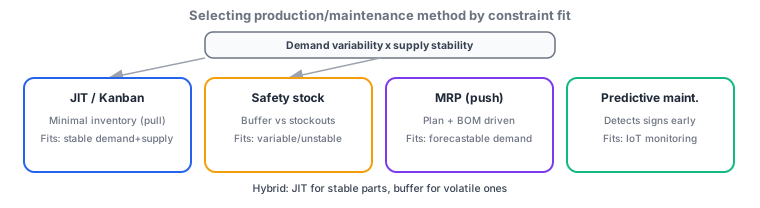
An IT strategist at a parts maker is reviewing its production and inventory methods. The firm's main line has run with a certain amount of work-in-process (buffer) between each step, but management requests to "fully adopt Toyota-style JIT/kanban to drive inventory near zero and improve cash flow." What the strategist must judge is which—minimal-inventory JIT or an operation holding safety (buffer) stock—optimizes the trade-off between stockout risk and inventory cost, given this product's demand and supply characteristics. JIT's benefit is inventory compression and lead-time reduction, but its precondition for working is relatively stable demand and short-lead-time, high-reliability parts supply. Investigation shows this product's demand fluctuates greatly with seasons and promotions, and some critical parts are procured overseas with long lead times and unstable supply. In this situation, driving inventory uniformly near zero risks production halting the moment demand spikes or a part is delayed, inviting stockout-driven opportunity loss and customer defection—losses far exceeding the inventory saved. The strategist therefore judges not to treat "JIT or safety stock" as either/or, but to use each according to the constraints of demand variability and supply instability. Concretely, the optimum is a hybrid: apply JIT/kanban to squeeze inventory for commodity parts with stable demand and short, reliable supply, while strategically holding statistically computed safety (buffer) stock for critical parts with high demand variability and unstable supply. Alongside, visualizing demand, inventory, and equipment operation in real time via IoT and raising demand-forecast accuracy creates room to lower the safety-stock level itself. The essence here is not the allure of the JIT method but the judgment of optimizing the trade-off against the constraints (demand variability, supply stability).
| Method | Characteristic | Situation where it fits |
|---|---|---|
| JIT/kanban (pull) | Minimal inventory, shorter lead time | Stable demand, short-lead-time reliable supply |
| Operation with safety (buffer) stock | Secures a buffer against stockouts | High demand variability / unstable supply for critical parts |
| MRP (push) | Computes requirements in advance from plan/BOM | Can be arranged based on demand forecasts |
| Predictive maintenance | Detects failure signs from condition data | Equipment condition can be monitored continuously via IoT |
Trap: "Fully adopting JIT/kanban to zero out inventory is surely optimal for any manufacturer" is wrong—JIT presupposes stable demand and short-lead-time, reliable supply, and uniformly cutting inventory under high demand variability and unstable supply can make stockout-driven opportunity loss exceed the inventory saved. Using safety stock selectively per the constraints is appropriate. Also wrong: "predictive maintenance = replacing parts at fixed intervals"—that is preventive maintenance; predictive maintenance detects signs from condition data and services when needed.
3.2.3Section summary
- JIT (pull, kanban) minimizes inventory but presupposes stable demand and reliable supply
- Under high demand variability and unstable supply, strategically hold safety (buffer) stock and use it selectively with JIT per the constraints
- Predictive maintenance detects signs from condition data (distinct from time-based preventive and post-failure reactive), and IoT / the smart factory support visualization and optimization
Sign in to track progress — Log in.
Quick check
(just a quick review)Q1. At a parts maker whose main product's demand fluctuates greatly with seasons/promotions and some critical parts are procured overseas with long, unstable lead times, management requests to "fully adopt JIT/kanban to drive inventory near zero." Which is the most appropriate judgment by the IT strategist?
Q2. A factory has one product group that is high-mix low-volume with frequent spec changes, and another that mass-produces a single spec. Which pairing of suitable production methods is most appropriate?
Q3. A factory wanting to reduce production halts from sudden equipment failures has introduced IoT sensors. Which advice on choosing a maintenance method is most appropriate?
Keep track of your progress
The full study guide is free to read. Sign up free to practice with the question bank, track what you have read, review your mistakes, and highlight passages.