

What's changed: Initial version
4.1IS strategy & enterprise optimization
Covers information-systems (IS) strategy, which sets the direction of informatization as a means of realizing corporate strategy, and the idea of an enterprise-optimization policy that cannot be achieved by stacking up local optima. It addresses that IS strategy must be aligned with corporate strategy, that department-by-department local optimization invites company-wide duplicate investment, silos, and data inconsistency, and the judgment of positioning individual investments within a whole picture drawn as the IS master plan.
The starting point for an IT strategist is to draw, from a company-wide viewpoint, "in which direction to advance informatization in order to realize the corporate strategy." This is the information-systems (IS) strategy, whose foundation lies in alignment with corporate strategy. Each department individually introducing the system best for itself—a stacking-up that looks reasonable at first glance—can, seen company-wide, invite duplicate investment, double maintenance of data, and inter-departmental siloing, thereby harming the whole enterprise's competitiveness. This section covers the harms of local optimization, the need for an enterprise-optimization policy, and the judgment of casting IS strategy into a whole picture called the IS master plan to position individual investments, from the standpoint of a strategist proposing informatization to management.
4.1.1Aligning IS strategy with corporate strategy
- The IS strategy is the medium-to-long-term policy for how to build and use information systems and IT resources in order to realize the corporate strategy and business objectives. Its purpose is realizing the corporate strategy, not system introduction in itself—if adopting the latest technology or meeting a single department's request does not contribute to the corporate strategy, its priority as an investment is low.
- IS strategy is aligned bidirectionally with corporate strategy. It both depicts how IT supports the corporate strategy and feeds back to the corporate strategy the new business opportunities IT brings (new digital-premised services, and so on). Without alignment, investment goes to functions the business does not want while functions the business needs are missing.
4.1.2Harms of local optimization and the enterprise-optimization policy
- Local optimization is a state where each department or process introduces systems individually, pursuing only what is best for itself. Even if each is rational, company-wide it produces duplicate investment, double data entry and inconsistency, and difficulty integrating systems (siloing), worsening overall cost and agility.
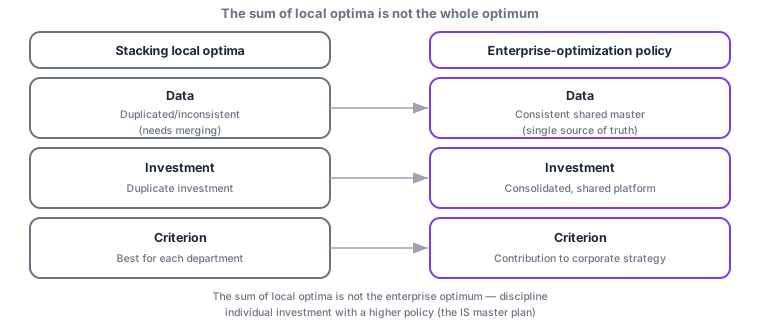
- The enterprise-optimization policy organizes the whole company's data, operations, and systems under a consistent policy, eliminating duplication and designing for integration from the outset. Since the sum of local optima is not the enterprise optimum, individual investments must be disciplined by a higher-level policy. EA (next section) is a representative means of achieving this enterprise optimization.
- The IS master plan concretizes the IS strategy, showing over the medium-to-long term the future picture of the company-wide information systems, priorities for their development, the investment plan, and the organization. An individual systemization project can have its priority and consistency judged only once positioned within this master plan's whole picture.
Most-tested: "the purpose of IS strategy is realizing the corporate strategy (not system introduction itself)", "alignment with corporate strategy is the foundation", "the sum of local optima is not the enterprise optimum", and "individual investments are disciplined by the enterprise-optimization policy." Watch for the wrong statements that "stacking up each department's requests yields the enterprise optimum" and that "adopting the latest technology is the purpose of IS strategy."
An IT strategist is about to propose the informatization of a manufacturer with multiple business divisions at a management meeting. Currently each division has introduced its own sales-management system, achieving usability that fits its work perfectly within that department. Company-wide, however, because the customer master is managed separately per division, the same customer is registered three times over, credit exposure cannot be grasped company-wide, and every month people manually merge records to produce the "company-wide profit by customer" that management wants. What the strategist should ask here is not "how to make each division's system even more feature-rich individually." Stacking up what is best for each department is merely reinforcing local optimization, and the essential problems of company-wide data inconsistency and siloing actually worsen. If the corporate strategy proclaims "maximizing customer lifetime value across the whole company," the IS strategy, as a means of realizing it, should draw an enterprise-optimization policy that integrates the customer master onto a company-wide shared platform and reorganizes the division systems to reference that shared platform. The key point is that even if each division's local usability is somewhat sacrificed, if the management value—eliminating company-wide duplicate investment, data consistency, and a company-wide customer view—outweighs it, prioritizing that enterprise optimum accords with alignment to the corporate strategy. Conversely, in a situation where the corporate strategy most values each business's independent profitability and agility and the benefit of company-wide integration is small, keeping loose coupling without forcing integration can be the appropriate judgment. In any case, the strategist draws such a future picture and priorities as an IS master plan, positions individual systemization projects (customer-master integration, division-system modification, and so on) within that whole picture, and explains the investment priority and consistency to management. Not mechanically summing individual requests, but first setting the enterprise-optimization policy in light of the corporate strategy and disciplining individual investments by that policy, is the essence of IS strategy.
| Aspect | Stacking local optima | Enterprise-optimization policy |
|---|---|---|
| Data | Duplicated/inconsistent per department (needs merging) | Consistent, single source of truth via shared master |
| Investment | Duplicate investment in similar systems | Duplication removed, consolidated onto a shared platform |
| Decision criterion | Best for each department | Contribution to corporate strategy / company-wide value |
Trap: "Stacking up locally optimal systems as each department requests will result in the company-wide optimum" is wrong—the sum of local optima is not the enterprise optimum and invites duplicate investment, data inconsistency, and siloing, so individual investments must be disciplined by a higher-level enterprise-optimization policy. Also wrong: "the purpose of IS strategy is to adopt the latest technology"—the purpose is always realizing the corporate strategy, and technology adoption is merely a means. Feature enrichment that does not contribute to the corporate strategy is judged low in investment priority.
4.1.3Section summary
- The IS strategy is a means of realizing the corporate strategy, with alignment to it as the foundation (system introduction itself is not the goal)
- The sum of local optimization is not the enterprise optimum—it invites duplicate investment, data inconsistency, and siloing
- Discipline individual investments by the enterprise-optimization policy, and position individual projects within the whole picture of the IS master plan
Sign in to track progress — Log in.
Quick check
(just a quick review)Q1. Multiple divisions each have their own sales-management system, the customer master is split per division so the same customer is registered redundantly, and company-wide profit by customer is merged manually every month. The corporate strategy proclaims "maximizing customer lifetime value across the whole company." Which proposal by the IT strategist is most appropriate?
Q2. Which statement most accurately describes the relationship between IS strategy and corporate strategy and the judgment of investment priority?
Q3. In explaining the investment priority and consistency of individual systemization projects to management, which should the IT strategist establish first, most appropriately?
Keep track of your progress
The full study guide is free to read. Sign up free to practice with the question bank, track what you have read, review your mistakes, and highlight passages.