

What's changed: Initial version
4.3DX & digital transformation
Covers the three-stage distinction of digitization (localized IT-ization of existing operations), digitalization (digitizing whole business processes), and DX (transforming products, services, business models, and the organization with data and digital technology to establish competitive advantage); the use of stability-oriented SoR versus agility-oriented SoE; the DX promotion index; and legacy renewal and the "2025 cliff." The key is judging "mere IT-ization" from "true DX (business transformation)."
What "we are doing DX too" actually means is a mix of three stages. Localized IT-ization (digitization) such as turning paper into PDFs or replacing manual work with a tool; process digitalization (digitalization) that re-connects the whole business process from ordering to settlement digitally; and DX, which transforms products, services, and the business model itself with data and digital technology to build competitive advantage—these three differ in purpose and in management impact. The IT strategist's role is, in a scene where management is satisfied with "IT-ization," to discern whether it reaches true DX (transformation of the business model) and to judge what to propose next. This section covers the three-stage distinction, the use of SoR/SoE, and legacy renewal and the "2025 cliff," framed as the judgment of a strategist leading DX.
4.3.1The three stages: digitization, digitalization, DX
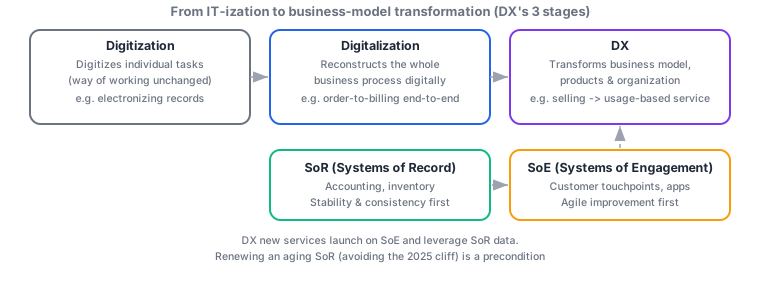
- Digitization is localized IT-ization that replaces analog/physical information or individual tasks with digital ones (electronizing paper forms, replacing manual calculation with a spreadsheet, and so on). It does not change the existing way of working itself.
- Digitalization goes beyond individual IT-ization to reconstruct the whole business process digitally (digitizing everything from order to shipment to billing end-to-end and shortening lead time, and so on). The process changes, but the product offered and the business model remain essentially existing.
- DX (digital transformation) uses data and digital technology to transform products, services, the business model, the organization, and the corporate culture itself, establishing competitive advantage. Its essence is not mere efficiency gains but a change in the source of revenue or the form of value delivered to customers (e.g., shifting from selling products outright to a usage-data-based subscription service).
4.3.2SoR/SoE, legacy renewal, and the 2025 cliff
- SoR (Systems of Record) are systems of record—core systems such as accounting, inventory, and orders where accuracy, consistency, and stable operation are the top priority. They change infrequently and are built for robustness.
- SoE (Systems of Engagement) are systems of customer touchpoints and engagement—apps, web, marketing, and so on—where customer experience and agile improvement are the top priority, keeping up with change quickly (releasing frequently, agile-style). Many DX new services launch on the SoE side and create value by leveraging SoR data.
- The 2025 cliff is the problem, warned of in the Ministry of Economy, Trade and Industry's "DX Report," that if aging, complex, black-boxed legacy systems cannot be renewed, DX will not advance and huge economic loss will result. Legacy renewal (resolving technical debt) is a precondition of DX, and the DX promotion index (METI's self-diagnosis index) is used to assess one's own maturity and advance transformation from both the management and IT sides.
Most-tested: the stage distinction—"digitization = localized IT-ization", "digitalization = digitizing the whole business process", and "DX = transforming the business model, products, and the organization itself to establish competitive advantage." Watch for confusions such as "turning paper into PDF = DX" (that is digitization). Also frequent: the mapping SoR = stability-oriented core / SoE = agility-oriented customer touchpoint, and "the 2025 cliff = delayed legacy renewal blocks DX."
The management of an industrial-machinery maker proudly tells an IT strategist, "We are advancing DX too. We electronized factory-inspection records on tablets and switched sales quotation from paper to a system." The strategist does not dismiss this out of hand, but calmly pinpoints the stages. Electronizing inspection records and replacing paper quotation with a system are digitization—replacing individual tasks with digital ones without changing the existing way of working—and are not DX. Even if the whole business process from order to production instruction to shipment to billing were connected to halve lead time, that would be digitalization—process efficiency, where what is sold (selling machines outright) and the revenue model have not changed. So what is true DX for this company? What the strategist should propose is a vision that, for example, "mounts IoT sensors on shipped machines to collect operating data (accumulated in a new SoE-side customer-touchpoint system), matches that data against the core-side maintenance and inventory data (SoR), and shifts to a preventive-maintenance service based on failure precursors or a usage-based, pay-per-operating-hour model"—that is, transforming the business model itself from selling products outright to a data-driven service business. That the source of revenue changes (sell once and done -> continuing service income) is precisely the essence of DX. Realizing this vision hinges on the SoR/SoE division of roles: agilely launching the new customer-touchpoint system (SoE) that handles operating data, while stably maintaining the core maintenance and inventory (SoR) it references. And one more thing the strategist should caution management about: if the existing core system is aging and black-boxed, its data cannot be leveraged in the new service and DX hits a ceiling—the so-called 2025 cliff. Therefore the strategist shows management the judgment to build legacy renewal (resolving technical debt) into the plan as a precondition of DX, and to advance stepwise while measuring the company's maturity with the DX promotion index. Making management re-measure the self-satisfaction of "we are IT-izing, so it is DX" against the proper yardstick of business-model transformation is the strategist's core role here.
| Stage | What it changes | Example |
|---|---|---|
| Digitization | Digitizes individual tasks (way of working unchanged) | Electronizing inspection records on a tablet |
| Digitalization | Reconstructs the whole business process | End-to-end from order to shipment to billing |
| DX | Transforms business model, products, organization | Selling outright -> usage-based data service |
Trap: Calling "we electronized paper forms / replaced manual work with a tool" DX is wrong—that is digitization (localized IT-ization) and the business model has not changed. The essence of DX is establishing competitive advantage by transforming products, services, the revenue model, and the organization itself. Also wrong: "if we build a new service (SoE), the core system (SoR) can be left alone"—without renewing the aging SoR, its data cannot be leveraged and DX hits a ceiling (the 2025 cliff), so legacy renewal is a precondition of DX.
4.3.3Section summary
- Distinguish the three stages: digitization (localized IT-ization), digitalization (digitizing the business process), and DX (business-model transformation)
- SoR = stability-oriented core / SoE = agility-oriented customer touchpoint; DX new services launch on SoE and leverage SoR data
- The 2025 cliff = delayed legacy renewal blocks DX; measure maturity with the DX promotion index and renew legacy as a precondition
Sign in to track progress — Log in.
Quick check
(just a quick review)Q1. The management of an industrial-machinery maker says, "We electronized inspection records on tablets and switched quotation from paper to a system, so we have achieved DX." Which evaluation and next proposal by the IT strategist is most appropriate?
Q2. Which statement most accurately describes the division of roles between SoR and SoE and the treatment of the core system in advancing DX?
Q3. A retailer "electronized store inventory, then integrated EC and store inventory, customer, and purchase data, launched a new member experience spanning stores and online (allocating from the same inventory on any channel and proposing based on purchase history in a subscription-type service), and shifted its revenue source." Which description of each stage is most appropriate?
Keep track of your progress
The full study guide is free to read. Sign up free to practice with the question bank, track what you have read, review your mistakes, and highlight passages.