

What's changed: Initial version
4.4Business process reengineering & management
Covers the difference between BPR, which radically redesigns the business process, and BPM, which continuously visualizes and improves the process, together with business modeling via DFD and BPMN, automation via workflow and RPA, and the cycle of visualization and continuous improvement. The key is judging, for a bottleneck, "whether a radical redesign (BPR) is needed or an incremental improvement/automation premised on the existing process (BPM/RPA) suffices."
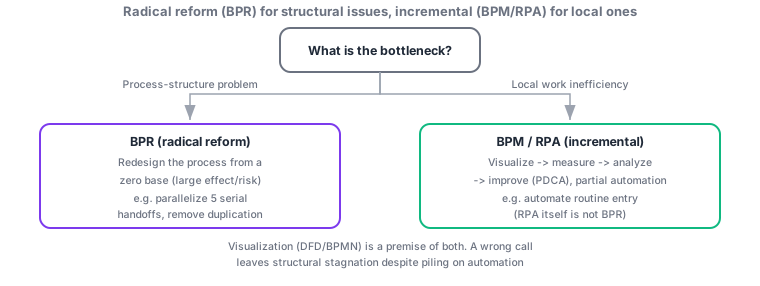
There are broadly two approaches to improving business processes: BPR (business process reengineering), which fundamentally rethinks the existing way and redesigns the flow of work itself from a zero base, and BPM (business process management), which continuously measures and improves the process while visualizing it. The easy pitfall here is a mismatch of judgment—piling small automations onto a structural problem that needs a radical rebuild, or conversely bringing a large-scale full redesign to a problem that an incremental improvement would suffice for, thereby bearing excessive cost and risk. This section covers the difference between BPR and BPM, business modeling via DFD/BPMN, and automation via workflow and RPA, and then the strategist's judgment of which to choose—radical reform or incremental improvement—according to the nature of the bottleneck.
4.4.1The difference between BPR and BPM
- BPR is an initiative that radically redesigns business processes, organization, and information systems to dramatically improve cost, quality, speed, and so on. Because it re-questions from a zero base without presupposing the existing way, its effect is large, but the scope of change is wide and the investment, risk, and impact on the field are also large.
- BPM is a management method that continuously visualizes -> measures -> analyzes -> improves (PDCA) the business process. It polishes the process incrementally on the basis of the existing one. If BPR is a one-off major reform, BPM is a continuous improvement cycle; the two are not exclusive and are used in combination.
4.4.2Business modeling and automation (DFD/BPMN, workflow, RPA)
- DFD (data flow diagram) visualizes the process from the viewpoint of data flow, and BPMN (Business Process Model and Notation) visualizes the flow, branches, and roles (lanes) of work in a standard notation. Visualization is a premise of both BPR and BPM; without correctly making the current state (As-Is) visible, neither improvement points nor the need for reform can be judged.
- Workflow is a mechanism that systematizes and runs the flow of work such as applications and approvals. RPA (robotic process automation) automates routine PC operations (data entry, transcription, reconciliation, and so on) with software robots. Both are means of partial efficiency and automation premised on the existing process, differing in the level of their aim from BPR, which remakes the very structure of the process.
Most-tested: the distinction—"BPR = radical redesign (zero-base, large effect, large risk)", "BPM = continuous visualization and improvement (PDCA, incremental)", and "RPA/workflow = partial automation premised on the existing process." Watch for the confusion that "introducing RPA amounts to BPR" (RPA automates the existing process and is not a radical redesign). Visualization (DFD/BPMN) is a premise of both improvement and reform.
An insurer's IT strategist is tackling the issue that the lead time of the claims-payment process is markedly longer than competitors'. Visualizing the current state (As-Is) with BPMN reveals the following: documents circulate on paper in series through five departments—reception, assessment, medical inquiry, re-assessment, and payment approval—and the waiting for handoffs between departments alone accounts for 70% of the total lead time. Although each department's work itself is fast, the serial cross-department handoffs and duplicate checks are the main cause of the stagnation. What the strategist should ask here is, "Can this stagnation be solved by automating the work within each department, or must the flow of work (the process structure) itself be remade?" If the routine work within each department (transcribing into systems or reconciling documents) is what takes time, partial automation premised on the existing process via RPA or workflow suffices. But in this case the main cause lies in the process structure itself—serial cross-department handoffs and duplicate assessment. Speeding up only the work within each department with RPA while preserving this structure leaves the cross-department waiting that is 70% of the stagnation, and lead time hardly shortens—this is a typical judgment error of "piling partial automation onto a problem that needs radical reform." What is appropriate is BPR that redesigns the business process from reception to payment on a zero base—for example, remaking the process structure by reorganizing the serial five-department circulation so that assessment and medical inquiry run in parallel, abolishing the duplicate re-assessment, and routing simple cases straight to payment via automatic assessment. Then, to run the redesigned process, systematize the approval flow with workflow and automate the remaining routine work with RPA—combining BPR with partial automation. Further, rather than ending at the redesign, place it on the PDCA cycle of BPM, continuously measuring, analyzing, and improving the lead time of each step after go-live. Conversely, if the issue were as local as "in one particular department a worker is swamped with manual transcription," a large-scale BPR would be over-investment, and an incremental improvement of introducing RPA to that department would suffice. Thus, discerning through visualization whether the bottleneck is rooted in the process structure or confined to local work, and choosing between radical reform (BPR) and incremental improvement/automation (BPM/RPA), is the strategist's core judgment in business-process reform.
| Aspect | BPR | BPM / RPA |
|---|---|---|
| Scope of change | Redesigns process structure from zero base | Incremental improvement/automation on the existing process |
| Effect and risk | Large effect, but large investment/risk/impact | Limited effect, but low risk and low cost |
| When it fits | Structural problem rooted in the process structure | Local inefficiency / automating routine work |
Trap: "Even though serial cross-department handoffs are the main cause of stagnation (a process-structure problem), automating the work within each department with RPA solves it" is wrong—stagnation rooted in the structure remains no matter how much partial automation is piled on, and a BPR that remakes the process from a zero base is needed. Conversely, "bringing a large-scale full BPR even to a local inefficiency in work" is also wrong—it invites over-investment and risk, and an incremental improvement such as RPA suffices there. Note too that introducing RPA is not in itself BPR (it automates the existing process).
4.4.3Section summary
- BPR = radical zero-base redesign of the process structure (large effect/risk); BPM = the PDCA of visualization and continuous improvement (incremental)
- Only by visualizing the current state with DFD/BPMN can improvement points and the need for reform be judged; RPA and workflow are partial automation premised on the existing process
- If the bottleneck is rooted in the process structure use BPR, if it is local work use BPM/RPA—introducing RPA is not in itself BPR
Sign in to track progress — Log in.
Quick check
(just a quick review)Q1. Visualizing the claims-payment process with BPMN shows that waiting for handoffs between five departments circulating documents in series on paper accounts for 70% of total lead time, while the work within each department itself is fast. Which response by the IT strategist is most appropriate?
Q2. Which statement most accurately describes the positioning of BPR, BPM, and RPA?
Keep track of your progress
The full study guide is free to read. Sign up free to practice with the question bank, track what you have read, review your mistakes, and highlight passages.