

What's changed: Revamped CLF-C02 Chapter 1 to the new depth (cloud traits/deployment models/six advantages, CapEx-OpEx/economics/TCO, Well-Architected six pillars)
1.3The AWS Well-Architected Framework
Understand the AWS Well-Architected Framework—guidance for building well on the cloud—and its six pillars.
The AWS Well-Architected Framework is a set of best practices for building well on the cloud. It reviews your design across six pillars to find and fix risks and improvements. Each pillar has design principles and review questions, and the free AWS Well-Architected Tool lets you assess your workloads. For the exam, the priority is to firmly know the names and one-line role of each of the six pillars.
1.3.1The six pillars
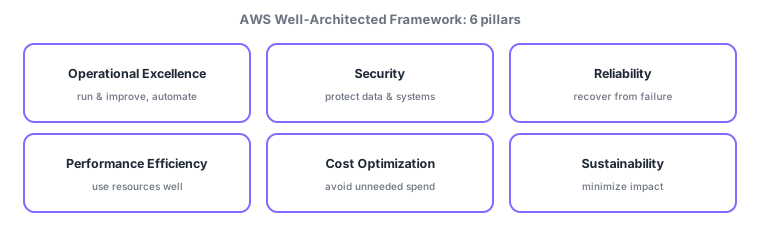
- Operational Excellence: automate, monitor, and continuously improve operations—"operations as code."
- Security: protect data and systems with defense in depth (identity, encryption, least privilege, traceability).
- Reliability: recover from failures and meet changing demand (auto-recovery, horizontal scaling).
- Performance Efficiency: use resources efficiently and appropriately, and revisit as needs change.
- Cost Optimization: avoid unneeded spend and optimize cost per value.
- Sustainability: minimize the environmental impact of running workloads.
| Pillar | In a phrase |
|---|---|
| Operational Excellence | Automate, run, and keep improving |
| Security | Protect data/systems in layers |
| Reliability | Recover from failure, meet demand |
| Performance Efficiency | Use resources efficiently/appropriately |
| Cost Optimization | Optimize cost per value |
| Sustainability | Minimize environmental impact |
Scenario: a design review for a new service. Before launch, review the six pillars with the Well-Architected Tool: "does it auto-recover on failure (reliability)?", "is least privilege in place (security)?", "any idle resources (cost optimization)?"—then fix the risks found before production. The pillars act as a checklist.
Watch the mix-ups: (1) there are six pillars (operational excellence, security, reliability, performance efficiency, cost optimization, sustainability); "marketing" or "availability" alone are not pillar names. (2) Don’t confuse reliability (recover from failure) with performance efficiency (use resources well). (3) Well-Architected is design guidance, not a specific service.
Q. Weren’t there five pillars? There used to be five; sustainability was added, making six today. Use six for the exam.
The names and gist of the six pillars come up often—especially "reliability = recover from failures," "cost optimization = cost per value," "operational excellence = automation and improvement," and "sustainability = minimize environmental impact."
1.3.2Section summary
- Well-Architected = cloud design best practices, reviewed across six pillars; assess with the Well-Architected Tool
- Six: operational excellence / security / reliability / performance efficiency / cost optimization / sustainability
- Don’t confuse "reliability = recover from failure" with "cost optimization = cost per value"
Sign in to track progress — Log in.
Quick check
(just a quick review)Q1. Which Well-Architected pillar primarily addresses recovering from failures?
Q2. Which is NOT a pillar of the Well-Architected Framework?
Q3. How many pillars does the AWS Well-Architected Framework have?
Q4. Which pillar addresses optimizing cost per value and avoiding unneeded spend?
Q5. Which free tool assesses your workload against the six pillars?
Keep track of your progress
The full study guide is free to read. Sign up free to practice with the question bank, track what you have read, review your mistakes, and highlight passages.