

What's changed: Revamped CLF-C02 Chapter 2 to the new depth (Regions/AZs/edge/containment/selection, SPOF/multi-AZ+ELB+Auto Scaling/HA/fault tolerance/elasticity/DR)
2.1Regions, Availability Zones, and Edge Locations
Understand AWS’s geography—Regions, Availability Zones (AZs), and edge locations—and how to choose a Region for your resources.
AWS is built from datacenters worldwide, and where you place resources is a more important design decision than it appears. It directly affects latency, legal/data-residency (data sovereignty), cost (varies by Region), and the availability of the services you want. This section organizes AWS geography—Region > Availability Zone > datacenter—plus the separate edge locations.
2.1.1Regions and Availability Zones
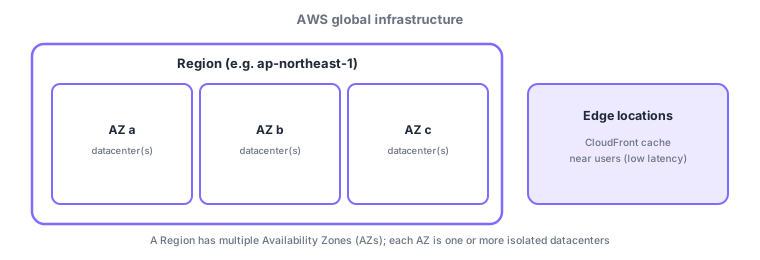
- Region: a geographically separate area (e.g., Tokyo ap-northeast-1), made up of multiple AZs (usually three or more).
- Availability Zone (AZ): one or more isolated datacenters with independent power, cooling, and networking, interconnected over low-latency dedicated links.
- Spreading across AZs (multi-AZ) makes you resilient to a single AZ failure.
The key is that AZs are physically separated, placed far enough apart that a local incident (lightning, flood, power loss) is unlikely to hit multiple AZs at once. That is why "spread across AZs and survive one failure" holds (design covered next). For wide-area disasters, consider backup/replication to another Region.
2.1.2Edge locations and related infrastructure
- Edge locations: sites that cache/deliver content near users (Amazon CloudFront); more numerous than AZs, used for low-latency delivery.
- Local Zones: place compute/storage near large metros for ultra-low-latency needs (supplementary).
- The four Region-selection factors: latency (proximity), compliance/data residency, cost (varies by Region), and service availability.
| Element | Scope | Main role |
|---|---|---|
| Region | Geographic area | Where you place resources |
| Availability Zone | Isolated DCs within a Region | Multi-AZ for high availability |
| Edge location | Delivery sites worldwide | Low-latency delivery via CloudFront |
| Factor | Why it matters |
|---|---|
| Latency (proximity) | Closer to users = faster response |
| Compliance/data residency | Where data may legally reside |
| Cost | Same service priced differently by Region |
| Service availability | New services launch in some Regions first |
Scenario: domestic video delivery. Viewers are mostly in-country → choose the Tokyo Region (latency). Cache static videos at edge locations (CloudFront) for low-latency global delivery. For availability, run the origin across multiple AZs, and back up to another Region for wide-area disasters.
Watch the mix-ups: (1) AZ (isolated DC within a Region, for HA) vs edge location (CloudFront delivery site, for low latency)—different roles. (2) "multi-AZ" is redundancy within one Region; wide-area disasters need another Region. (3) Region choice is not about preference—decide by latency, compliance, cost, and availability.
Common points: AZ = isolated DC within a Region (multi-AZ for redundancy) / edge location = CloudFront content delivery / Region selection = latency, compliance, cost, service availability. Don’t confuse AZ with edge locations.
2.1.3Section summary
- Containment: Region > AZ > datacenter; AZs are physically separated
- Edge locations = low-latency delivery near users via CloudFront (a different role than AZs)
- Region selection = latency, compliance/data residency, cost, service availability
Sign in to track progress — Log in.
Quick check
(just a quick review)Q1. Which correctly describes an Availability Zone (AZ)?
Q2. Which caches/delivers content near users for low latency?
Q3. Which is NOT a relevant consideration when choosing a Region?
Q4. Which containment is correct?
Q5. What is the basic placement to withstand a single datacenter failure within a Region?
Keep track of your progress
The full study guide is free to read. Sign up free to practice with the question bank, track what you have read, review your mistakes, and highlight passages.