

What's changed: Revamped CLF-C02 Chapter 2 to the new depth (Regions/AZs/edge/containment/selection, SPOF/multi-AZ+ELB+Auto Scaling/HA/fault tolerance/elasticity/DR)
2.2Designing for High Availability and Fault Tolerance
Understand the basics of avoiding single points of failure and achieving high availability and fault tolerance via multi-AZ deployment, load balancing, and Auto Scaling.
Good design avoids a single point of failure (SPOF) and keeps running through failures. A SPOF is a weak point whose single failure stops the whole system. On AWS, the classic high-availability pattern is three pieces: make components redundant across multiple AZs, distribute traffic with a load balancer at the entry, and let Auto Scaling adjust instance count automatically.
2.2.1Redundancy across AZs
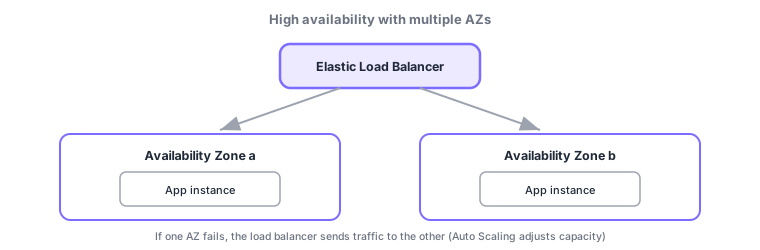
- Place instances across multiple AZs (multi-AZ).
- Use a load balancer (Elastic Load Balancing, ELB) to distribute traffic to healthy instances across AZs.
- Use Auto Scaling to automatically adjust instance count with demand or failures (replacing lost capacity).
When these mesh, here is what happens: if an AZ fails, the ELB stops routing to it and keeps sending traffic to healthy instances in other AZs, while Auto Scaling launches replacements in another AZ to restore capacity—near-zero downtime for users. Conversely, a single-AZ, single-instance setup is itself the SPOF and goes down entirely on one failure.
2.2.2High availability, fault tolerance, elasticity
| Term | Meaning | Example |
|---|---|---|
| High availability | Minimize downtime, keep running | Multi-AZ + ELB |
| Fault tolerance | Whole keeps working despite component failure | Redundancy for no downtime |
| Elasticity | Auto scale with demand | Auto Scaling |
2.2.3Peripheral knowledge: disaster recovery (DR)
Multi-AZ is high availability "within one Region." For wide-area disasters affecting an entire Region, plan disaster recovery (DR) with backup/replication to another Region. DR has targets—RPO (how much data loss is acceptable) and RTO (how fast to recover)—and you pick strategies (backup & restore / pilot light / warm standby / multi-site) balancing cost (detailed in higher certs). For CLF-C02, it is enough to grasp "another Region for wide-area disasters" and "RPO/RTO are the targets."
Scenario: a Web API that must not go down. Run EC2 across two or more AZs, front it with an ELB, and use Auto Scaling to follow demand and auto-replace failures. This survives a single AZ outage (HA). For severe incidents, add periodic backups to another Region (DR). You eliminate SPOFs step by step.
Watch the mix-ups: (1) high availability (design to stay up) vs elasticity (auto scale with demand) are different (elasticity = Auto Scaling, HA = multi-AZ + ELB). (2) Don’t confuse multi-AZ (HA within a Region) with multi-Region (DR for wide-area disasters). (3) The load balancer itself is redundant (AWS-managed, automatically).
Common points: the pattern multi-AZ + load balancer (ELB) + Auto Scaling = high availability and the principle of avoiding SPOF. Also note HA (multi-AZ within a Region) vs DR (another Region) and HA vs elasticity.
2.2.4Section summary
- Core principle: avoid single points of failure (SPOF)
- HA pattern: multiple AZs + load balancer (ELB) + Auto Scaling
- Distinguish HA / fault tolerance / elasticity; wide-area disasters need another Region (DR, RPO/RTO)
Sign in to track progress — Log in.
Quick check
(just a quick review)Q1. Which placement best improves high availability?
Q2. What is the main role of Auto Scaling?
Q3. Why should you avoid a single point of failure (SPOF)?
Q4. What is the main role of a load balancer (Elastic Load Balancing)?
Q5. What best prepares for a wide-area disaster affecting an entire Region?
Keep track of your progress
The full study guide is free to read. Sign up free to practice with the question bank, track what you have read, review your mistakes, and highlight passages.