

What's changed: Revamped CLF-C02 Chapter 1 to the new depth (cloud traits/deployment models/six advantages, CapEx-OpEx/economics/TCO, Well-Architected six pillars)
1.2Cloud Economics (CapEx and OpEx)
Understand the economics of the cloud: shifting from CapEx to OpEx, economies of scale, no capacity guessing, and lower total cost of ownership (TCO).
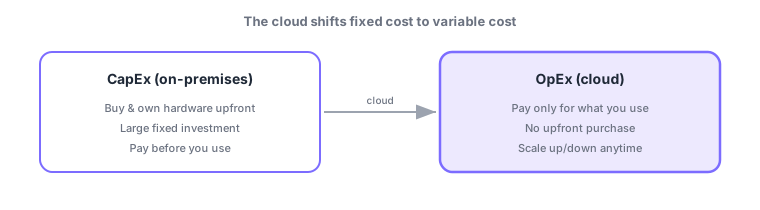
A major appeal of the cloud is that it changes how you spend (the nature of cost). Instead of buying equipment upfront, you pay for what you use—reducing waste and enabling agility. This section deepens "fixed → variable cost" from the previous section, from a money perspective.
1.2.1CapEx and OpEx
CapEx (capital expenditure) is an upfront, one-time investment to buy and own servers/equipment (on-premises). OpEx (operational expenditure) is an ongoing expense to pay for services as you use them, and the cloud leans this way. CapEx ties up capital upfront and takes time to procure; OpEx starts fast with zero upfront and stops billing when no longer needed.
| Aspect | CapEx (on-prem) | OpEx (cloud) |
|---|---|---|
| Payment | Upfront, lump sum | Ongoing, as used |
| Ownership | Buy and own | Rent and use |
| Speed | Weeks | Minutes |
| Fits when | Long-term steady load | Variable load, fast start |
1.2.2The economics of the cloud
- Economies of scale: aggregated usage lowers unit price, passed on as lower prices.
- No capacity guessing: avoid over-investment or running out.
- Agility: provision in minutes, lowering experimentation cost; throw away failures cheaply.
- Lower total cost of ownership (TCO): reduce not just hardware but power, cooling, ops staff, and maintenance.
TCO includes not just purchase price but power, cooling, ops staff, and maintenance. Use the AWS Pricing Calculator to estimate a configuration cost (also useful when comparing with on-premises).
Scenario: a seasonal e-commerce site. On-prem (CapEx) forces buying servers for the sale peak, idle and wasted off-season. In the cloud (OpEx), you auto-scale only at peak and shrink off-season, lowering spend. No capacity guessing and lower TCO apply at once.
Watch the mix-ups: (1) CapEx (upfront/own) vs OpEx (pay-as-you-go)—"buy hardware = CapEx / pay for use = OpEx." (2) TCO is the total (not just purchase price). (3) The cloud is not "always cheaper"; value comes from variable load, agility, and no guessing.
Common points: trading CapEx for variable cost (OpEx), economies of scale, no capacity guessing, and lower TCO. Estimate with the AWS Pricing Calculator.
1.2.3Section summary
- The core is shifting CapEx (upfront/own) → OpEx (pay-as-you-go)
- Economic benefits: economies of scale, no guessing, agility, lower TCO
- TCO = total (incl. power/ops/maintenance); estimate with the AWS Pricing Calculator
Sign in to track progress — Log in.
Quick check
(just a quick review)Q1. How is buying and owning servers upfront classified?
Q2. What does the cloud "removing the need to guess capacity" mean?
Q3. Which is appropriately included in total cost of ownership (TCO)?
Q4. What is the main effect of the cloud’s economies of scale for customers?
Q5. Which AWS tool estimates the cost of a planned configuration?
Keep track of your progress
The full study guide is free to read. Sign up free to practice with the question bank, track what you have read, review your mistakes, and highlight passages.