

What's changed: Revamped CLF-C02 Chapter 1 to the new depth (cloud traits/deployment models/six advantages, CapEx-OpEx/economics/TCO, Well-Architected six pillars)
1.1Cloud Computing and the Value of AWS
Understand what cloud computing is, the value AWS provides, and AWS’s six advantages of cloud computing. The starting point for CLF-C02.
Cloud computing means renting IT resources—servers, storage, databases—over the internet, on demand, and paying only for what you use (pay-as-you-go). AWS (Amazon Web Services) is one of the largest clouds, letting you use modern infrastructure without owning a datacenter. Traditionally you bought lots of servers upfront for peak demand; in the cloud you start in minutes and stop—halting billing—when done. This shift from "owning to using" is the source of every advantage that follows.
1.1.1Core characteristics of the cloud
- On-demand self-service: provision instantly yourself when needed, without waiting on an admin.
- Pay-as-you-go: pay only for usage, with no upfront investment.
- Elasticity: scale automatically with demand, reducing waste.
- Broad access and resource pooling: reach over the internet from anywhere, sharing a vast pool across many users.
1.1.2Deployment models
How and where you run systems is the deployment model. CLF-C02 distinguishes three: cloud (run everything in the cloud; cloud-native), hybrid (connect cloud with on-premises to fit existing assets/regulation), and on-premises/private cloud (run in your own datacenter). The more you move to the cloud, the less operational load and upfront investment, and the more you hand off.
1.1.3The six advantages of the cloud (AWS)
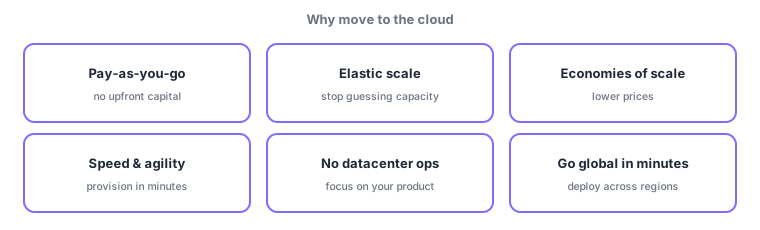
| Advantage | Meaning |
|---|---|
| Trade CapEx for variable expense | Pay for use instead of upfront investment |
| Massive economies of scale | Aggregated usage lowers cost, passed on as lower prices |
| Stop guessing capacity | Avoid over/under-provisioning; scale as needed |
| Speed and agility | Provision in minutes and experiment fast |
| Stop running data centers | Focus on your product |
| Go global in minutes | Deploy across regions worldwide quickly |
High availability, elasticity, and fault tolerance are core cloud design traits: elasticity = auto-scale with demand, high availability = keep running despite failures, fault tolerance = the whole keeps working even if a part fails. The next chapter covers concrete designs.
Scenario: a new startup. No capital or time to buy servers → pay-as-you-go means zero upfront, and you build an environment in minutes (speed/agility). As users grow, elasticity auto-scales, and expanding abroad is global in minutes. You gain speed and reduced risk impossible if you had to own it all.
Watch the mix-ups: (1) elasticity (auto scaling) vs scalability (ability to change capacity, possibly manual). (2) high availability (stay up) vs fault tolerance (the whole continues despite a part failing)—related, but fault tolerance more strongly targets "no downtime even on a single failure." (3) "cloud = always cheaper" is false (it shines for variable load and agility).
AWS’s six advantages (trade CapEx for variable expense / economies of scale / stop guessing capacity / speed and agility / stop running data centers / go global in minutes), the deployment models (cloud/hybrid/on-prem), and distinguishing HA, elasticity, and fault tolerance are common on CLF-C02.
1.1.4Section summary
- The cloud = renting IT resources on demand, pay-as-you-go (e.g., AWS); from owning to using
- Deployment models: cloud / hybrid / on-premises
- Six advantages: CapEx→variable / economies of scale / no guessing / speed & agility / no DC ops / go global
- Core traits: high availability, elasticity, fault tolerance (don’t confuse them)
Sign in to track progress — Log in.
Quick check
(just a quick review)Q1. Which best describes the cloud computing billing model?
Q2. Which is one of AWS’s stated advantages of the cloud?
Q3. What does "on-demand self-service" mean?
Q4. Which deployment model connects cloud with on-premises?
Q5. Which cloud trait automatically adds/removes resources based on demand?
Q6. Which best captures the advantage "trade capital expense for variable expense"?
Keep track of your progress
The full study guide is free to read. Sign up free to practice with the question bank, track what you have read, review your mistakes, and highlight passages.