

What's changed: Added AZ-900 Chapter 1 (Cloud Concepts)
1.3Cloud Deployment Models and Consumption-Based Pricing
Understand the deployment models—public, private, hybrid, multi-cloud—and the ideas of CapEx vs OpEx and consumption-based pricing.
How and for whom you place the cloud is described by deployment models. Earlier sections covered "what you rent" (IaaS/PaaS/SaaS); here we organize "in what form you hold it." We also cover how cloud pricing works (consumption-based = pay for what you use) and how its cost structure differs from owning your own equipment (CapEx vs OpEx). Deployment and cost are tightly linked: the choice of "own up front vs pay as you go" maps directly onto the model you pick.
1.3.1The four deployment models
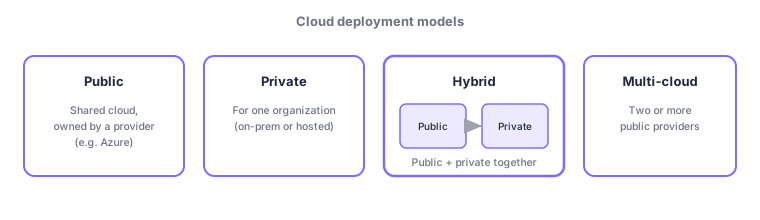
Public cloud is a shared cloud owned and operated by a provider (e.g., Microsoft Azure). Resources are shared across many customers, and the big benefit is starting in minutes with no up-front investment. It may be less suitable when you must finely dictate physical location or how sharing happens. The public cloud is the focus of AZ-900.
Private cloud is a cloud dedicated to a single organization, built in your own datacenter or a dedicated hosted location. You keep cloud mechanics (self-service, automation) while retaining management and control in-house. It is chosen in heavily regulated industries or to fit legacy assets, but owning the gear means higher up-front cost (CapEx) and operational load.
Hybrid cloud combines public with private (or on-premises) and links them so they work together. For example, "keep sensitive data in-house, send burst load to the public cloud," balancing regulation/existing assets with cloud flexibility. For AZ-900, the definition "hybrid = public + private combined" is a frequent exam point.
Multi-cloud uses two or more public cloud providers together (e.g., Azure alongside another cloud). It is adopted to avoid dependence on one provider (vendor lock-in) or to mix each provider strengths. "Hybrid (public + private)" and "multi-cloud (public + public)" are easily confused—tell them apart by what is being combined.
| Model | Composition | Control / location | Good for |
|---|---|---|---|
| Public | Provider shared cloud | Provider-run, no up-front cost | General use, fast start |
| Private | Dedicated to one org | In-house control, high CapEx | Strict regulation, legacy assets |
| Hybrid | Public + private | Place workloads by need | Sensitive in, burst out |
| Multi-cloud | Multiple public clouds | Operate across providers | Avoid lock-in, best-of-breed |
Peripheral knowledge: Azure Arc. A pain point in hybrid/multi-cloud is "how do you manage scattered environments centrally?" Azure Arc brings servers, Kubernetes, and databases that live on-premises or in other clouds under the Azure control plane (portal/policy/tags). For AZ-900, it is enough to grasp "Arc = manage resources outside Azure the Azure way."
1.3.1.1How to choose a deployment model
Which model you choose depends on regulation, existing assets, tolerance for up-front cost, and required speed. Generally: "public unless there is a special constraint; hybrid to compromise when there is; multi-cloud when you need to avoid lock-in or pick best-of-breed." The table shows typical decision factors.
| Requirement | Recommended | Why |
|---|---|---|
| Start fast, minimal up-front cost | Public | Start in minutes, pay-as-you-go |
| Keep data in-country/in-house | Private or hybrid | Keep sensitive data local; combine for flexibility |
| Extend while reusing on-prem assets | Hybrid | Best of existing + cloud |
| Avoid vendor lock-in | Multi-cloud | Spread across providers, best-of-breed |
1.3.2CapEx vs OpEx and consumption-based pricing
When discussing the cloud, the nature of cost changes in an important way. Owning your own equipment is CapEx—a large investment up front. The cloud shifts toward OpEx—ongoing payments for what you use. This difference affects cash flow, accounting, and how fast you can decide.
| Aspect | CapEx (capital expenditure) | OpEx (operational expenditure) |
|---|---|---|
| Payment | Up front, lump sum | Ongoing, as used |
| Ownership | Buy and own the asset | Rent and use |
| Example | Own-datacenter hardware | Azure pay-as-you-go |
| Fits when | Long-term, steady load | Variable load, fast start |
With consumption-based pricing you pay for what you actually use, not for reserved capacity. Benefits include no up-front investment, less waste, and scaling with demand. There are also savings options to match usage—reservations (Reserved Instances / Savings Plans) that discount committed long-term use, and spot that uses spare capacity cheaply (details in the management and governance chapter).
To estimate costs, use the Pricing Calculator (monthly estimate for a planned configuration); to compare total cost of ownership of "own vs Azure" when migrating from on-premises, use the TCO (Total Cost of Ownership) Calculator. The two serve different purposes—do not mix them up.
Cloud pricing is "for what you use," but what costs how much is driven by several factors. Knowing the main ones gives you a feel for estimating and cutting cost.
- Resource type and size: VM size, storage type/capacity, and so on.
- Region: the same service can cost differently by location.
- Network egress: outbound data transfer from the datacenter is billed (inbound is usually free).
- Uptime/usage: running time, request counts, stored volume; stopping resources stops the charges.
- Discount options: reservations (RI/Savings Plans), spot, and Azure Hybrid Benefit (reuse existing licenses) reduce cost.
Mnemonic: CapEx = buy and own (up front) / OpEx = rent and pay-as-you-go. A major appeal of the cloud is avoiding big up-front investment by shifting to OpEx.
Scenario: a regulated financial system. Customer data must stay in-country and self-managed by law, while month-end batch processing spikes. → Use hybrid: keep sensitive data private (in-house) and send only the month-end burst to the public cloud (Azure), managing both with Azure Arc. This balances regulation and cost efficiency.
Watch the mix-ups: (1) hybrid (public + private) vs multi-cloud (public + public)—tell them apart by whether the partner is "private" or "another public." (2) CapEx (up-front, owned) vs OpEx (pay-as-you-go)—"buy hardware = CapEx / pay for usage = OpEx." Beware swapped options.
Q. Is private cloud the same as on-premises? Not exactly. On-premises is about location—"gear in your own facility." Private cloud is about form—"cloud mechanics (self-service, pooling, automation) provided dedicated to one organization," which may be hosted in your facility or dedicated elsewhere. They overlap, but the lens differs.
Common points: definitions of public/private/hybrid/multi-cloud (especially hybrid = public + private, multi-cloud = public + public), CapEx (up-front, owned) vs OpEx (pay-as-you-go), benefits of consumption-based pricing, and Pricing Calculator (estimate) vs TCO Calculator (migration comparison).
1.3.3Section summary
- Deployment: public (shared) / private (dedicated) / hybrid (public + private) / multi-cloud (multiple public)
- Use Azure Arc to centrally manage hybrid/multi-cloud
- CapEx = own up front / OpEx = pay as you go; the cloud leans OpEx
- Consumption-based = pay for actual use; estimate = Pricing Calculator / migration = TCO Calculator
Sign in to track progress — Log in.
Quick check
(just a quick review)Q1. Which deployment model combines a public cloud with an on-premises private environment?
Q2. Which best matches the cloud "pay for what you use" cost structure?
Q3. Which is a benefit of consumption-based pricing?
Q4. Which deployment model uses two or more public cloud providers together?
Q5. Which service brings on-premises or other-cloud servers under the Azure control plane for central management?
Q6. Which tool compares total cost of ownership of "own vs Azure" when migrating from on-premises?
Keep track of your progress
The full study guide is free to read. Sign up free to practice with the question bank, track what you have read, review your mistakes, and highlight passages.