

What's changed: Revamped AZ-900 Chapter 2 to the new depth (geography, resource hierarchy, scope inheritance, ARM/IaC)
2.1Azure Geography (Regions and Availability Zones)
Understand Azure global structure—regions, region pairs, availability zones, and datacenters—and how it relates to availability and data residency.
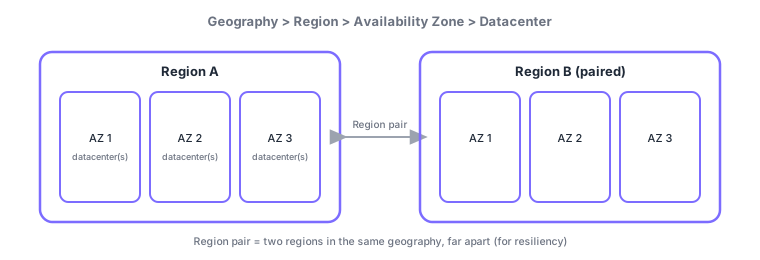
Azure is built from datacenters around the world, and where you place resources is a more important design decision than it appears. Placement directly affects latency (distance to your users), availability (resilience to failures and disasters), and legal/data-residency (data sovereignty)—e.g., whether data may leave the country. This section organizes Azure geographic structure—geography > region > availability zone > datacenter—and how to choose.
2.1.1What is a region
A region is a geographic grouping of one or more datacenters connected by a low-latency network (e.g., Japan East, West US). You choose a region when creating resources. Note that not every service or VM size is available in every region—new capabilities roll out to specific regions first. Above regions sits a geography, which bundles regions and acts as a boundary for data residency and compliance.
Be aware of special regions too. There are government regions (e.g., Azure Government) that meet strict government requirements, and sovereign regions for countries that must keep data in-country—these are isolated from the ordinary public regions. For AZ-900, it is enough to grasp "regulatory needs may dictate a dedicated region."
Azure has 60+ regions worldwide—among the broadest footprints of any cloud. Why so many? First, proximity: the closer a region is to users, the shorter the network distance and the faster the response. Second, data sovereignty: meeting laws like "this data may not leave the country" requires a region in that country/area. Third, resiliency: only with multiple, distant locations can business continue elsewhere during a disaster. This geographic breadth is the foundation for speed, compliance, and availability.
2.1.2Region pairs
A region pair is a set of two regions hundreds of kilometers apart within the same geography. The distance ensures a wide-area disaster (earthquake, flood) is unlikely to hit both. Region pairs bring three benefits: (1) staged updates—Azure maintenance is applied to one side of the pair at a time, so both never go down together; (2) prioritized recovery—during a major outage, one of the pair is recovered first; (3) geo-redundant storage (GRS)—data is automatically replicated to the paired region (detailed in the storage chapter).
2.1.3Availability zones
An availability zone (AZ) is a set of physically separated datacenters within a single region. Each zone has independent power, cooling, and networking, so an outage or equipment failure in one zone does not cascade to others. Crucially, zones are inside a region—distinct from a region pair, which is "two distant regions." Spreading an app across zones (zone redundancy) keeps the service running even if one zone fails, achieving high availability.
| Aspect | Availability zone | Region pair |
|---|---|---|
| Scope | Within one region | Two distant regions |
| Distance | Same region (close) | Hundreds of km+ |
| Main purpose | Stay up despite a zone failure (HA) | Recover from wide-area disaster (DR) |
| Protects against | Datacenter-level failures | A whole-region disaster |
2.1.4How to choose a region
A region is not easy to change later (it often requires recreating or migrating resources), so the initial choice matters. There are four main factors, and they can trade off against each other (e.g., the nearest region is not always the cheapest, and regulation may forbid the nearest one).
| Factor | Why it matters | Example |
|---|---|---|
| Latency (proximity) | Closer to users = faster response | Domestic users → domestic region |
| Data sovereignty/compliance | Where data may legally reside | Keep personal data in-country |
| Feature availability | Whether the feature/VM size exists | New GPU VMs in specific regions |
| Cost | Same service priced differently | Pick a cheaper region |
Containment: datacenter < availability zone < region < geography. Remember "zone = inside a region" vs "pair = between regions" (inside vs outside) and you will not confuse them.
Scenario: a domestic, availability-focused web service. Users are mostly in-country → choose a low-latency domestic region. Avoid downtime → deploy across multiple availability zones (zone redundancy). Prepare for a major earthquake → back up/replicate to the region pair. Latency, HA, and DR are each met by a different mechanism.
Watch the mix-up: "availability zone" vs "region pair." A zone is a separated DC within one region, mainly for HA; a pair is two distant regions, mainly for DR (wide-area disaster). Exams ask "which for disaster recovery? → region pair" and "which resists a zone failure? → availability zone."
Q. Do all regions have availability zones? No. Availability zones exist in many major regions but not in every region. If your design needs zones, you must pick a zone-enabled region.
Common points: availability zone = physically separated DC within a region (HA), region pair = two distant regions in the same geography (DR, staged updates, GRS), region choice = latency, data sovereignty/compliance, feature availability, cost, and features are not uniform across all regions.
2.1.5Section summary
- Containment: geography > region > availability zone > datacenter
- Availability zone = separated DC within a region → HA; region pair = two distant regions → DR/staged updates/GRS
- Choose a region by latency, data sovereignty/compliance, feature availability, and cost; features are not uniform across regions
- Regulation may require government/sovereign regions
Sign in to track progress — Log in.
Quick check
(just a quick review)Q1. Which correctly describes an availability zone?
Q2. What is the main purpose of a region pair?
Q3. Which is NOT a relevant consideration when choosing a region?
Q4. You want to keep a service running despite a datacenter failure within the same region. Best choice?
Q5. Which containment order is correct?
Keep track of your progress
The full study guide is free to read. Sign up free to practice with the question bank, track what you have read, review your mistakes, and highlight passages.