

What's changed: Deepened AZ-700 Chapter 2 (ja figures; comparison tables/scenarios/FAQ/traps/deep paragraphs in all sections)
2.1Site-to-Site and P2S with VPN Gateway
Understand VPN Gateway that connects on-premises or individual clients to Azure over an encrypted tunnel. Site-to-site (S2S), point-to-site (P2S), and VNet-to-VNet are the basis of AZ-700 hybrid networking.
To securely connect on-prem and Azure over the internet, you establish an encrypted VPN tunnel, handled by the VPN Gateway.
2.1.1Types of VPN connections
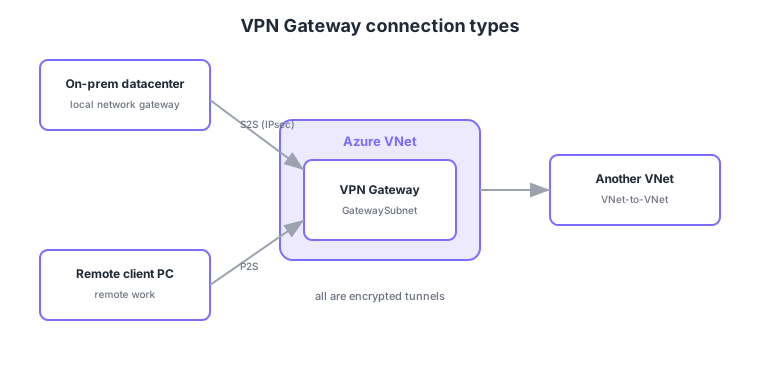
- Site-to-site (S2S): connect an entire on-prem site to Azure via an IPsec tunnel (the on-prem side is represented by a local network gateway).
- Point-to-site (P2S): connect individual client PCs to the VNet (e.g., remote work).
- VNet-to-VNet: connect two VNets via VPN gateways (an alternative/complement to peering).
- SKU and performance: the gateway SKU determines throughput, tunnel count, and redundancy (active-active).
Common on AZ-700: connect a whole site = S2S, connect individual PCs = P2S, represent on-prem side = local network gateway, redundancy = active-active. Distinguish VPN (encrypted tunnel over internet) from ExpressRoute (private circuit, next section).
A VPN Gateway is deployed into a dedicated GatewaySubnet; reserve it during subnet design.
A VPN Gateway is built from a virtual network gateway representing the VNet side (type = VPN, placed in GatewaySubnet), a local network gateway representing on-prem (the site’s address space and the VPN device’s public IP), and a connection between them (shared key / PSK). The SKU (VpnGw1–5; AZ variants are zone-redundant) governs throughput, tunnel count, BGP support, and SLA, and active-active (two public IPs on the gateway) provides redundancy. S2S comes in route-based (multiple tunnels, coexists with P2S, recommended) and policy-based (single static tunnel); enabling BGP exchanges routes dynamically (on-prem ASN and Azure’s default ASN 65515). P2S protocols are OpenVPN/IKEv2/SSTP with certificate/Entra ID/RADIUS authentication. VNet-to-VNet can also use peering, but use VPN when crossing tenants or needing BGP/tunnels.
| Type | Connects | Notes |
|---|---|---|
| Site-to-site (S2S) | A whole site (VPN device) | IPsec; route/policy-based; BGP-capable |
| Point-to-site (P2S) | Individual client PCs | OpenVPN/IKEv2/SSTP; cert/Entra/RADIUS |
| VNet-to-VNet | Two VNets | Use VPN for cross-tenant or BGP needs |
Scenario: keep HQ permanently connected to Azure while letting remote workers connect individually to the VNet. → Create a route-based VPN Gateway; connect HQ via S2S (represented by a local network gateway) and remote workers via P2S (Entra ID auth). Route-based allows S2S and P2S to coexist on one gateway.
FAQ: Q. Route-based vs policy-based? → A. Prefer route-based (multiple tunnels, P2S coexistence, BGP); policy-based is a static single-tunnel option for older devices. Q. VNet-to-VNet: peering or VPN? → A. Peering for low latency/high bandwidth; VPN when crossing tenants or needing BGP/encrypted tunnels.
Trap: “policy-based VPN can also run P2S and multiple S2S tunnels” is wrong—those are route-based features. Also “the local network gateway is the Azure-side gateway” is wrong—the Azure side is the virtual network gateway; the local one represents on-prem. VPN is over the internet—distinct from ExpressRoute (private circuit).
2.1.2Section summary
- VPN Gateway = encrypted tunnels (S2S = site, P2S = client, VNet-to-VNet)
- On-prem side = local network gateway, redundancy = active-active
Sign in to track progress — Log in.
Quick check
(just a quick review)Q1. Which VPN type connects an entire on-prem site to Azure via an IPsec tunnel?
Q2. You want individual remote client PCs to VPN into the VNet. Which type?
Q3. In a site-to-site VPN, what represents the on-prem network (address space and VPN device public IP) in Azure?
Keep track of your progress
The full study guide is free to read. Sign up free to practice with the question bank, track what you have read, review your mistakes, and highlight passages.