

What's changed: Deepened AZ-700 Chapter 2 (ja figures; comparison tables/scenarios/FAQ/traps/deep paragraphs in all sections)
2.2Private Connectivity with ExpressRoute
Understand ExpressRoute, which connects on-prem and Azure over a dedicated, private connection that bypasses the internet. Choose it over VPN for enterprise connectivity needing high bandwidth, low latency, and stability.
VPN runs over the internet, so latency/bandwidth can be unstable. ExpressRoute is a dedicated private connection via a connectivity provider, offering stable high bandwidth and low latency.
2.2.1ExpressRoute building blocks
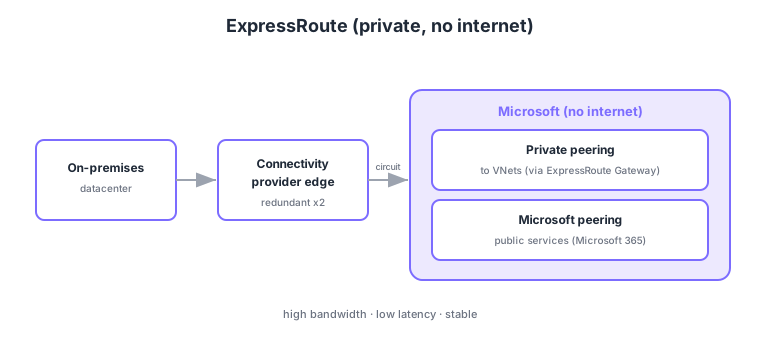
- Private connection: a dedicated connection that bypasses the internet; high bandwidth, low latency, stable.
- Private peering: privately connect to resources inside VNets.
- Microsoft peering: used to connect to public services like Microsoft 365.
- Redundancy and SKU: redundant dual connections by default; land in the VNet via an ExpressRoute Gateway; Global Reach can link sites.
Common on AZ-700: dedicated private connection bypassing the internet = ExpressRoute, private connectivity to VNets = private peering, public services like Microsoft 365 = Microsoft peering, link sites via ExpressRoute = Global Reach. Choose ExpressRoute for stability/bandwidth, VPN for cost/small scale.
A common design pairs ExpressRoute with VPN as a failover path if ExpressRoute fails—frequently tested.
ExpressRoute circuits come in connectivity models—CloudExchange colocation, point-to-point Ethernet, and Any-to-Any (IPVPN)—with bandwidth from 50 Mbps to 100 Gbps. Billing is metered or unlimited; unlimited favors egress-heavy workloads. All route exchange uses BGP: private peering advertises VNet prefixes, Microsoft peering advertises public-service prefixes. For availability, circuits are a redundant pair by default, and meeting the SLA requires keeping both paths. To share one circuit across VNets, place an ExpressRoute Gateway in each VNet or aggregate at a Virtual WAN hub. Global Reach links distant on-prem sites via the ExpressRoute circuit; for stronger encryption, add MACsec (layer-2) or IPsec/VPN over ExpressRoute. Versus VPN: ExpressRoute is dedicated, stable, and high-bandwidth but has longer lead time and higher cost, whereas VPN is immediate and cheap but depends on internet quality.
| Aspect | VPN Gateway | ExpressRoute |
|---|---|---|
| Path | Over the internet (encrypted) | Dedicated, bypasses internet |
| Bandwidth/latency | Moderate, variable | High, low, stable |
| Setup/cost | Immediate, cheap | Provider lead time, higher cost |
| Encryption | IPsec by default | Unencrypted by default (add MACsec/IPsec) |
Scenario: a core system needs stable high-bandwidth connectivity but must keep minimal connectivity during a circuit outage. → Use ExpressRoute (private peering) as the primary and a site-to-site VPN as a backup path. BGP metrics prefer ExpressRoute normally and fail over to VPN on an outage.
FAQ: Q. Does ExpressRoute encrypt data? → A. It’s a dedicated circuit but not encrypted by default; add MACsec or IPsec/VPN over ExpressRoute if required. Q. Private vs Microsoft peering? → A. Private peering is private connectivity to VNet resources; Microsoft peering is for public services like Microsoft 365.
Trap: “ExpressRoute is a private circuit, so traffic is automatically encrypted” is wrong—private means isolated, but it’s not encrypted by default (add MACsec/IPsec). Also “ExpressRoute goes over the internet” is wrong—bypassing the internet is the decisive difference from VPN.
2.2.2Section summary
- ExpressRoute = dedicated private connection (bypasses internet, high bandwidth/low latency)
- Peering = private (VNets) / Microsoft (public services)
Sign in to track progress — Log in.
Quick check
(just a quick review)Q1. You want high-bandwidth, low-latency on-prem-to-Azure connectivity over a dedicated private connection (no internet). What do you use?
Q2. Which ExpressRoute peering provides private connectivity to resources inside VNets?
Q3. Which correctly distinguishes VPN from ExpressRoute?
Keep track of your progress
The full study guide is free to read. Sign up free to practice with the question bank, track what you have read, review your mistakes, and highlight passages.