

What's changed: Deepened AZ-104 Chapter 2 to Associate depth (tables, scenarios, FAQ, traps; localized figures)
2.1Storage Accounts and Redundancy
Understand the four services a storage account groups (Blob, Files, Queue, Table) and the redundancy options that protect data (LRS / ZRS / GRS).
The entry point for storing data on Azure is the storage account. One account groups four services—Blob, Files, Queue, Table—chosen by use case.
2.1.1Storage account services
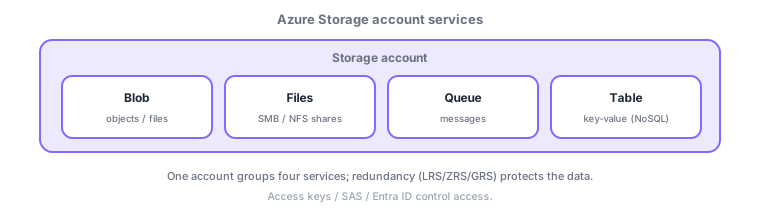
- Blob: object storage for unstructured data (images, logs, backups).
- Files: managed file shares mountable over SMB/NFS by VMs and on-prem.
- Queue: passes messages between components. Table: key-value NoSQL.
2.1.2Redundancy options
- LRS (locally redundant): 3 copies within one datacenter; cheapest but vulnerable to a DC failure.
- ZRS (zone redundant): spread across availability zones in the same region; resilient to a zone failure.
- GRS (geo-redundant): replicates to another region; protects against a region-wide disaster.
A common AZ-104 distinction: LRS = within one DC, ZRS = multiple zones in the same region, GRS = replicate to another region. If region-disaster protection is required, choose GRS.
A storage account groups four services (Blob/Files/Queue/Table); choose a performance tier (Standard = HDD/general, Premium = SSD/low-latency) and redundancy at creation. Think of redundancy on two axes—"in-region redundancy" and "cross-region replication." LRS = 3 copies within one datacenter (cheapest, weak to a DC failure); ZRS = spread across three availability zones in the region (resilient to a zone failure). Adding geo replication gives GRS = async copy to another region (LRS at two sites) and GZRS = ZRS primary plus cross-region copy. The geo secondary is normally not readable; to read it choose RA-GRS/RA-GZRS (read-access geo-redundant). Switch over on a regional outage via account failover (async replication, RPO ~minutes). The standard account kind is General Purpose v2. The axes: "cheapest/single-DC = LRS," "zone-failure protection = ZRS," "region-disaster protection = GRS/GZRS," "read the secondary = the RA- variant."
| Redundancy | Protects against |
|---|---|
| LRS | 3 copies in one DC (in-DC failure) |
| ZRS | AZ failure in the same region |
| GRS / GZRS | Region-wide disaster (cross-region copy) |
| RA-GRS / RA-GZRS | Above + readable secondary |
Scenario: tolerate a zone failure and also read from the secondary during a region disaster. Use ZRS for in-region zone redundancy, GZRS to add geo replication for region-disaster protection, and RA-GZRS if you must read the secondary. If cost is paramount and a single DC suffices, use LRS. Switch regions via account failover.
Q. Cheapest? LRS. Q. Zone-failure protection? ZRS. Q. Region-disaster protection? GRS/GZRS. Q. Read the secondary? RA-GRS/RA-GZRS. Q. SSD/low-latency? Premium. Q. Standard account kind? General Purpose v2.
Watch the mix-ups: (1) ZRS (zones in one region) and GRS (another region) protect different things—ZRS for zone failures, GRS for region disasters. (2) The geo secondary isn’t readable by default—use the RA- variant. (3) Geo replication is async, so RPO isn’t zero. (4) Some redundancy changes are restricted after account creation (especially Premium).
Choose by purpose: Blob is object storage for unstructured data, while Files is file storage you mount and share over SMB/NFS.
2.1.3Section summary
- One account = four services: Blob / Files / Queue / Table
- Redundancy: LRS (in-DC) → ZRS (zones) → GRS (another region)
Sign in to track progress — Log in.
Quick check
(just a quick review)Q1. Which Azure Storage service best stores unstructured data like images and logs?
Q2. You want data replicated to another region to survive a region-wide disaster. Which redundancy?
Q3. Which redundancy spreads data across availability zones within the same region?
Keep track of your progress
The full study guide is free to read. Sign up free to practice with the question bank, track what you have read, review your mistakes, and highlight passages.