

What's changed: In-scope coverage: added machine learning (SageMaker AI/Comprehend/Kendra/Polly/Rekognition/Textract/Transcribe/Translate), storage (FSx/Storage Gateway), media (Elastic Transcoder/Kinesis Video Streams), frontend/API (API Gateway/Amplify/Device Farm), analytics (Kinesis Data Streams/Data Firehose/MSK/Glue/Lake Formation/Athena/EMR/OpenSearch/QuickSight/Data Exchange), and additional databases (Aurora Serverless/DocumentDB/Keyspaces) across sections
3.1Choosing Compute and Storage
Understand choosing compute (EC2 instance types, serverless Lambda) and storage (EBS, EFS, S3) to fit the workload.
High performance comes from choosing the right resource for the workload: EC2 for steady servers, Lambda for event-driven/spiky work, and EBS/EFS/S3 by data shape.
3.1.1Compute and storage
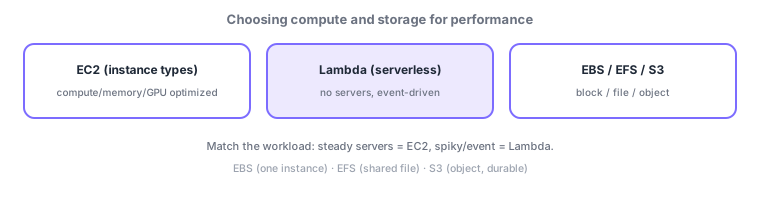
- EC2: virtual servers; pick an instance type (general/compute-optimized/memory-optimized/GPU). Best for steady workloads needing fine control.
- Lambda: serverless, event-driven; suits spiky/intermittent work, billed by usage, auto-scaling.
- Containers (ECS/EKS/Fargate): run containerized apps; Fargate runs containers serverlessly.
- Storage: EBS (block, one instance) / EFS (shared file, NFS) / S3 (durable object, static/backup) / instance store (ephemeral).
High performance starts with choosing the right resource for the workload. Compute: EC2 for predictable, steady workloads needing OS-level control; Lambda for intermittent, event-driven work with minimal ops; ECS/EKS for portable containers (Fargate for serverless). Storage is chosen by attachment model: block = EBS (fast, one EC2), shared file = EFS (mounted by many), object = S3 (HTTP, highly durable). EBS further offers general-purpose SSD (gp3), provisioned IOPS SSD (io2, high IOPS), and HDD (throughput)—pick by performance need.
| Requirement | Choice |
|---|---|
| Steady, OS control | EC2 |
| Intermittent, event-driven | Lambda (serverless) |
| Fast disk on one instance | EBS (block) |
| File shared by many | EFS (file/NFS) |
| Static files, backups, big data | S3 (object) |
Scenario: choose by use. A steady API runs on EC2 (or ECS/Fargate); intermittent work like thumbnail generation on image upload uses Lambda. The OS disk is EBS (gp3); if multiple web servers share files, use EFS; uploaded images and static sites go to S3, as do DB backups. Work backward from attachment model, frequency, and durability.
Watch the mix-ups: (1) EBS (one instance, block) vs EFS (shared, file) vs S3 (object, HTTP). (2) steady = EC2 / event-driven, spiky = Lambda. (3) Instance store is ephemeral (lost on stop)—don’t use for persistence. (4) EBS attaches within the same AZ (not across AZs).
Q. EC2 or Lambda? EC2 for steady, fine-grained control; Lambda for intermittent, event-driven, minimal ops. Q. EBS vs EFS vs S3? EBS = block on one instance, EFS = shared file across many, S3 = object via HTTP. Q. Instance store? Fast but ephemeral (lost on stop); use EBS/S3 for persistence.
Common: steady = EC2, event-driven/spiky = Lambda, containers = ECS/EKS/Fargate; storage = one instance = EBS, shared file = EFS, object/static = S3, ephemeral = instance store.
3.1.2Other key in-scope services (machine learning and storage)
High-performing apps also use purpose-built managed AI/ML and storage options beyond EC2 disks. The core platform is Amazon SageMaker AI: a managed service to build, train, and deploy machine learning models end to end—choose it when you do not want to operate ML infrastructure yourself. The following are pre-trained AI services usable via API calls with no training: Amazon Comprehend is natural language processing that extracts sentiment, key phrases, and entities from text; Amazon Kendra is natural-language full-text (enterprise) search over internal documents; Amazon Polly is text-to-speech (speech synthesis); Amazon Rekognition detects objects/faces/unsafe content in images and video; Amazon Textract extracts text, tables, and form fields from scanned documents (OCR); Amazon Transcribe is speech-to-text; Amazon Translate is machine translation across languages. Pick these when you want to embed a common AI task instantly without training your own model.
For storage, beyond EBS/EFS/S3 two services appear often. Amazon FSx is a fully managed shared file system—choose it when you need protocol/use-specific shares such as a Windows File Server (SMB) or Lustre for high-performance computing. AWS Storage Gateway is hybrid storage bridging on-premises and AWS—on-prem apps see NFS/SMB/iSCSI volumes backed by S3 and similar, ideal when you want to move backups and tiering into AWS.
| What you want | Service |
|---|---|
| Build/train/deploy ML models | Amazon SageMaker AI |
| Sentiment/entity extraction (NLP) | Amazon Comprehend |
| Natural-language search over docs | Amazon Kendra |
| Text to speech / speech to text | Amazon Polly / Amazon Transcribe |
| Image/video analysis, OCR | Amazon Rekognition / Amazon Textract |
| Machine translation | Amazon Translate |
| Managed shared files (SMB/Lustre) | Amazon FSx |
| Hybrid on-prem and AWS storage | AWS Storage Gateway |
3.1.3Section summary
- Compute: EC2 (steady/control) / Lambda (event-driven/serverless) / containers (ECS/EKS/Fargate)
- Storage: EBS (one/block) / EFS (shared/file) / S3 (object) / instance store (ephemeral)
Sign in to track progress — Log in.
Quick check
(just a quick review)Q1. Which compute is event-driven, intermittent, and requires no server management?
Q2. Which storage can be mounted and shared by many EC2 instances at once?
Q3. Which highly durable storage suits static files and backups?
Keep track of your progress
The full study guide is free to read. Sign up free to practice with the question bank, track what you have read, review your mistakes, and highlight passages.