

What's changed: In-scope coverage: added machine learning (SageMaker AI/Comprehend/Kendra/Polly/Rekognition/Textract/Transcribe/Translate), storage (FSx/Storage Gateway), media (Elastic Transcoder/Kinesis Video Streams), frontend/API (API Gateway/Amplify/Device Farm), analytics (Kinesis Data Streams/Data Firehose/MSK/Glue/Lake Formation/Athena/EMR/OpenSearch/QuickSight/Data Exchange), and additional databases (Aurora Serverless/DocumentDB/Keyspaces) across sections
3.2Caching and Content Delivery
Understand reducing latency and improving performance with Amazon CloudFront (CDN) edge delivery and Amazon ElastiCache in-memory caching.
A classic way to cut latency is caching: CloudFront for content at the edge, and ElastiCache (in-memory) in front of databases.
3.2.1Caching and delivery
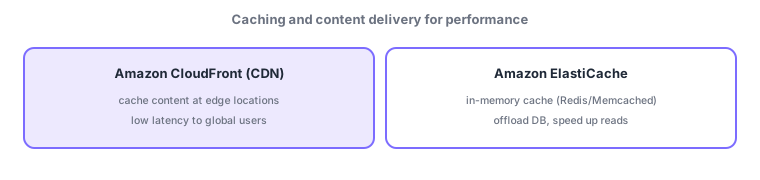
- Amazon CloudFront: a CDN caching at edge locations for low latency near users; origins can be S3/ALB/EC2.
- Amazon ElastiCache: in-memory cache (Redis/Memcached) in front of a DB; speeds frequent reads and offloads the DB.
- Global Accelerator: anycast IPs route TCP/UDP over the AWS backbone to reduce latency for dynamic traffic (distinct from a CDN).
A classic latency reducer is "keep frequently used things close/fast (caching)." For content delivery, use CloudFront: cache static/dynamic content at global edges, cutting round-trips to the origin (S3 or ALB). In front of a database, use ElastiCache: keep frequently read results in memory, reducing DB queries and response time. They operate at different layers (network edge vs data tier) and are often combined. If you need to optimize the path of dynamic traffic itself (not caching), Global Accelerator is a candidate.
| Goal | Service |
|---|---|
| Low-latency global content delivery | CloudFront (CDN) |
| Speed DB reads / offload | ElastiCache (in-memory) |
| Optimize dynamic traffic path | Global Accelerator |
Scenario: a read-heavy global app. Serve static assets (images/JS/CSS) via S3 + CloudFront from nearby edges, and cache frequent API responses in ElastiCache to offload RDS. This cuts both perceived latency and DB load. Split roles: delivery = CloudFront, in front of DB = ElastiCache.
Watch the mix-ups: (1) CloudFront = content delivery (CDN/edge) vs ElastiCache = in front of DB (in-memory)—different layers. (2) CloudFront accelerates dynamic content too, not just static. (3) Global Accelerator is not a CDN (no caching; it optimizes the path). (4) ElastiCache mainly speeds reads (distinct from scaling writes).
Q. CloudFront vs ElastiCache? CloudFront delivers content at the edge (CDN); ElastiCache is an in-memory cache in front of a DB. Q. CloudFront vs Global Accelerator? CloudFront is a caching CDN; Global Accelerator doesn’t cache—it optimizes the path of dynamic traffic over the AWS backbone. Q. Fast S3 static site? S3 origin + CloudFront.
Common: low-latency global content delivery = CloudFront, speed up DB reads/offload = ElastiCache, optimize dynamic traffic path = Global Accelerator. Note CloudFront vs Global Accelerator (caching or not).
3.2.2Other key in-scope services (media and frontend/API)
Around content delivery sit managed services for media conversion and for frontend/API. AWS Elemental MediaConvert performs video/audio format conversion (transcoding)—choose it to convert to formats and resolutions that fit target devices (note: the older Amazon Elastic Transcoder is closed to new use and being retired; MediaConvert is the current standard). Amazon Kinesis Video Streams ingests, stores, and plays back/analyzes video streams from cameras and similar sources—choose it for real-time surveillance or IoT video.
For API and frontend, Amazon API Gateway is a fully managed front door for REST/HTTP/WebSocket APIs with auth, throttling, and caching—place it in front of backends such as Lambda. AWS Amplify hosts web/mobile frontends and builds/deploys them together with backends like auth and APIs—choose it to spin up frontend-centric apps quickly. AWS Device Farm tests apps on real phones and tablets in the cloud—choose it when you must verify behavior across many real devices.
| What you want | Service |
|---|---|
| Convert video/audio formats | AWS Elemental MediaConvert (Elastic Transcoder is being retired) |
| Ingest/analyze camera video streams | Amazon Kinesis Video Streams |
| Managed API front door | Amazon API Gateway |
| Build/host web/mobile frontends | AWS Amplify |
| Test apps on real devices | AWS Device Farm |
3.2.3Section summary
- CloudFront (CDN/edge) / ElastiCache (in-memory/in front of DB) / Global Accelerator (path optimization)
- Caching cuts both perceived latency and DB load; delivery = CloudFront, in front of DB = ElastiCache
Sign in to track progress — Log in.
Quick check
(just a quick review)Q1. Which service caches content at global edge locations for low-latency delivery?
Q2. Which sits in front of a read-heavy database to speed up reads in memory?
Q3. What pairs well with an S3 static site for fast global delivery?
Keep track of your progress
The full study guide is free to read. Sign up free to practice with the question bank, track what you have read, review your mistakes, and highlight passages.