

What's changed: Deepened MS-900 Chapter 1 to the AZ-900 baseline (service models IaaS/PaaS/SaaS + responsibility table, deployment models, M365=SaaS; cloud benefits + CapEx/OpEx table, economies of scale, elasticity; scenarios, FAQ, traps). Localized 3 figures
1.2Benefits of the Cloud and Pay-as-you-go
Understand the benefits of the cloud—scalability, reliability, security, and cost (CapEx to OpEx)—and the pay-as-you-go model.
The appeal of the cloud (and Microsoft 365) is that it scales on demand, is reliable, and reduces upfront investment.
1.2.1Key benefits of the cloud
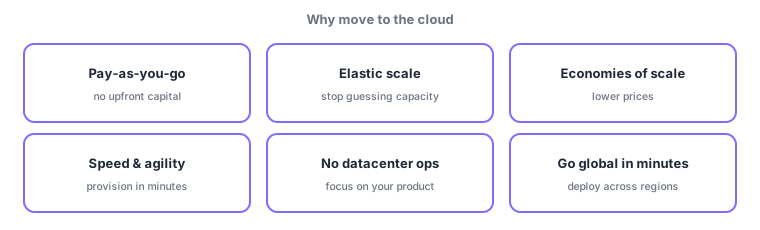
- Scalability/elasticity: scale capacity with demand. Scalability = planned growth; elasticity = automatic adjustment to load.
- Reliability/availability: redundancy makes it resilient and keeps services running; aids disaster recovery (DR).
- Security: providers invest heavily in security and certifications (under shared responsibility).
- Cost (CapEx → OpEx): shift upfront capital expense (CapEx) to pay-as-you-go operating expense (OpEx).
The cost essence of the cloud is shifting from CapEx (capital expense) to OpEx (operating expense). Traditionally you bought and owned servers upfront (CapEx), over-provisioning for peaks. The cloud is pay-as-you-go after use (OpEx), cutting upfront cost and avoiding waste even with unpredictable demand. Economies of scale from sharing huge infrastructure lower unit cost, and you’re freed from datacenter operations (power, cooling, hardware maintenance). These are also business reasons to choose Microsoft 365.
| Aspect | CapEx (traditional/own) | OpEx (cloud/pay-as-you-go) |
|---|---|---|
| Payment | Upfront (purchase) | Pay after use |
| Upfront cost | Large | Small |
| Capacity | Fixed for peak | Scales with demand |
| Operations | You maintain hardware | Provider handles it |
Scenario: a seasonal workload. With demand spiking only in peak season, you used to buy servers for the peak (CapEx) and leave them idle off-season. The cloud’s elasticity scales up only in peak and down off-season under pay-as-you-go (OpEx), cutting waste; redundancy adds reliability against outages. Microsoft 365 likewise scales licenses with headcount.
Watch the mix-ups: (1) CapEx (upfront/own) vs OpEx (pay-as-you-go)—the cloud leans OpEx. (2) Scalability (planned growth) vs elasticity (automatic adjustment to load)—related but distinct. (3) Cloud security is shared responsibility—not "all safe because the provider handles it."
Q. CapEx vs OpEx? CapEx is buying/owning upfront; OpEx is paying for what you use. Cloud leans OpEx with small upfront cost. Q. Scalability vs elasticity? Often used synonymously, but elasticity stresses "automatic scaling with load." Q. Economies of scale? Sharing huge infrastructure among many lowers unit cost.
Common: scalability/elasticity (scale with demand), reliability (redundancy keeps running), CapEx→OpEx (pay-as-you-go), economies of scale. The cloud handles unpredictable demand and cost optimization well; Microsoft 365 is SaaS leveraging these.
1.2.2Section summary
- Benefits: scalability/elasticity / reliability / security / cost (CapEx→OpEx) / economies of scale
- CapEx (upfront/own) → OpEx (pay-as-you-go) cuts upfront cost and waste
- Security is shared responsibility—not all-safe just because the provider handles it
Sign in to track progress — Log in.
Quick check
(just a quick review)Q1. Which cloud benefit lets you scale resources up or down with demand?
Q2. Which cloud trait shifts upfront CapEx to paying for what you use?
Q3. Which cloud benefit uses redundancy to stay resilient and keep services running?