

What's changed: Deepened MS-900 Chapter 1 to the AZ-900 baseline (service models IaaS/PaaS/SaaS + responsibility table, deployment models, M365=SaaS; cloud benefits + CapEx/OpEx table, economies of scale, elasticity; scenarios, FAQ, traps). Localized 3 figures
1.1Cloud Concepts and Service Models
Understand cloud computing basics, service models (IaaS/PaaS/SaaS), deployment models (public/private/hybrid), and how Microsoft 365 is a SaaS. The starting point for MS-900.
Cloud computing means renting IT resources—servers, storage, software—over the internet, paying for what you use, instead of owning and running them yourself. MS-900 (Microsoft 365 Fundamentals) is an entry-level credential testing the big picture of "what cloud and Microsoft 365 provide, and how you choose, secure, and license them," more than deep technical detail. As a starting point, grasp the service models (how it’s delivered) and deployment models (how it’s placed), and that Microsoft 365 is a SaaS (use finished apps as-is).
1.1.1Service models
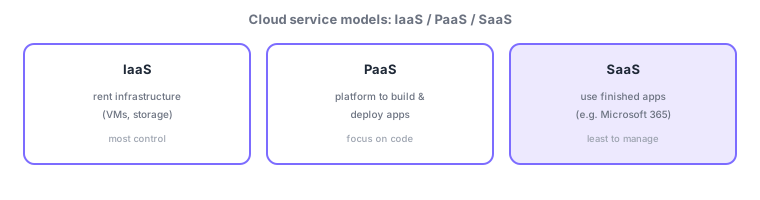
- IaaS: rent infrastructure like VMs and storage; most control.
- PaaS: rent a platform to build/deploy apps; focus on code.
- SaaS: use finished apps; Microsoft 365 is a prime example. Least to manage.
1.1.2Deployment models
The three service models line up by "how much you manage vs. hand to the provider." IaaS: you manage above the OS (most control, most effort); PaaS: the app-hosting platform is managed, you focus on code; SaaS: you just use the app (least to manage). The further down, the smaller the customer’s scope. Because Microsoft 365 is SaaS, you get email, docs, and meetings immediately without operating servers or apps.
| Model | You manage | Example |
|---|---|---|
| IaaS | OS, middleware, app, data | Azure VM |
| PaaS | App and data only | Azure App Service |
| SaaS | Mostly data, accounts, settings | Microsoft 365 |
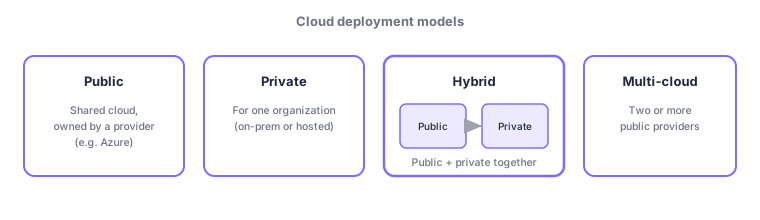
- Public cloud: a shared cloud owned by a provider; low-cost and quick to use (e.g., Microsoft 365).
- Private cloud: a cloud dedicated to one organization; more control/compliance but heavier to run.
- Hybrid cloud: combine public and private, choosing per requirement (also useful during migration).
Scenario: an SMB modernizing email. Instead of owning/operating mail servers (on-prem), migrate to SaaS Microsoft 365—freed from procurement, patching, and backups, with Exchange email and Teams meetings ready immediately. Some highly sensitive systems may stay on-prem (private), running hybrid.
Watch the mix-ups: (1) IaaS (rent infra) / PaaS (platform) / SaaS (finished app)—management shrinks downward. (2) Microsoft 365 is SaaS (not IaaS/PaaS). (3) Service model (delivery) and deployment model (public/private/hybrid) are different axes. (4) Even in SaaS, data, accounts, and access management remain the customer’s (shared responsibility).
Q. Why is Microsoft 365 SaaS? You use finished email/docs/meeting apps as-is, with no building/operating of servers or apps. Q. Service vs deployment model? Service model = "what you rent (IaaS/PaaS/SaaS)"; deployment model = "where it’s placed (public/private/hybrid)." Q. When is hybrid used? When keeping some systems on-prem, or during a phased cloud migration.
Common: IaaS = infrastructure, PaaS = platform, SaaS = finished apps, and Microsoft 365 is SaaS. Also: service model vs deployment model (public/private/hybrid) are different axes, and even in SaaS data/accounts are the customer’s responsibility.
1.1.3Section summary
- Service models: IaaS (infra) / PaaS (platform) / SaaS (finished apps)—less to manage downward
- Microsoft 365 is SaaS; deployment is public/private/hybrid (a different axis)
- Even in SaaS, data/accounts/access management are the customer’s (shared responsibility)
Sign in to track progress — Log in.
Quick check
(just a quick review)Q1. Which cloud service model is Microsoft 365?
Q2. Which service model rents infrastructure like VMs and storage?
Q3. Which deployment model combines public and private?