

What's changed: Deepened MLS-C01 Chapter 5 (output-loss pairing/Adam/training diagnosis, CNN/RNN/Transformer internals & task mapping, transfer-learning stages/Ground Truth/distributed training/mixed precision + tables, scenarios, FAQ, traps; ja figures)
5.3Transfer Learning and Tuning Deep Nets
Smart with little data—understand transfer learning/fine-tuning, SageMaker JumpStart, dropout/batch normalization, data augmentation, and early stopping.
Training from scratch needs lots of data and compute. With transfer learning, you fine-tune a pretrained model on a small dataset for efficiency.
5.3.1Transfer learning and regularization
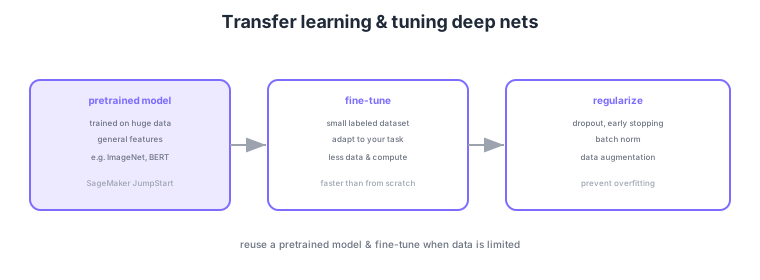
- Transfer learning/fine-tuning: adapt a pretrained model on small data; saves data/compute.
- SageMaker JumpStart: a hub of ready-to-use pretrained models and solutions.
- Dropout/batch norm: reduce overfitting and stabilize training in deep nets.
- Data augmentation/early stopping: augment data (rotate/flip images), stop early when validation worsens.
Common on MLS-C01: little labeled data = transfer learning/fine-tuning (JumpStart), deep-net overfitting = dropout/data augmentation/early stopping, and stabilize training = batch normalization. "High accuracy with little data" → use a pretrained model.
Continue reading — free sign-up
You're reading the free preview. Sign up free to read this section in full, plus every chapter (including 4+) and all questions.