

What's changed: Deepened MLS-C01 Chapter 5 (output-loss pairing/Adam/training diagnosis, CNN/RNN/Transformer internals & task mapping, transfer-learning stages/Ground Truth/distributed training/mixed precision + tables, scenarios, FAQ, traps; ja figures)
5.2Deep Learning Architectures
Architectures by data—understand CNN (images), RNN/LSTM (sequences), Transformer (language), and choosing by use case. Pick architecture by the nature of the data.
In deep learning, choose an architecture that matches the data. Images, sequences, and language each have canonical choices.
5.2.1Choosing an architecture
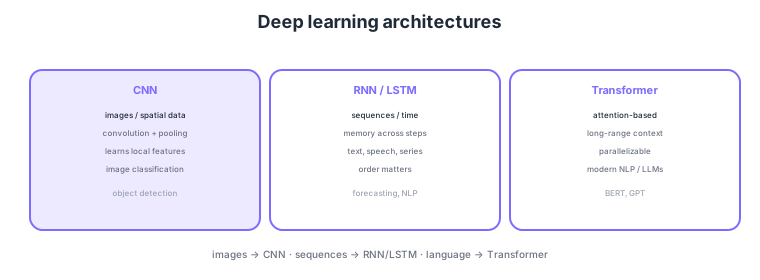
- CNN: images/spatial data. Convolutions learn local features. Image classification/object detection.
- RNN/LSTM: sequences/time series. Memory across steps; for text, speech, and series.
- Transformer: language. Attention captures long-range context and parallelizes well (BERT/GPT).
- Guideline: images → CNN, sequences → RNN/LSTM, language → Transformer.
Common on MLS-C01: image recognition = CNN, sequential/time-series data = RNN/LSTM, and long-range language context = Transformer (attention). Map quickly: images → CNN, order-dependent → RNN/LSTM.
Continue reading — free sign-up
You're reading the free preview. Sign up free to read this section in full, plus every chapter (including 4+) and all questions.