

What's changed: Revamped AZ-900 Chapter 4 to the new depth and added security coverage (Zero Trust/defense in depth/Defender for Cloud/RBAC/external ID) to the identity section
4.2Identity, Access, and Security
Centered on Microsoft Entra ID: authentication vs authorization, MFA/SSO/passwordless, Conditional Access, RBAC, external ID, Entra ID vs AD DS, plus security basics—Zero Trust, defense in depth, and Microsoft Defender for Cloud.
The foundation of secure cloud use is identity. We have shifted from defending at the perimeter (the corporate network) to "identity is the new perimeter." This section covers identity management (authentication, authorization, Entra ID, RBAC) and the surrounding security mindset (Zero Trust, defense in depth, Defender for Cloud) together.
4.2.1Authentication and authorization
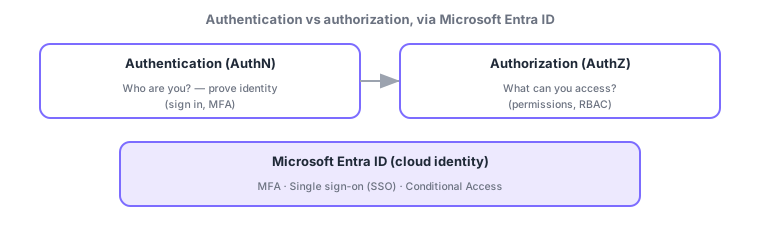
Authentication (AuthN, "who you are") and authorization (AuthZ, "what you can access") are different concepts. The order is always authenticate → authorize: confirm identity first, then decide "may you act on this resource." Exams frequently swap these two terms in options.
| Aspect | Authentication | Authorization |
|---|---|---|
| Question | Who are you? | What can you do? |
| Means | Sign-in, MFA, passkeys | RBAC, role assignment |
| Order | First | Second |
Use Azure Key Vault to protect secrets. Centrally and securely manage API keys, connection strings, certificates, and encryption keys; apps and services retrieve them via managed identity instead of hard-coding secrets, with access controlled by Microsoft Entra ID and RBAC.
4.2.2Microsoft Entra ID and stronger authentication
- Microsoft Entra ID (formerly Azure AD): the cloud identity/access management service that manages sign-in for users, groups, and apps.
- Multi-factor authentication (MFA): strengthens identity proof with a second factor (phone approval, code, etc.) beyond a password.
- Passwordless: sign in more securely without a password at all, using passkeys, Windows Hello, or the Authenticator app.
- Single sign-on (SSO): sign in once to access many services.
- Conditional Access: grants or challenges access based on conditions like location, device, or risk (e.g., require MFA off-network).
- External ID (B2B/B2C): handles external users such as partners (B2B) and customers (B2C).
4.2.3Authorization in practice: RBAC
Authorization is implemented by RBAC (role-based access control): grant permissions by assigning "to whom (user/group), which role (Reader/Contributor/Owner, etc.), at what scope (the previous chapter scopes: management group down to resource)." The principle is least privilege—give the right people the right access at the right scope, no more. Assignments inherit down the scope, so broad roles applied high can over-grant.
4.2.4Entra ID vs on-premises AD DS
Microsoft Entra ID is a cloud identity service for web/SaaS apps and devices, using modern protocols (OAuth/OpenID Connect/SAML). Active Directory Domain Services (AD DS) is the on-premises domain (managing in-house PCs/servers with Kerberos/LDAP). They are different: Entra ID is not domain-join or Group Policy. In hybrid setups, Entra Connect synchronizes and links them.
4.2.5Security mindset
Zero Trust is the modern principle of "never trust, always verify." Do not implicitly trust traffic just because it is inside the corporate network; verify identity, device, and context on every access (Conditional Access and MFA are implementations). Its companion is defense in depth—layering protections so that if one is breached, the next still holds.
| Layer | What it guards / example |
|---|---|
| Identity & access | MFA, Conditional Access, least privilege |
| Perimeter & network | DDoS protection, NSG/firewall |
| Compute & app | Patching, vuln fixes, endpoint protection |
| Data | Encryption (at rest/in transit), access control |
Tying this together for visibility and hardening is Microsoft Defender for Cloud. It scores your resources security posture (Secure Score), detects misconfigurations and threats, and recommends fixes. Its role is to continuously assess the portion you own under the shared responsibility model (configuration, identity, data, and so on) and surface prioritized remediations.
Scenario: defending against unauthorized sign-ins. Require MFA for all users and use Conditional Access to add verification "from unfamiliar locations/devices" (Zero Trust). Grant admin rights via RBAC only to the right people at the right scope (least privilege). Continuously watch overall posture with Defender for Cloud Secure Score. Layered protection.
Watch the mix-ups: (1) authentication (who) vs authorization (what)—order is authn → authz. (2) Entra ID (cloud identity) vs AD DS (on-prem domain) are different (Entra ID is not domain-join/Group Policy). (3) MFA (stronger proof) vs SSO (one sign-in for many) point in opposite directions.
Q. Do Zero Trust and defense in depth conflict? No—they complement each other. Zero Trust is the policy of "verify every time, even inside," and defense in depth is the posture of "layer protections." You apply Zero Trust thinking across each defense-in-depth layer (identity, network, data, etc.).
Common points: authn = who / authz = what, Entra ID = cloud identity (MFA/SSO/passwordless/Conditional Access), Entra ID ≠ AD DS, RBAC = grant by role (least privilege, scope inheritance), and Zero Trust = always verify / defense in depth = layered / Defender for Cloud = posture visibility and hardening.
4.2.6Section summary
- Authenticate (who) → authorize (what); authorization is implemented by RBAC (least privilege, scope inheritance)
- Entra ID = cloud identity: MFA/SSO/passwordless/Conditional Access/external ID; ≠ AD DS (on-prem)
- Zero Trust = always verify / defense in depth = layered / Defender for Cloud = score and harden posture
Sign in to track progress — Log in.
Quick check
(just a quick review)Q1. Which decides "what you can access" (permissions)?
Q2. Which lets you sign in once to use multiple services?
Q3. Which correctly describes Microsoft Entra ID?
Q4. Which security principle means "never trust, always verify"?
Q5. Which Azure service scores security posture and detects misconfigurations/threats to recommend fixes?
Q6. Which best states a principle of RBAC (role-based access control)?
Keep track of your progress
The full study guide is free to read. Sign up free to practice with the question bank, track what you have read, review your mistakes, and highlight passages.