

What's changed: Deepened AZ-305 Chapter 2 (added comparison tables, scenarios, FAQs, exam traps, deep-dive paragraphs to each section; localized figures to Japanese)
2.3Designing Data Integration, Analytics, and Protection
Understand using and protecting data—Data Lake Storage, Synapse Analytics, Data Factory, caching (Azure Cache for Redis), and encryption (at rest/in transit). Integrate/analyze data and keep it secure.
Turn data into value via integration and analytics, and protect it with encryption. Data Factory ingests; Synapse analyzes.
2.3.1Integration, analytics, and protection
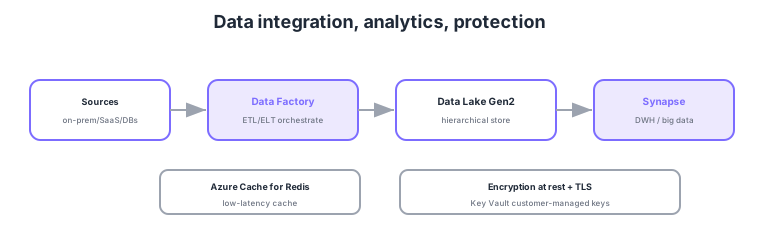
- Data Factory: orchestrate ETL/ELT to ingest and transform data.
- Data Lake Storage Gen2: large-scale hierarchical data lake (on Blob).
- Synapse Analytics: unified data warehouse/big-data analytics.
- Redis cache/encryption: Azure Cache for Redis for low latency, protected by at-rest encryption + TLS.
Common on AZ-305: ingest/ETL orchestration = Data Factory, data lake = Data Lake Storage Gen2, DWH/big-data analytics = Synapse Analytics, low-latency cache = Azure Cache for Redis, at-rest key management = Key Vault (customer-managed keys). Storage is encrypted at rest by default.
AZ-305 data-utilization design centers on "connecting ingest → store → analyze → serve with services that fit requirements." Azure Data Factory orchestrates ETL/ELT from diverse sources in pipelines, with codeless mapping data flows and schedule/event triggers (combine with Stream Analytics or Event Hubs for real time). Storage standardizes on Data Lake Storage Gen2 (hierarchical namespace on Blob, ideal for large-scale analytics), and Synapse Analytics unifies dedicated SQL pools (DWH), serverless SQL, and Spark—with Microsoft Fabric (OneLake/Direct Lake) now also an option. For performance, Azure Cache for Redis caches hot data to cut DB load and latency, combined with Front Door/CDN to accelerate delivery. Protection is layered: Storage is encrypted at rest (SSE) by default, with Key Vault customer-managed keys (CMK) for stricter control, TLS in transit, private endpoints to limit exposure, and RBAC + managed identities for access. Classify and protect sensitive data with Microsoft Purview governance. The key is to build a pipeline and protection that are neither over- nor under-engineered, considering batch vs stream, scale, latency, cost, and regulation.
| Stage | Service | Key point |
|---|---|---|
| Ingest/transform | Data Factory | ETL/ELT orchestration; triggers |
| Store (data lake) | Data Lake Storage Gen2 | Hierarchical namespace; analytics-scale |
| Analyze (DWH/big data) | Synapse Analytics | SQL pool/serverless/Spark unified |
| Speed/protect | Redis; SSE/CMK; TLS | Cache + layered encryption + private endpoints |
Scenario: Ingest on-prem DB and SaaS data nightly, aggregate into a data lake, and run BI analytics. Sensitive data requires self-managed encryption keys. → Schedule ingestion with Data Factory pipelines into Data Lake Storage Gen2, analyze with Synapse Analytics. Encrypt Storage with Key Vault customer-managed keys (CMK), access via managed identity + RBAC, and keep traffic private with private endpoints.
FAQ: At-rest encryption is default—why use Key Vault CMK? Azure Storage is encrypted by default with platform-managed keys (PMK), sufficient for many requirements. When regulation/compliance requires self-controlling key lifecycle, revocation, and audit, switch to Key Vault customer-managed keys (CMK). The difference is "who manages the keys."
Exam trap: Handling real-time stream processing with Data Factory alone is a weak design. Data Factory is mainly batch/scheduled ETL orchestration; low-latency streams suit Stream Analytics / Event Hubs. Also, don’t solve "analytics speed-up" via a storage-tier choice—the cache layer is Azure Cache for Redis.
2.3.2Section summary
- Integrate/analyze = Data Factory + Data Lake Gen2 + Synapse
- Speed = Redis / protect = at-rest encryption + Key Vault + TLS
Sign in to track progress — Log in.
Quick check
(just a quick review)Q1. You want to orchestrate pipelines that ingest/transform data from diverse sources. What?
Q2. Which analytics platform unifies data warehousing and big-data analytics?
Q3. You want to cache hot data in front of a database to cut read latency. What?
Keep track of your progress
The full study guide is free to read. Sign up free to practice with the question bank, track what you have read, review your mistakes, and highlight passages.