

What's changed: Deepened AI-900 Chapter 1 to the AZ-900 baseline (AI⊃ML⊃deep learning, prebuilt vs custom delivery table, per-principle Azure tools table, how bias arises, FAQ and extra quizzes)
1.2Principles of Responsible AI
Understand Microsoft’s six Responsible AI principles—fairness, reliability & safety, privacy & security, inclusiveness, transparency, and accountability—and the Azure features/tools that support each, for using AI safely, fairly, and transparently.
AI is powerful but carries risks like bias, errors, privacy harm, and misuse. Microsoft defines six Responsible AI principles as guidance for using AI soundly. These are not just abstract ideals—Azure ships concrete tools and features that support each. For AI-900, you must know each principle’s meaning and which situation maps to which principle.
1.2.1The six principles
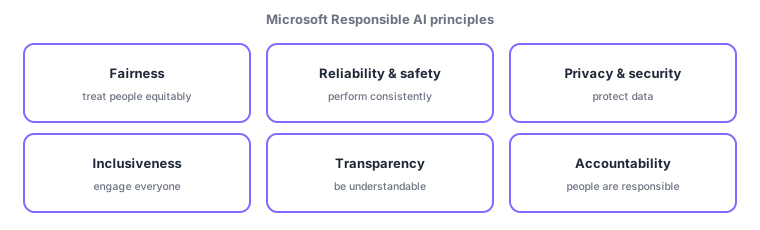
- Fairness: avoid unfair bias against particular groups (e.g., no disparity by gender/race).
- Reliability & safety: operate consistently and safely, even with unexpected input (e.g., safe behavior in autonomous driving).
- Privacy & security: protect personal data and handle it securely.
- Inclusiveness: ensure everyone (regardless of ability, etc.) can benefit and participate.
- Transparency: make how the AI works, its capabilities, and its limits understandable (e.g., explain decisions).
- Accountability: have governance so people/organizations are responsible for AI outcomes.
| Principle | Keyword | Example |
|---|---|---|
| Fairness | Avoid bias | Hiring AI not biased by gender |
| Reliability & safety | Safe, consistent | No runaway on odd input |
| Privacy & security | Protect data | Anonymize/protect PII |
| Inclusiveness | Everyone | Accessible via speech/captions |
| Transparency | Explainable | Explain why a decision was made |
| Accountability | Human responsibility | Org owns the outcomes |
1.2.2Why bias arises
Fairness gets special attention because AI bias arises from bias in the training data itself. If past hiring data skews toward certain attributes, an AI trained on it reproduces that skew. This is not the AI being "malicious"—it faithfully learns the bias it was given. That is why you must check the representativeness of training data and continuously monitor outcomes. Likewise, errors and privacy harms are treated as "things that can happen in operation" and mitigated by design—the essence of Responsible AI.
1.2.3Azure features that support each principle
| Principle | Azure support (examples) |
|---|---|
| Fairness | Responsible AI dashboard (fairness assessment) / Fairlearn |
| Reliability & safety | Error analysis, testing/monitoring |
| Privacy & security | Data encryption, access control, differential privacy |
| Inclusiveness | Speech-to-text, text-to-speech, captions, Immersive Reader |
| Transparency | Model interpretability (InterpretML) / transparency notes |
| Accountability | Governance, audit logs, human final approval |
Q. Transparency vs accountability? Transparency is that the workings/reasons are understandable (explainability); accountability is that people/orgs take responsibility and govern outcomes. Q. Fairness vs inclusiveness? Fairness is "no unfair disparity for some groups"; inclusiveness is "everyone can use it regardless of ability (accessibility)." One avoids bias; the other ensures everyone can participate.
Scenario: deploying a diagnostic-support AI. Protect patient data (privacy & security), validate to avoid misdiagnosis (reliability & safety), check accuracy does not drop for some races (fairness), show reasoning to physicians (transparency), keep final decision/responsibility with the physician (accountability), and make it usable by visually impaired physicians (inclusiveness). All six apply.
Watch the mix-ups: (1) fairness (avoid bias) vs inclusiveness (everyone can use it = accessibility). (2) transparency (understandable/explainable) vs accountability (people responsible/governance). (3) reliability & safety (safe, consistent) vs privacy & security (protect data). Linking keywords prevents confusion.
Questions often map a principle → example. E.g., fairness (no gender bias), transparency (explain decisions), privacy & security (protect PII), accountability (humans own outcomes), inclusiveness (usable regardless of ability), reliability & safety (safe on unexpected input).
1.2.4Section summary
- Responsible AI = guidance for using AI safely, fairly, and transparently
- Six principles: fairness / reliability & safety / privacy & security / inclusiveness / transparency / accountability
- Bias arises from biased training data → check representativeness and monitor continuously
- The exam centers on principle → example; link keywords (fairness = bias / transparency = explain / accountability = human responsibility)
Sign in to track progress — Log in.
Quick check
(just a quick review)Q1. Ensuring a hiring AI is not biased against a gender relates most to which Responsible AI principle?
Q2. Letting users understand why an AI reached a decision corresponds to which principle?
Q3. Which principle states that people are ultimately responsible for AI outcomes?
Q4. Ensuring everyone—regardless of ability—can use an AI service is which principle?
Q5. Ensuring an AI behaves safely and consistently even with unexpected input is which principle?
Q6. What is the most common cause of bias in an AI model?