

What's changed: Deepened AI-900 Chapter 1 to the AZ-900 baseline (AI⊃ML⊃deep learning, prebuilt vs custom delivery table, per-principle Azure tools table, how bias arises, FAQ and extra quizzes)
1.1AI Workloads and Their Types
Understand what AI is, the relationship among AI/ML/deep learning, the common AI workloads on Azure—machine learning, computer vision, NLP, document intelligence, knowledge mining, and generative AI—and how Azure delivers them as prebuilt or custom services. The starting point for AI-900.
AI (Artificial Intelligence) is an umbrella term for software that performs tasks normally requiring human intelligence—learning, prediction, recognition, and language understanding. AI-900 is the entry-level credential: it asks for no deep math or programming. Instead it expects a map of which technique solves which problem with which service. The key skill is choosing the right workload and service from a scenario.
1.1.1AI, machine learning, and deep learning
First, the nesting. AI is the broadest concept; inside it sits machine learning (ML); inside ML sits deep learning. AI is "software that behaves intelligently," ML is "techniques that learn rules from data," and deep learning is "ML using multi-layer neural networks." Most of today’s image recognition, speech recognition, and generative AI rest on deep learning. For AI-900, remember that ML is the foundation running inside many workloads (computer vision, NLP, generative AI).
1.1.2Common AI workloads
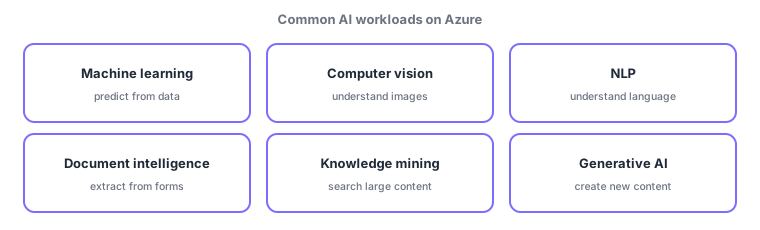
- Machine learning: learn patterns from data to make predictions—the foundation of AI, used inside many other workloads.
- Computer vision: analyze images/video to recognize objects, faces, and text (OCR).
- Natural language processing (NLP): understand the meaning, sentiment, and intent of text; translate, summarize, and recognize speech.
- Document intelligence: extract fields (amounts, dates, etc.) from invoices, receipts, and forms.
- Knowledge mining: extract and index information from large document sets to make it searchable (Azure AI Search).
- Generative AI: generate new content—text, images, code (via large language models, etc.).
It helps to organize these workloads by the type of input data they handle: images/video → computer vision and document intelligence; language (text/speech) → NLP; tabular numeric data for prediction → machine learning; large document sets to make searchable → knowledge mining; creating new content → generative AI. The exam asks you to judge the workload from both the input and the goal.
| Scenario (example) | Workload | Example Azure service |
|---|---|---|
| Predict sales numbers | Machine learning | Azure Machine Learning |
| Recognize objects/text in photos | Computer vision | Azure AI Vision |
| Detect sentiment/intent in text | NLP | Azure AI Language |
| Extract amounts from invoices | Document intelligence | Azure AI Document Intelligence |
| Search across internal docs | Knowledge mining | Azure AI Search |
| Draft an email | Generative AI | Azure OpenAI Service |
1.1.3How Azure delivers workloads (prebuilt vs custom)
Azure delivers AI in two broad ways. One is Azure AI services (formerly Cognitive Services): Microsoft provides pretrained models as APIs. With a key and endpoint you can call image recognition, translation, sentiment analysis, and more—no data collection or training needed. The other is Azure Machine Learning, a platform to train and deploy your own custom models from your data. The rule of thumb: common generic tasks → prebuilt (Azure AI services); company-specific prediction → custom (Azure ML). Custom Vision is a middle option: train only your own images within a prebuilt framework.
| Aspect | Prebuilt (Azure AI services) | Custom (Azure Machine Learning) |
|---|---|---|
| Training data | Not needed (pretrained) | You provide it and train |
| How to use | Call API with key + endpoint | Train → evaluate → deploy workflow |
| Best for | Generic tasks (translation, sentiment, OCR) | Company-specific prediction/classification |
| Expertise | Low (ready to use) | Higher (data-science skills) |
These workloads are not isolated—they combine. For example, knowledge mining makes information extracted by computer vision (OCR) or NLP searchable, and machine learning runs inside many workloads. One scenario does not always map to a single workload.
Scenario: automating insurance claims. Extract fields from paper forms with document intelligence → assess damage in attached photos with computer vision → classify message urgency with NLP → search past cases with knowledge mining → draft a reply with generative AI. Multiple workloads chain together to automate one process.
Watch the mix-ups: (1) computer vision (images) vs document intelligence (structured extraction from forms)—both take images, but the latter specializes in field extraction. (2) knowledge mining (make existing docs searchable) vs generative AI (create new content). (3) OCR (text recognition) is a computer-vision capability. (4) Do not confuse a workload (what you do) with a service (product name).
Q. ML vs generative AI? Classic ML (classification/regression) aims to pick an existing answer / estimate a number; generative AI aims to create new content. Both use trained models, but the output differs—label/number vs text/image. Q. Azure AI services or Azure ML? Use the former for ready-made generic tasks; the latter when you need a custom model from your own data.
Questions often map a scenario → the right workload. E.g., "identify products in a photo" = computer vision; "detect sentiment in a message" = NLP; "extract amounts from invoices" = document intelligence; "search across internal docs" = knowledge mining; "draft an email" = generative AI. Some also ask you to pick Azure AI services ("no training data, generic task") vs Azure Machine Learning ("build a predictive model from your own data").
1.1.4Section summary
- AI = software performing human-like intelligent tasks; AI ⊃ machine learning ⊃ deep learning
- Key workloads: ML / computer vision / NLP / document intelligence / knowledge mining / generative AI
- Delivery: prebuilt = Azure AI services (generic, no training) / custom = Azure Machine Learning (train on your data)
- The exam centers on scenario → workload (→ service); workloads combine
Sign in to track progress — Log in.
Quick check
(just a quick review)Q1. Which AI workload best fits automatically identifying objects in a photo?
Q2. Which AI workload fits detecting the sentiment (positive/negative) of a support email?
Q3. Which AI workload creates new content such as text or images?
Q4. Which workload best fits extracting fields like amounts and dates from invoices and receipts?
Q5. Which workload indexes large document sets to enable cross-document search?
Q6. Which correctly describes the nesting of AI, machine learning, and deep learning?
Q7. With no training data, to use generic translation or sentiment analysis immediately via API, which fits best?