

What's changed: Deepened AI-900 Chapter 2 to the AZ-900 baseline (features/labels/generalization/overfitting, deep learning = multi-layer NN, metrics accuracy/precision/recall/confusion matrix, workspace, FAQ)
2.1Types of Machine Learning
Understand the basics of machine learning and the difference between supervised learning (regression, classification) and unsupervised learning (clustering).
Machine learning (ML) learns patterns from data to make predictions on new data. Instead of coding every rule, you teach it with examples (data). The inputs are called features, and the known answers in supervised learning are labels. For AI-900, you must map a goal → the right learning type.
2.1.1Types of learning
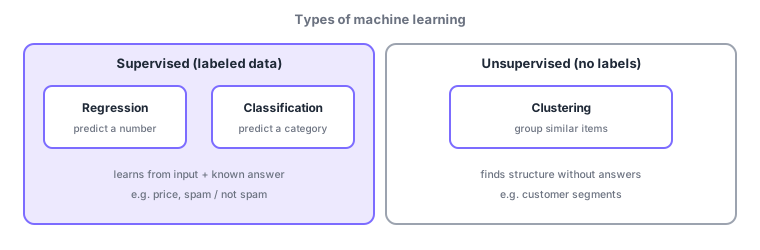
- Supervised: learn from labeled data. Regression predicts a number (continuous) (e.g., price, temperature); classification predicts a category (e.g., spam or not, dog or cat).
- Unsupervised: find structure in unlabeled data. Clustering groups similar items (e.g., customer segmentation).
- Reinforcement learning: learn good actions from rewards through trial and error (e.g., games, robotics).
- Deep learning: uses multi-layer neural networks; strong on complex data like images, audio, and language (the basis of generative AI).
| Type | Data | Output | Example |
|---|---|---|---|
| Regression | Labeled | Number (continuous) | Predict price/sales |
| Classification | Labeled | Category | Spam detection, image class |
| Clustering | Unlabeled | Groups | Customer segmentation |
| Reinforcement | Rewards | A policy/actions | Games, control |
2.1.2How learning works: features, labels, and generalization
In supervised learning, each example is a pair of features (inputs) and a label (answer). For house-price prediction, size, age, and distance to a station are features, and the actual price is the label. The model learns the relationship between features and labels from many examples, aiming for rules that also hold on new, unseen data—called generalization. So you split data into training and evaluation sets and measure on the held-out (not-used-for-training) data. Fitting the training data too closely and then missing on new data is overfitting, the failure to watch most in ML.
Deep learning stacks neural networks (mathematical models loosely inspired by brain neurons) into many layers. Depth lets it progressively extract useful patterns even from complex data like image pixels or word sequences. The high accuracy of today’s computer vision, speech recognition, and generative AI rests largely on deep learning. For AI-900 it is enough to know "deep learning = multi-layer neural nets, strong on complex data"; no math is tested.
Tell regression from classification by "number vs. category." "Next month’s sales (amount)" is regression; "is this image a dog or a cat" is classification. Both regression and classification are supervised (need labels); clustering is unsupervised (no labels).
Scenario: choose the type by goal. "Predict house prices" → regression; "decide if a transaction is fraud" → classification; "group customers by buying behavior" → clustering (unlabeled); "learn the best restocking actions" → reinforcement learning. First check for labels, then whether the output is a number or a category.
Watch the mix-ups: (1) regression (number) vs classification (category)—both supervised; tell apart by output type. (2) classification (labeled, assign to known categories) vs clustering (unlabeled, discover natural groups)—tell apart by labels. (3) Do not confuse features (inputs) with labels (answers).
Q. Classification vs clustering? Both look like "grouping," but classification assigns items to predefined categories (labels)—supervised; clustering discovers natural groups without labels—unsupervised. "Sort into dog/cat (categories known)" is classification; "group customers by behavior (categories unknown)" is clustering. Q. Features vs labels? Features are inputs to the model; labels are the known answers in supervised learning.
Questions often map a scenario → learning type. Predict a number = regression, assign a category = classification, group without labels = clustering, learn actions via rewards = reinforcement. Both regression and classification are supervised.
2.1.3Section summary
- ML = learn from data (features) to predict on new data; answers = labels
- Supervised: regression (number), classification (category) / Unsupervised: clustering (grouping)
- Also reinforcement (rewards) and deep learning (neural nets); tell apart by labels + output type
Sign in to track progress — Log in.
Quick check
(just a quick review)Q1. Which type of ML fits predicting next month’s sales amount from past data?
Q2. Sorting email into "spam" or "not spam" is which type of ML?
Q3. Which technique finds "groups of similar customers" from unlabeled data?
Q4. In supervised learning, what is the term for the "known answer" given to the model?
Q5. Which ML learns good actions from rewards through trial and error?