

What's changed: Deepened AI-102 Chapter 5 (ja figures; comparison tables/scenarios/FAQ/traps/deep paragraphs in all sections)
5.1Azure OpenAI, Prompts, and RAG
Understand Azure OpenAI Service for using large language models on Azure, prompt engineering, and RAG (retrieval-augmented generation) for answers grounded in your own data—the core of building generative AI.
Azure OpenAI Service lets you use large language models like GPT under enterprise security/compliance. Output quality is improved via prompts and grounding data (RAG).
5.1.1Generative AI building blocks
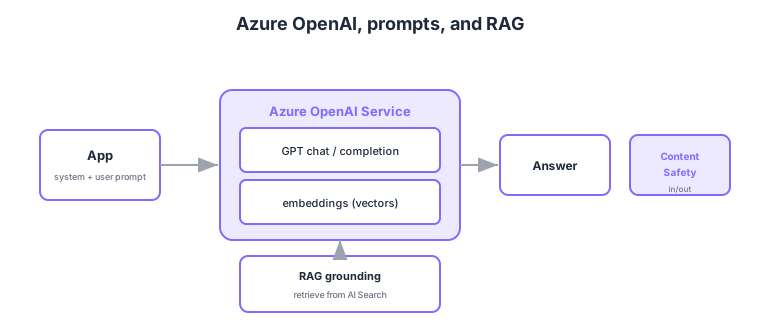
- Azure OpenAI: deploy and call GPT-family models—chat/completion, embeddings, images—via API.
- Prompt engineering: set role/constraints with a system prompt and steer output with few-shot examples.
- RAG: retrieve relevant data (vector/semantic search) and pass it to the prompt as grounding.
- Parameters: tune output diversity/determinism with temperature, etc.
Common on AI-102: enterprise GPT = Azure OpenAI Service, set role/constraints = system prompt, answers grounded in your data = RAG (retrieval + prompt), embeddings = vectorization (for similarity search). To reduce hallucinations, ground with RAG.
Continue reading — free sign-up
You're reading the free preview. Sign up free to read this section in full, plus every chapter (including 4+) and all questions.