

What's changed: Deepened AI-102 Chapter 3 (ja figures; comparison tables/scenarios/FAQ/traps/deep paragraphs in all sections)
3.1Text Analysis with Azure AI Language
Understand the pre-built features of Azure AI Language that extract meaning from text—sentiment analysis, key phrase extraction, named entity recognition (NER), language detection, PII detection, and summarization. The basis of NLP.
Azure AI Language automatically extracts sentiment, keywords, named entities, and more from text like reviews and inquiries. Most features are pre-built—just call the API.
3.1.1Text analysis features
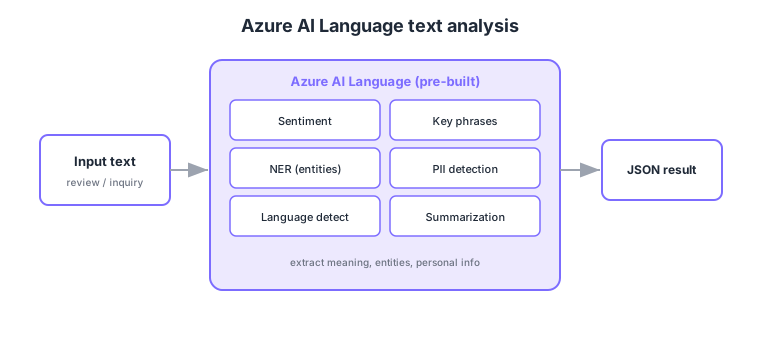
- Sentiment analysis: classify positive/negative/neutral with confidence (opinion mining too).
- Key phrase extraction / language detection: extract key terms; auto-detect the input language.
- NER / PII detection: extract persons/locations/orgs/dates; detect and mask personally identifiable information.
- Summarization: condense long text via extractive/abstractive summaries.
Common on AI-102: positive/negative = sentiment analysis, key terms = key phrase extraction, persons/locations = NER, detect/mask personal info = PII detection, auto language = language detection. These are pre-built; custom classification uses Conversational/Custom in the next section.
Azure AI Language has both pre-built and custom families. Pre-built includes sentiment analysis (with sentence/aspect opinion mining), key phrase extraction, language detection, NER, PII detection (detect by category and mask/redact), entity linking (disambiguate to Wikipedia, etc.), summarization (extractive = pick key source sentences / abstractive = paraphrase and generate), and Text Analytics for health. Custom includes custom text classification (single/multi-label), custom NER, Conversational Language Understanding (CLU), and custom Question Answering—all trained from labeled data. APIs split into synchronous (short text) and asynchronous (bulk/long analysis jobs), and you can bundle multiple analyses in one request. Sentiment returns document- and sentence-level scores, with thresholds deciding positive/negative. Choose by use: “sort into custom categories” = custom text classification, “understand intent” = CLU, “FAQ-style Q&A” = Question Answering.
| Goal | Feature | Type |
|---|---|---|
| Positive/negative | Sentiment (+ opinion mining) | Pre-built |
| Detect/mask PII | PII detection | Pre-built |
| Condense long text | Summarization (extractive/abstractive) | Pre-built |
| Sort into custom categories | Custom text classification | Custom |
Scenario: gauge inquiry emails as positive/negative, redact personal info in the body, and summarize long ones for staff. → Use sentiment analysis to score, PII detection to mask personal info, and summarization (extractive/abstractive) to condense. All pre-built, bundleable into one async request.
FAQ: Q. Extractive vs abstractive summarization? → A. Extractive picks key source sentences as-is; abstractive paraphrases and generates new text. Q. Sentiment vs custom text classification? → A. Sentiment is pre-built with fixed labels (positive/negative); to sort by custom labels (e.g., inquiry type), use custom text classification.
Trap: “use sentiment analysis for custom categorization” is wrong—sentiment has fixed labels (positive/negative); custom categories need custom text classification. Also “NER and PII detection are the same” is wrong—NER is general entities; PII focuses on personal info for detection/masking.
3.1.2Section summary
- Language = sentiment/key phrase/NER/PII/language detection/summarization (pre-built)
- Extract meaning, entities, and personal info from text
Sign in to track progress — Log in.
Quick check
(just a quick review)Q1. You want to classify product reviews as positive/negative with confidence. Which Azure AI Language feature?
Q2. You want to extract entities like persons, locations, orgs, and dates from text. Which feature?
Q3. You want to detect and mask personally identifiable information (PII) in text. Which feature?