

What's changed: Deepened AI-102 Chapter 2 (ja figures; comparison tables/scenarios/FAQ/traps/deep paragraphs in all sections)
2.2Custom Vision and Face Analysis
Understand Custom Vision for training your own image classification/object-detection models, and Azure AI Face for face detection, attributes, and matching. Use custom models when pre-built isn’t enough.
For custom classifications pre-built models can’t handle (e.g., your product types), train your own with Custom Vision. For face-specific processing, use Face.
2.2.1Custom models and face analysis
When you need model training on your own data, fine-tuning, or MLOps, use Azure Machine Learning. Whereas Azure AI services provide prebuilt APIs, Azure Machine Learning handles the custom-model lifecycle with training jobs, pipelines, and model management.
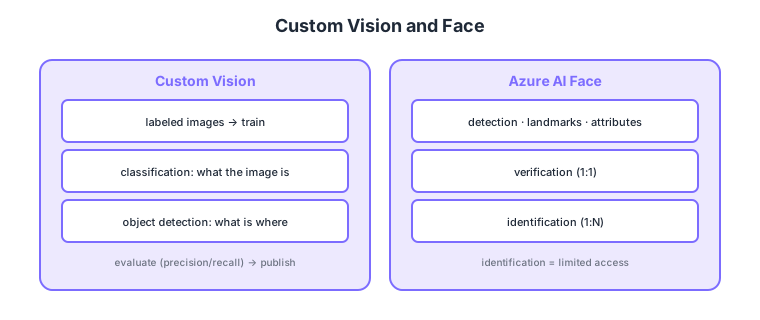
- Custom Vision: train a custom image-classification/object-detection model from labeled images, evaluate, and publish.
- Classification vs object detection: classification = "what the image is"; object detection = "what is where (with location)."
- Face: face detection, landmarks, attributes, plus verification (1:1) and identification (1:N).
- Responsible use: some Face features (e.g., identification) are limited access, requiring use-case application/approval.
Common on AI-102: train custom classification/detection = Custom Vision, what the image is = classification, what is where = object detection, face detection/attributes/verification (1:1)/identification (1:N) = Face, face identification is limited access. Use AI Vision when pre-built suffices, Custom Vision for custom needs.
Custom Vision can reach usable accuracy from few images via transfer learning, but verify quality with metrics (precision/recall).
Custom Vision splits into a training resource and a prediction resource, and uses transfer learning so labeled images can reach usable accuracy from small data (object detection needs bounding box annotations per image). After training, check quality with precision, recall, and mAP, publish an iteration (a trained version) for the prediction API, and optionally export (ONNX/TensorFlow for edge). Improve misclassifications by adding data and retraining. Face, meanwhile, offers detection (attributes like age/expression/head pose/accessories, plus landmarks), 1:1 verification, 1:N identification, grouping, and liveness (anti-spoofing). Sensitive features (identification, liveness, etc.) are limited access, requiring use-case application/approval, and some attributes (age, gender) have been scaled back for Responsible AI. Choose: “pre-built suffices → AI Vision,” “need custom classification/detection → Custom Vision,” “face-specific → Face.”
| Need | Service | Point |
|---|---|---|
| General objects/tags/text | Azure AI Vision (pre-built) | No training, ready to use |
| Custom-category classify/detect | Custom Vision | Train from labeled images, publish |
| Face detect/verify/identify | Azure AI Face | Identification etc. is limited access |
Scenario: from production-line camera images, distinguish your parts A/B/C and indicate defects by location. → Custom categories pre-built can’t handle, so train Custom Vision object detection on labeled images. Evaluate with precision/recall, publish the iteration for the prediction API, and export to ONNX if edge inference is needed.
FAQ: Q. Classification vs object detection in Custom Vision? → A. If you only need “what the whole image is,” classification; if you need “what is where (location),” object detection (requires bounding-box annotations). Q. Why can’t I use Face identification immediately? → A. Sensitive features like identification are limited access, requiring use-case application/approval.
Trap: “use Custom Vision for general objects/tags” is usually wrong—pre-built AI Vision suffices for general cases; Custom Vision is for custom categories. Also “Face identification (1:N) is freely usable without application” is wrong—it’s limited access requiring approval.
2.2.2Section summary
- Custom Vision = train custom image classification/object detection
- Face = face detection/attributes/verification (1:1)/identification (1:N) (identification is limited)
Sign in to track progress — Log in.
Quick check
(just a quick review)Q1. You want to train a custom model from labeled images to recognize your product types. What do you use?
Q2. Which correctly distinguishes image classification from object detection?
Q3. You want to verify (1:1) whether two face images are the same person. Which service?