

What's changed: Deepened AI-102 Chapter 3 (ja figures; comparison tables/scenarios/FAQ/traps/deep paragraphs in all sections)
3.2Conversational Language, Translation, and Speech
Understand Conversational Language Understanding (CLU) for intent/entity prediction, Translator for text/document translation, and Azure AI Speech for speech-to-text and text-to-speech. Applied NLP for dialogue, multilingual, and voice.
CLU, Translator, and Speech understand a user’s intent, translate across languages, and transcribe speech, respectively—each with a distinct role.
3.2.1Intent, translation, and speech
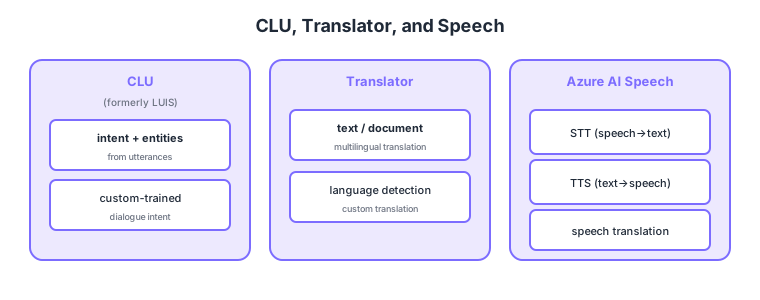
- Conversational Language Understanding (CLU): predict intent and entities from utterances; custom-trained (successor to LUIS).
- Translator: translate text/documents across languages with language detection; custom translation available.
- Speech (STT/TTS): speech-to-text, text-to-speech, and speech translation.
- Custom/neural voice: build custom speech models or brand voices.
Common on AI-102: utterance intent/entities = CLU (formerly LUIS), multilingual translation = Translator, speech-to-text = Speech STT, text-to-speech = Speech TTS, Q&A responses = Question Answering (a Language feature). Distinguish intent (CLU) from FAQ-style Q&A (Question Answering).
Chatbots often combine CLU (intent), Question Answering (FAQ responses), and the Bot Framework (dialog orchestration).
CLU defines intents and entities as a schema and trains from labeled utterances. Entity types include prebuilt (numbers, dates), list (synonym enumerations), regex, and learned, and an orchestration workflow can route across CLU, Question Answering, and custom projects from one entry point. Translator offers text translation, document translation (format-preserving), and Custom Translator, with source-language auto-detection, profanity handling, and glossary-based term locking. Speech provides speech-to-text (STT) (real-time/batch, punctuation, custom speech to adapt to jargon), text-to-speech (TTS) (control speech via SSML, brand voices via custom neural voice), speech translation, and speaker recognition. Chatbots combine “CLU for intent, Question Answering for canned responses, Bot Framework / Azure AI Foundry for dialog control.” A common exam point is not confusing intent understanding (dynamic) with FAQ answering (fixed QnA pairs).
| Need | Service/feature | Point |
|---|---|---|
| Predict utterance intent | CLU | Train intents + entities |
| Answer fixed FAQs | Question Answering | Q&A pair knowledge base |
| Translate languages | Translator | Text/doc; glossary term locking |
| Recognize/synthesize speech | Speech (STT/TTS) | SSML, custom voice |
Scenario: a multilingual voice chatbot must understand spoken intent and also answer fixed FAQs. → Use Speech STT to transcribe, CLU to predict intent/entities, Question Answering for canned questions, Translator for multilingual as needed, and TTS for voice replies—routing at the entry via an orchestration workflow.
FAQ: Q. CLU vs Question Answering? → A. CLU predicts utterance intent (dynamic understanding); Question Answering returns canned answers from a Q&A-pair knowledge base. Q. What is SSML? → A. Markup for TTS that controls prosody, rate, pronunciation, etc.
Trap: “use CLU to answer fixed FAQs” is wrong—CLU is intent understanding; canned Q&A-pair responses are Question Answering. Also “Translator recognizes speech” is wrong—speech recognition is Speech STT; Translator does text/document translation.
3.2.2Section summary
- CLU = intent/entities, Translator = multilingual translation
- Speech = STT / TTS / speech translation
Sign in to track progress — Log in.
Quick check
(just a quick review)Q1. You want a custom model to predict intent and entities from user utterances. What do you use?
Q2. You want to transcribe audio (speech-to-text). Which service?
Q3. Which correctly distinguishes intent understanding (CLU) from answering FAQ-style questions?