

What's changed: Deepened AI-102 Chapter 1 (ja figures; comparison tables/scenarios/FAQ/traps/deep paragraphs in all sections)
1.2Responsible AI and Content Safety
Understand Microsoft’s Responsible AI principles (fairness; reliability & safety; privacy & security; inclusiveness; transparency; accountability) and Azure AI Content Safety for detecting harmful content. The basis for operating AI safely.
AI is powerful, so it carries a responsibility to use it fairly and safely. Microsoft defines six Responsible AI principles and, in practice, mitigates harmful content with tools like Content Safety.
1.2.1Responsible AI principles
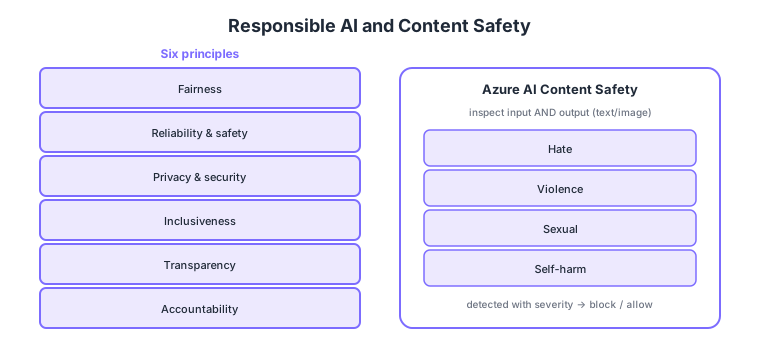
- Six principles: fairness; reliability & safety; privacy & security; inclusiveness; transparency; accountability.
- Content Safety: detects harmful categories (hate, violence, sexual, self-harm) with severity in text/images.
- Both input and output: inspect both user input and AI-generated output to reduce risk.
- Transparency notes: documents describing model capabilities and limitations to promote appropriate use.
Common on AI-102: detect harmful content (hate/violence/sexual/self-harm with severity) = Azure AI Content Safety, fairness; reliability & safety; privacy; inclusiveness; transparency; accountability = the six Responsible AI principles, inspect both input and output. For generative AI, combine Content Safety with prompt safeguards.
Content Safety lets you set severity thresholds per category, tuning block/allow criteria to your business tolerance.
Content Safety returns four categories (hate, violence, sexual, self-harm) with a severity of 0–6, and thresholds decide block/allow. Generative-AI-specific threats have dedicated features: Prompt Shields detect direct jailbreak and document-borne indirect prompt injection, groundedness detection checks whether output is grounded in source material (not a hallucination), and protected material detection flags reuse of known code/text. Azure OpenAI includes a built-in content filter inspecting both input (prompt) and output (completion). Implementing Responsible AI is layered: an Impact Assessment at design time, Content Safety at runtime, and transparency notes for explanation. Note Content Safety handles harm detection, while anonymizing personal data is Language’s PII detection and anti-impersonation is the auth domain—separate responsibilities by design.
| Feature | Protects against | When |
|---|---|---|
| Category detection (4) | Hate/violence/sexual/self-harm | Score harm in input/output |
| Prompt Shields | Jailbreak, indirect injection | Defend generative-AI input |
| Groundedness detection | Ungrounded output (hallucination) | Validate RAG output |
| Protected material detection | Reuse of known code/text | Check for protected content |
Scenario: a document-grounded generative chat must prevent jailbreaks and ungrounded answers. → On top of Azure OpenAI’s content filter, use Prompt Shields to detect jailbreak/indirect injection in input, groundedness detection to verify answers are grounded in the docs, and Content Safety to score output harm by severity.
FAQ: Q. Is Content Safety separate from Azure OpenAI’s content filter? → A. OpenAI has a built-in filter; Content Safety is a standalone service applicable to arbitrary text/images and other models. Q. How to address hallucination? → A. Combine groundedness detection with RAG (cite sources).
Trap: “Content Safety only needs to inspect input” is wrong—for generative AI, inspect both input (prompt) and output (result). Also “Content Safety anonymizes PII” is wrong—PII detection/anonymization is Azure AI Language’s job.
1.2.2Section summary
- Responsible AI = six principles (fairness, safety, privacy, inclusiveness, transparency, accountability)
- Content Safety = detect harmful content with severity (input & output)
Sign in to track progress — Log in.
Quick check
(just a quick review)Q1. Which Azure service detects harmful categories (hate, violence, sexual, self-harm) with severity in text/images?
Q2. Which is NOT one of the Responsible AI principles?
Q3. For reducing generative AI risk, where should Content Safety inspect?