

What's changed: Initial version
6.3Accounting & finance
Covers reading the financial statements (BS/PL/CF), the break-even point measuring viability from fixed cost and variable-cost ratio, ROE/ROA measuring capital efficiency, and the gap between profit and cash (depreciation, insolvency-while-profitable), so an IT strategist can wield them when judging the viability of an investment or the profitability of a solution. The key is being able to compute the numbers and decide whether to invest.
An IT strategist's proposal ultimately cannot pass unless it can be explained to management in the language of finance—viability (will it make money) and funds (will cash flow). This section, after grounding the roles of the balance sheet (BS) showing financial position, the profit-and-loss statement (PL) showing a period's earnings, and the cash-flow statement (CF) showing changes in cash, covers—through settings where you actually compute the numbers to decide whether to invest—the break-even point that finds "how much must be sold to be in the black" from fixed cost and variable-cost ratio, ROE/ROA showing profit efficiency against equity and total assets, and the mechanism by which accounting profit and cash on hand diverge (depreciation is a non-cash expense; a firm can go insolvent while profitable).
6.3.1Break-even point and marginal profit
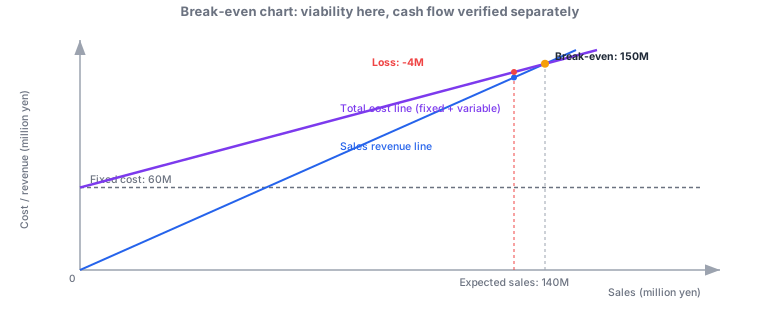
- Break-even sales = fixed cost / (1 - variable-cost ratio). The variable-cost ratio = variable cost / sales. Marginal profit = sales - variable cost = sales x (1 - variable-cost ratio); the break-even point is the sales at which marginal profit exactly covers fixed cost. If expected sales fall below break-even, there is a loss.
- IT investment for automation often raises fixed cost (depreciation, etc.) while lowering the variable-cost ratio and raising the marginal-profit ratio. If sales are large enough, automation yields greater profit, though the break-even point itself may actually rise—so one must judge together "at what level are the expected sales."
6.3.2Capital efficiency and the profit-cash gap
- ROE (return on equity) = net income / equity—the efficiency of how much profit was earned on shareholders' money. ROA (return on assets) = profit / total assets. Even a large absolute net income means low efficiency (ROE/ROA) if the capital invested is large. If a high ROE comes from leverage (use of debt), financial risk must be evaluated together.
- Accounting profit and cash flows do not coincide. Depreciation reduces profit as an expense but involves no cash outlay (a non-cash expense), so it is added back in the CF. Conversely, even with a PL profit, delayed collection of receivables or a rise in inventory can cause a cash shortage leading to insolvency while profitable. So one scrutinizes not just PL profit but also the CF (especially operating CF).
Most-tested: "break-even = fixed cost / (1 - variable-cost ratio)", "marginal profit = sales x (1 - variable-cost ratio)", "ROE = net income / equity (efficiency, not absolute amount)", "depreciation is a non-cash expense added back in the CF", and "a firm can go insolvent from a cash shortage even while profitable (look at operating CF)." Watch for formula confusions such as "break-even = fixed cost x variable-cost ratio" or "ROE = net income / total assets."
An IT strategist is judging the viability of a new-service business plan from a financial standpoint. The business is expected to have fixed cost of 60 million yen and a variable-cost ratio of 60%. Break-even sales are 6,000 / (1 - 0.6) = 6,000 / 0.4 = 150 million yen (15,000 in ten-thousands). But the sales team's expected sales are 140 million yen (14,000), below break-even. Checking profit at those sales: marginal profit = 14,000 x (1 - 0.6) = 5,600, and subtracting fixed cost 6,000 gives a loss of 4 million yen (-400 in ten-thousands). The strategist judges that "pressing ahead with the investment under a plan below break-even is risky" and recommends deferring the investment or revising the plan unless it is accompanied by cutting fixed cost, raising sales above 150 million by price or volume, or lowering the variable-cost ratio. A beginner's pitfall here is to compute with the wrong formula "break-even = fixed cost x variable-cost ratio = 3,600" and, concluding that expected sales of 14,000 are comfortably in the black, mistakenly give the investment a go. Getting the formula wrong throws the viability judgment off at the root. Next, the strategist examines the whole company's financial health. Comparing two firms—Firm A with net income 10 million and equity 200 million (1,000 and 20,000), Firm B with net income 6 million and equity 60 million (600 and 6,000)—A has the larger absolute net income (1,000), yet A's ROE is 1,000 / 20,000 = 5% and B's is 600 / 6,000 = 10%, showing B has the higher return on equity. The point of ROE is to look at efficiency, not be misled by absolute size. If, however, B's high ROE comes from heavy use of debt (leverage), financial risk must also be evaluated. Finally, a PL profit is no cause for relief: if receivables collection lags or inventory swells, cash can fall short and lead to insolvency while profitable, so the strategist always scrutinizes operating cash flow as well as profit. Accounting profit and cash movements do not coincide—this perspective guards against pitfalls in investment judgment.
| Metric/concept | Formula/meaning | Judgment point |
|---|---|---|
| Break-even point | Fixed cost / (1 - variable-cost ratio) | A loss if expected sales fall below it |
| Marginal profit | Sales - variable cost = sales x (1 - variable ratio) | Whether it covers fixed cost |
| ROE | Net income / equity | Judge by capital efficiency, not absolute (watch leverage) |
| Depreciation | Non-cash expense (reduces profit, no cash outlay) | Added back in the CF |
| Operating CF | Cash flow from core operations | Watch insolvency-while-profitable from cash shortage |
Trap: "Break-even = fixed cost x variable-cost ratio" is wrong—correctly it is fixed cost / (1 - variable-cost ratio), and getting the formula wrong throws the viability judgment off at the root. Also wrong: "a firm with larger absolute net income always has higher capital efficiency"—ROE = net income / equity, so if the capital invested is large, efficiency is low even with a large absolute amount. "If the PL is profitable, cash flow is necessarily healthy" is also wrong—depreciation is a non-cash expense, and a rise in receivables or inventory can cause a cash shortage even while profitable (insolvency-while-profitable), so scrutinize operating CF.
6.3.3Section summary
- Break-even = fixed cost / (1 - variable-cost ratio); a loss if expected sales fall below it (watch the formula)
- ROE = net income / equity is capital efficiency; judge by efficiency, not absolute income (a high ROE may reflect leverage)
- Accounting profit and cash differ; depreciation is non-cash, and a firm can go insolvent from a cash shortage while profitable (scrutinize operating CF)
Sign in to track progress — Log in.
Quick check
(just a quick review)Q1. A new-service business plan is expected to have fixed cost of 60 million yen, a variable-cost ratio of 60%, and expected sales of 140 million yen. Which is the most appropriate viability judgment by the IT strategist?
Q2. Firm A has net income of 10 million yen and equity of 200 million; Firm B has net income of 6 million and equity of 60 million. Which is the most appropriate judgment about return on equity?
Q3. A company shows a profit on its profit-and-loss statement yet has negative operating cash flow. Which is the most appropriate view for the IT strategist?
Keep track of your progress
The full study guide is free to read. Sign up free to practice with the question bank, track what you have read, review your mistakes, and highlight passages.