

What's changed: Initial version
5.4Evaluating return on investment
Covers evaluating IT investments with ROI, NPV (discounting future cash flows to present value and subtracting the initial investment), IRR (the discount rate where NPV = 0), the payback method (simple and discounted) measuring the years to recover the investment, and lifecycle TCO; and the ability to interpret numbers to decide which to weight when simple payback and NPV disagree (how time value and post-payback cash flows are treated).
IT investment is a decision to commit management resources, and the strategist must evaluate "whether the investment is worth it" numerically and be able to explain it to management. The representative measures are ROI (the ratio of profit to investment), NPV (discounting future cash flows to present value and subtracting the initial investment), IRR (the discount rate where NPV = 0), and the payback method measuring in how many years the investment is recovered. The key is that each measure differs in "what it sees and what it overlooks." The simple payback period in particular sees only the speed of recovery and ignores time value and post-payback cash flows, so it can disagree with NPV. This section covers how the strategist interprets which numbers, and how, to decide an investment when multiple measures point to different conclusions.
5.4.1The main investment-evaluation measures
- NPV is the sum of each year's future cash flow discounted to present value, minus the initial investment. If NPV > 0 the investment pays off. IRR is the discount rate at which NPV is exactly zero; if it exceeds the cost of capital, the investment is judged favorable. Both reflect the time value of money.
- The payback method (PBP) is the number of years to recover the investment, in a simple payback that ignores time value and a discounted payback measured with discounted cash flows. ROI = profit / investment (a profitability ratio). TCO is the total cost of ownership over the whole lifecycle, including operation and maintenance, not just the initial cost.
5.4.2Deciding when measures disagree
- Simple payback sees only recovery speed and ignores post-payback cash flows and time value. It can therefore undervalue a project that recovers slowly but yields large long-term returns, pointing to the opposite conclusion from NPV. Judging by payback alone overlooks large long-term returns.
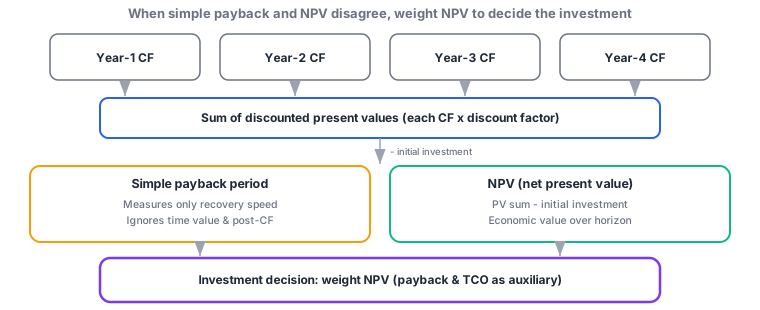
- When simple payback and NPV disagree, the principle is to weight NPV, which expresses economic value (the net value over the whole investment horizon reflecting time value). Payback is used as an auxiliary measure for the risk aspect of cash flow and recovery speed. Measures are used together, not alone, and the decision is comprehensive, also considering TCO and risk.
Most-tested: "NPV = sum of future cash flows discounted to present value minus the initial investment, pays off when NPV > 0", "IRR = the discount rate where NPV = 0", "simple payback ignores time value and post-payback cash flows", "do not judge by payback alone; use it with NPV/IRR", and "TCO is the lifecycle total cost including operation and maintenance." Watch for errors like "NPV is the simple (undiscounted) sum minus the initial investment," "forgetting to subtract the initial investment in the NPV calculation," and "a faster-recovering project is always economically superior."
A strategist is asked, under a budget constraint, to choose one of two IT investments, A or B. Both have the same initial investment of 9 million yen. Project A's cash flows are projected at 5.0 / 4.0 / 1.0 / 1.0 million yen in years 1-4, and Project B's at 3.0 / 3.0 / 4.0 / 5.0 million yen. Looking first at simple payback: Project A reaches (5.0 + 4.0 =) 9.0 million by the end of year 2, recovering in exactly 2.0 years. Project B's cumulative through year 2 is 6.0 million, recovering the remaining 3.0 million during year 3 for about 2.75 years. By simple payback alone, the faster-recovering Project A looks favorable. But here one must recall simple payback's weakness—it ignores post-payback cash flows and the time value of money. Project B recovers slowly but generates large cash flows in later years (4.0 million in year 3, 5.0 million in year 4), producing more value over the whole horizon than A. So compute NPV at a 10% discount rate (factors: 0.909 / 0.826 / 0.751 / 0.683 for years 1-4). Project A: (5.0x0.909 + 4.0x0.826 + 1.0x0.751 + 1.0x0.683) = 9.283 million minus the 9.0 million initial = about +0.28 million. Project B: (3.0x0.909 + 3.0x0.826 + 4.0x0.751 + 5.0x0.683) = 11.624 million minus 9.0 million = about +2.62 million. By NPV, Project B greatly exceeds Project A. The strategist's judgment here is to not be dragged by the "A is favorable" conclusion of simple payback, but to weight NPV—which expresses economic value (the net value over the whole horizon reflecting time value)—and choose Project B. A looked superior on simple payback only because B's large later returns were ignored as post-payback. NPV is not the sole yardstick, though: recovery speed matters for cash flow and risk, so if slow recovery brings cash-flow constraints or the business environment is highly uncertain, the payback period is also weighed as an auxiliary measure. When multiple measures point to different conclusions, understanding "what each measure sees and overlooks" and, as a principle, deciding comprehensively with NPV at the center and payback, TCO, and risk as auxiliaries is the core of the strategist's return-on-investment evaluation.
| Measure | What it sees | What it tends to overlook |
|---|---|---|
| NPV | Net value over the whole horizon, discounted | (reflects time value and full horizon—few blind spots) |
| Simple payback | The speed of recovering the investment | Post-payback cash flows and time value |
| TCO | Lifecycle total cost incl. operation/maintenance | The effects/revenue gained (it is a cost-side measure) |
Trap: "NPV is the simple sum of future cash flows minus the initial investment" is wrong—NPV discounts each year's cash flow to present value, sums them, and then subtracts the initial investment (forgetting to discount, or forgetting to subtract the initial investment, are typical calculation errors). Also wrong: "a project with a shorter simple payback is always economically superior"—simple payback ignores post-payback cash flows and time value, so it undervalues a project with large long-term returns (a high-NPV project). Do not judge by payback alone; use it with NPV/IRR.
5.4.3Section summary
- NPV = future cash flows discounted to present value, summed, minus the initial investment (pays off when NPV > 0); IRR = the discount rate where NPV = 0
- The simple payback period ignores time value and post-payback cash flows, overlooking large long-term returns; do not judge by payback alone
- When simple payback and NPV disagree, weight NPV for economic value and decide comprehensively with payback, TCO, and risk as auxiliaries
Sign in to track progress — Log in.
Quick check
(just a quick review)Q1. For an IT investment, the discount rate is 5%, the initial investment is 30 million yen, and the cash flows are 15 / 12 / 10 million yen in years 1-3. With discount factors 0.952 / 0.907 / 0.864, which investment judgment based on NPV is most appropriate?
Q2. Investments A and B both have an initial investment of 9 million yen. A's cash flows are 5/4/1/1 million and B's are 3/3/4/5 million in years 1-4. At a 10% discount rate (factors 0.909/0.826/0.751/0.683), which investment judgment from simple payback and NPV is most appropriate?
Q3. For procuring a business system used for 5 years, Project X costs 5 million yen initially plus 9 million yen annual running cost, and Project Y costs 20 million yen initially plus 5 million yen annual running cost. Which judgment based on TCO is most appropriate?
Keep track of your progress
The full study guide is free to read. Sign up free to practice with the question bank, track what you have read, review your mistakes, and highlight passages.