

What's changed: Initial version
5.1System concept & planning
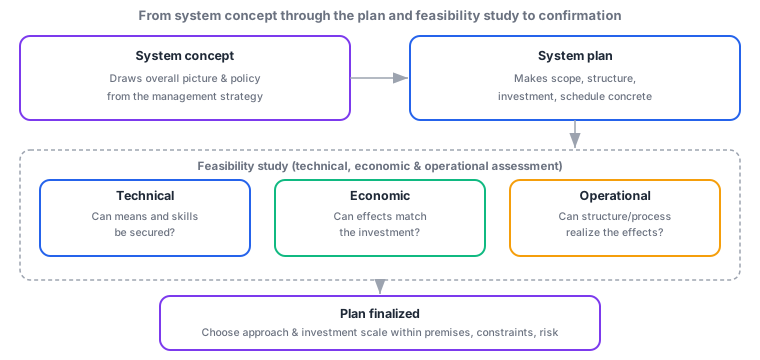
Covers the division of roles between the system concept, which draws the overall picture and policy of systematization from the management and information-systems strategy, and the system plan, which then makes concrete the target scope, structure, investment, schedule, effects, and risks; and the judgment of gauging premises, constraints, and risks through a feasibility study (technical, economic, operational) before committing to a plan.
The starting point of system planning is not to pick a development target on a whim, but to draw the overall picture of systematization from the management and information-systems strategy, gauge its feasibility, and then bring it down into a plan. Drawing the overall policy upstream is the system concept; making the target scope, structure, investment, schedule, effects, and risks concrete on that basis is the system plan. Before committing to the plan, assessing whether it can really be realized from the technical, economic, and operational sides is the feasibility study. This section covers upstream planning decisions from the viewpoint of an IT strategist judging which realization approach and investment scale to choose within premises, constraints, and risks.
5.1.1The roles of the system concept and the system plan
- The system concept is the uppermost planning stage that, informed by the management and information-systems strategy and the business's issues and to-be state, draws the overall picture, policy, and purpose of which processes to systematize and how. It sets "for what, where, and in which direction" to change, not the individual implementation.
- The system plan takes the concept and makes concrete the target scope, realization approach, structure, schedule, investment, expected effects, and risks. It sits in the planning process of the common frame (SLCP) and becomes the basis for requirements definition onward. The upstream concept directs the downstream plan.
5.1.2Feasibility study and premises, constraints, and risks
- The feasibility study comprehensively assesses, before committing to the plan, whether it can be realized from the technical (means, skills), economic (return on investment), operational (structure, operating capability), and scheduling sides. Feasibility on one side alone does not make a plan viable if another side fails.
- Clarify the premises and constraints (budget ceiling, deadline, regulations, integration with existing systems, staffing) and risks at the planning stage, and choose the target scope and realization approach within them. Weaving response policies for constraint-driven risks (phased rollout, securing skills, revisiting the investment scale) into the plan is the strategist's role.
Most-tested: "the system concept = the overall picture and policy derived from management strategy", "the system plan = making the target scope, structure, investment, schedule, effects, and risks concrete", and "the feasibility study = multi-faceted feasibility assessment across technical, economic, operational, and other aspects". Watch for the leap that "if it is technically feasible, start regardless of the other aspects" or that "constraints and risks can be handled while developing"—feasibility is a comprehensive multi-aspect assessment, and constraints and risks are gauged at the planning stage.
A manufacturing IT strategist is about to finalize the system plan for a new system to advance demand forecasting. At the concept stage, the policy "optimize inventory with AI demand forecasting to cut stockouts and overstock at once" was drawn from the management strategy. Before finalizing, the strategist runs a feasibility study. On the technical side, the proposed state-of-the-art forecasting model is theoretically highly accurate, but the company lacks the data-science skills to operate and tune it. On the economic side, the initial investment is large, while the payback from reduced inventory cost depends heavily on the assumed magnitude of demand variability and is assessed as highly uncertain. On the operational side, the process by which floor inventory staff reflect forecast results in business decisions is not yet in place, raising the concern that installing the system alone will not produce effects. The key point here is to not leap to "it is technically feasible, so start immediately." Technical feasibility is only one of several assessment axes; finalizing the plan while ignoring the constraints and risks of insufficient operating skills and uncertain payback risks failure—no effect even once live, or unrecovered investment. The strategist clarifies the premises and constraints (budget ceiling, staffing, integration with the existing inventory system) and then judges how to weave risk responses into the plan. Concretely, rather than applying it to the whole company and all items at once, the strategist revises the plan to roll out in phases (a small start), proving feasibility on a limited product line with large demand variability and promising effects, while in parallel securing operating skills (using external talent, growing in-house capability) and building the operational process, then judging whether to scale the investment based on the results. Drawing on the system concept's policy while comprehensively assessing the technical, economic, and operational sides in a feasibility study, and choosing the realization approach and investment scale within the premises, constraints, and risks, is the strategist's core judgment upstream in planning.
| Feasibility aspect | Question assessed | If overlooked |
|---|---|---|
| Technical | Can the means and required skills be secured? | A technology no one can operate gets installed |
| Economic | Can effects matching the investment be recovered? | A plan whose investment cannot be recovered is committed |
| Operational | Can the structure and process realize the effects? | Even once live, no effect in the business |
Trap: "If it is technically feasible, you may start development immediately without assessing the economic and operational aspects" is wrong—a feasibility study comprehensively assesses multiple aspects (technical, economic, operational, scheduling), and feasibility on one side does not make a plan viable if another fails. Also wrong: "premises, constraints, and risks can be identified after the plan is finalized"—constraints and risks are clarified at the planning stage, the target scope and realization approach are chosen within them, and responses are woven into the plan; that is the strategist's role.
5.1.3Section summary
- The system concept draws the overall picture and policy from management strategy; the system plan makes concrete the scope, structure, investment, schedule, effects, and risks
- The feasibility study comprehensively assesses feasibility across multiple aspects (technical, economic, operational); one aspect alone is not enough to decide
- Premises, constraints, and risks are clarified at the planning stage; within them, choose the realization approach and investment scale and weave in response policies
Sign in to track progress — Log in.
Quick check
(just a quick review)Q1. In a system plan, the proposed technology is state-of-the-art but the company lacks the skills to operate it, and the payback from cost reductions is uncertain, depending on demand variability. Which judgment based on the strategist's feasibility study is most appropriate?
Q2. Which best describes the relationship between the stage that draws the overall picture and policy of systematization from management strategy, and the stage that makes concrete the target scope, structure, investment, schedule, effects, and risks?
Q3. In formulating a system plan, which is the most appropriate judgment by the strategist regarding the treatment of premises and constraints such as the budget ceiling, relevant regulations, integration with existing systems, and staffing?
Keep track of your progress
The full study guide is free to read. Sign up free to practice with the question bank, track what you have read, review your mistakes, and highlight passages.