

What's changed: Deepened SOA-C02 Chapter 2 to Associate depth (tables, scenarios, FAQ, traps; localized figures)
2.3Backup and Disaster Recovery (RPO/RTO)
Understand EBS/RDS snapshots, centralized management with AWS Backup (schedules, cross-region/account copy), and choosing a DR strategy via RPO/RTO.
To guard against data loss and disasters, take backups on a plan and choose a DR strategy matching your recovery objectives (RPO/RTO).
2.3.1Backups and recovery objectives
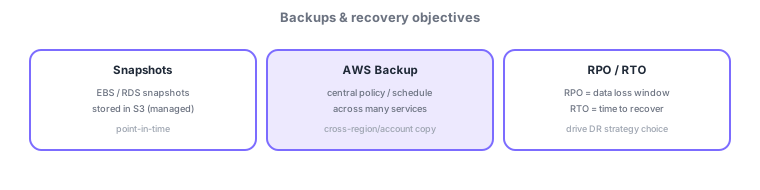
- Snapshots: point-in-time backups of EBS/RDS, stored managed in S3.
- AWS Backup: schedules backups centrally across services, with cross-region/account copy.
- RPO: acceptable data-loss window. RTO: acceptable time to recover. These drive the DR strategy.
Common on SOA: RPO = how much data loss is acceptable, RTO = how fast you must recover, central cross-service backup = AWS Backup, replicate to another region for DR = cross-region copy.
Decide backup/DR in order: "objectives (RPO/RTO) → strategy → cost." RPO is "how far back you can recover = acceptable data loss"; RTO is "how fast you recover." Means include snapshots (EBS/RDS point-in-time, incremental, managed in S3) and AWS Backup for many services at once (backup plans for schedule/retention, cross-region/cross-account copy, and tamper-proof Backup Vault Lock). For region-wide failures, DR strategies span four tiers: backup & restore (cheap, slow) → pilot light (a minimal core on standby) → warm standby (a scaled-down stack always on) → multi-site/active-active (fast, costly). Shorter RPO/RTO means higher tier and higher cost. S3 cross-region replication and Route 53 failover routing (health-check to a standby region) are typical building blocks. Selecting targets by tag automatically includes new resources in the backup plan.
| DR strategy | RTO/RPO | Cost |
|---|---|---|
| Backup & restore | Long | Low |
| Pilot light | Medium | Low–medium |
| Warm standby | Short | Medium–high |
| Multi-site | Shortest | High |
Scenario: govern backups across all services and replicate to another region. Centralize schedule/retention via an AWS Backup plan and select targets by tag (new resources auto-included). Use cross-region copy for region-wide failures and Backup Vault Lock to prevent deletion. For a short RTO, choose warm standby + Route 53 failover.
Q. Acceptable-data-loss metric? RPO. Q. Recovery-time metric? RTO. Q. Central cross-service backup + cross-region? AWS Backup. Q. Cheapest DR? Backup & restore. Q. Fastest-recovery DR? Warm standby/multi-site.
Watch the mix-ups: (1) RPO = data-loss window, RTO = recovery time—frequently swapped. (2) EBS snapshots are managed in S3 (not visible in your S3 bucket). (3) Shorter RPO/RTO costs more—"always multi-site" is wrong (match the requirement).
Cost trades off against RPO/RTO: looser requirements suit backup & restore; stricter ones suit pilot light through multi-site.
2.3.2Section summary
- Snapshots / AWS Backup (central, cross-region)
- RPO (loss window) / RTO (recovery time) drive the DR strategy
Sign in to track progress — Log in.
Quick check
(just a quick review)Q1. You want centralized backups across services with schedules and cross-region copy. What do you use?
Q2. Which metric expresses "how much data loss is acceptable"?
Q3. Where are EBS point-in-time backups stored?
Keep track of your progress
The full study guide is free to read. Sign up free to practice with the question bank, track what you have read, review your mistakes, and highlight passages.