

What's changed: In-scope coverage: added identity (Cognito/Directory Service/IAM Identity Center), keys/certs (CloudHSM/ACM), threat detection (GuardDuty/Inspector/Macie/Detective/Security Hub), network defense (Network Firewall/Firewall Manager), and compliance (Artifact/Audit Manager) across sections
1.2Data Protection and Encryption
Understand data protection design: encryption at rest/in transit, key management with AWS KMS, encrypting S3/EBS/RDS, and secrets management with Secrets Manager.
Protect data both at rest and in transit. On AWS, manage keys centrally with KMS and enable each service’s encryption.
1.2.1Data protection elements
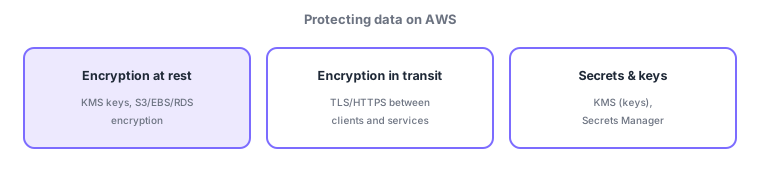
- Encryption at rest: encrypt S3, EBS, RDS, DynamoDB, etc., with KMS keys—often just a toggle.
- Encryption in transit: protect client-to-service traffic with TLS/HTTPS.
- AWS KMS: centrally create/manage keys with CloudTrail-audited usage; AWS-managed vs more controllable customer-managed keys.
- Secrets Manager: store secrets (DB creds, API keys) with automatic rotation. SSM Parameter Store stores config/secrets (with a free tier).
| Protects | Service/method | Note |
|---|---|---|
| Data at rest | KMS encryption (S3/EBS/RDS) | Key usage auditable |
| Data in transit | TLS/HTTPS | Certs via ACM |
| Encryption keys | AWS KMS | AWS- vs customer-managed |
| Secrets | Secrets Manager / Parameter Store | Auto-rotation available |
The design principle is "always encrypt, at rest and in transit." On AWS many services enable at-rest encryption by default or with one click, and KMS manages keys centrally. Keys come as AWS-managed defaults or customer-managed keys where you control policy and rotation—choose a customer-managed key for strict audit needs. Secrets (passwords, connection strings, API keys) should not be hard-coded; store them in Secrets Manager (with auto-rotation) or SSM Parameter Store, and have apps fetch them via an IAM role. TLS certificates can be issued and auto-renewed by ACM (Certificate Manager).
Scenario: a web app using RDS. Encrypt RDS and its EBS at rest with KMS (customer-managed key); encrypt app⇔RDS and user⇔ALB in transit with TLS (certs via ACM). Store DB credentials in Secrets Manager with auto-rotation, fetched by the app via an IAM role (no embedded keys). Audit key usage with CloudTrail.
Watch the mix-ups: (1) keys = KMS / secrets = Secrets Manager (or Parameter Store)—different roles. (2) Encrypt both at rest and in transit (not just one). (3) Don’t hard-code secrets—fetch via an IAM role. (4) customer-managed vs AWS-managed keys (degree of control/audit).
Q. KMS vs Secrets Manager? KMS manages encryption keys; Secrets Manager manages secrets like passwords (with auto-rotation). Q. AWS-managed vs customer-managed key? A customer-managed key lets you control key policy/rotation—fits strict audit needs. Q. Certificates? Issue/auto-renew with ACM and attach to ALB or CloudFront.
Common: key management = KMS (AWS-managed/customer-managed), secrets management/rotation = Secrets Manager, certificates = ACM, and encrypt both at rest (KMS) and in transit (TLS). Never hard-code secrets—fetch via IAM role.
1.2.2Other key in-scope services (keys and certificates)
Beyond KMS and Secrets Manager, know the options for stricter-compliance key management and certificate management. AWS CloudHSM provides dedicated hardware security modules (HSMs)—choose it when you must solely control keys and meet strict requirements such as FIPS 140-3 Level 3 (current hsm2m type) or custom key custody (versus KMS, which is multi-tenant managed keys that are simpler to operate). AWS Certificate Manager (ACM) issues and auto-renews SSL/TLS certificates—choose it to attach certificates to ELB or CloudFront and maintain encryption in transit with no operational overhead.
| What you want | Service |
|---|---|
| Dedicated HSM, sole key control | AWS CloudHSM |
| Issue/auto-renew TLS certificates | AWS Certificate Manager (ACM) |
1.2.3Section summary
- Always encrypt both at rest (KMS) and in transit (TLS/ACM)
- Use KMS (keys; AWS-managed/customer-managed) vs Secrets Manager (secrets; auto-rotation); fetch via IAM role
Sign in to track progress — Log in.
Quick check
(just a quick review)Q1. Which AWS service centrally creates and manages encryption keys?
Q2. Which service securely stores and auto-rotates secrets like database credentials?
Q3. Which is the best practice for protecting data?
Keep track of your progress
The full study guide is free to read. Sign up free to practice with the question bank, track what you have read, review your mistakes, and highlight passages.