

What's changed: Initial version (topic G1)
1.4Replication Operations
Go deep on building and monitoring streaming and logical replication: streaming setup via wal_level, max_wal_senders, synchronous_standby_names, synchronous_commit, hot_standby_feedback; logical replication's CREATE/ALTER/DROP PUBLICATION and SUBSCRIPTION; the monitoring views pg_stat_replication and pg_stat_wal_receiver; the sender/receiver processes walsender/walreceiver; and the dedicated receiving tool pg_receivewal.
In Silver, replication was "basic knowledge" only. Gold demands the operator's perspective: actually building replication, choosing a synchronization mode, and monitoring for lag or gaps. You need enough depth to make concrete parameter choices that balance availability requirements (how much downtime is acceptable) against data-loss tolerance (how much data loss is acceptable).
1.4.1Streaming replication setup parameters
- wal_level determines how much information gets written to WAL. Replication requires at least
replica(orlogicalif using logical replication). max_wal_senders caps the number of concurrently connected standbys/replication clients (i.e., the limit on walsender processes). - synchronous_standby_names specifies which standbys count as synchronous replicas, by name, priority, and grouping (e.g.,
'FIRST 1 (standby1, standby2)'). synchronous_commit controls how much confirmation a commit waits for (on= wait for the sync standby to confirm the WAL write,remote_write= wait only for the standby's OS-level write,off= local only). - hot_standby_feedback sends information about long-running queries on the standby back to the primary, preventing the primary's VACUUM from removing row versions those queries still need (which would otherwise cause a replication conflict that cancels the query). The trade-off: it can increase bloat on the primary.
1.4.2Logical replication operations
- On the publisher side: CREATE PUBLICATION defines the set of tables to replicate (
CREATE PUBLICATION pub1 FOR TABLE orders, customers;orFOR ALL TABLES). ALTER PUBLICATION adds/removes target tables, and DROP PUBLICATION removes the publication. - On the subscriber side: SUBSCRIPTION (
CREATE SUBSCRIPTION sub1 CONNECTION '...' PUBLICATION pub1;specifies the connection and publication and starts subscribing; an initial data copy runs automatically at creation). Unlike physical replication, this allows table-level selective sync, and can be arranged bidirectionally or aggregated from multiple sources. - Logical replication does not auto-propagate DDL (schema changes must be applied manually on both sides), and it does not cover sequence values or large objects—key differences from physical replication.
1.4.3Monitoring views and processes
- pg_stat_replication is checked on the primary side. It shows one row per connected standby with
sent_lsn(WAL position sent),write_lsn,flush_lsn,replay_lsn(position applied), andsync_state(sync/potential/async)—letting you see lag and which standby is currently synchronous. - pg_stat_wal_receiver is checked on the standby side. It shows the connection info for the upstream primary and the WAL position received (
received_lsn)—the standby-side counterpart to the primary-side pg_stat_replication. - Processes: walsender (forked per standby on the primary to send WAL; counts against
max_wal_senders) and walreceiver (receives and applies WAL on the standby). pg_receivewal is a dedicated client tool that streams WAL and saves it as files—useful for archiving, or when you just want to collect WAL without standing up a full standby.
Most-tested mappings: minimum replication requirement = wal_level=replica (logical needs logical); how much commit confirmation to wait for = synchronous_commit; which standbys are synchronous = synchronous_standby_names; preventing replication conflicts = hot_standby_feedback. Also a staple: primary-side monitoring = pg_stat_replication / standby-side monitoring = pg_stat_wal_receiver. Repeatedly tested: logical replication does not auto-propagate DDL.
Trace building streaming replication from scratch. On the primary's postgresql.conf, set wal_level = replica and max_wal_senders = 10 or so, and add a line to pg_hba.conf permitting replication connections from the standby. Create the standby with something like pg_basebackup -h primary_host -D /var/lib/pgsql/data -U replicator -P -R—the -R option auto-generates standby.signal and the connection info (primary_conninfo). If the availability requirement is strict and "not a single committed row can be lost," set synchronous_standby_names = 'FIRST 1 (standby1)' and leave synchronous_commit = on, making commits on the primary wait for standby1 to confirm the WAL write—synchronous replication (at the cost of higher commit latency). If performance is the priority instead, choose synchronous_commit = off or an asynchronous setup. If long analytical queries run on the standby, set hot_standby_feedback = on to avoid a replication conflict where the primary's VACUUM removes rows those queries still need, canceling them.
After setup, monitor on the primary by periodically running SELECT application_name, sync_state, replay_lsn FROM pg_stat_replication;, checking that sync_state shows sync as expected and that the gap between sent_lsn and replay_lsn is not growing too large. On the standby, check SELECT status, received_lsn FROM pg_stat_wal_receiver;. To stream only specific tables to another system via logical replication, create CREATE PUBLICATION sales_pub FOR TABLE orders; on the publisher, then run CREATE SUBSCRIPTION sales_sub CONNECTION 'host=pub_host dbname=sales user=repl' PUBLICATION sales_pub; on the subscriber—the initial data copy runs at creation time, followed by ongoing changes. To add a table later, use ALTER PUBLICATION sales_pub ADD TABLE customers;, but since DDL changes like adding a new column are not auto-propagated by logical replication, enforce an operational rule to apply such changes manually on both the publisher and subscriber. To archive WAL exclusively, keep a streaming receiver running with something like pg_receivewal -D /archive/wal -h primary_host.
| Parameter/command | Category | Key point |
|---|---|---|
| wal_level | WAL detail level | replica = physical / logical = also enables logical |
| synchronous_standby_names | Synchronous target selection | By name, priority, grouping |
| synchronous_commit | Commit confirmation depth | on/remote_write/off |
| hot_standby_feedback | Conflict prevention | Restrains VACUUM on the primary |
| pg_stat_replication | Monitoring (primary side) | Shows sync_state and each lsn |
| pg_stat_wal_receiver | Monitoring (standby side) | Shows received_lsn |
Trap: "Logical replication automatically propagates DDL changes to the subscriber" is wrong—DDL is not auto-propagated; it must be applied manually on both the publisher and subscriber. Also wrong: "pg_stat_wal_receiver is checked on the primary side"—that reverses the pairing: pg_stat_wal_receiver is standby-side, pg_stat_replication is primary-side.
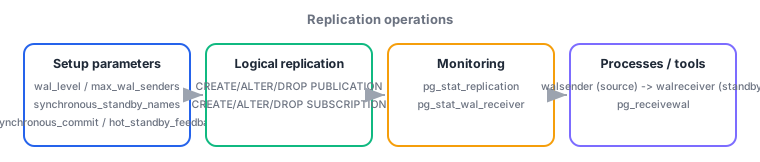
1.4.4Section summary
- Streaming setup: tune availability/performance/data-loss tolerance via wal_level=replica (logical needs
logical), max_wal_senders, synchronous_standby_names, synchronous_commit, hot_standby_feedback - Logical replication: publisher-side CREATE/ALTER/DROP PUBLICATION, subscriber-side SUBSCRIPTION. DDL is not auto-propagated
- Monitoring: primary-side pg_stat_replication / standby-side pg_stat_wal_receiver. Processes are walsender/walreceiver; pg_receivewal is for WAL-only collection
Sign in to track progress — Log in.
Quick check
(just a quick review)Q1. Availability requirements are extremely strict and you must not lose a single committed row. Which combination of settings satisfies this requirement?
Q2. Long-running analytical queries on the standby keep getting canceled because the primary's VACUUM removes rows they still need (a replication conflict). Which setting should you enable to mitigate this?
Q3. You added a new column to a table on the publisher side of a logical replication setup. What is the correct way to reflect this change on the subscriber side?
Keep track of your progress
The full study guide is free to read. Sign up free to practice with the question bank, track what you have read, review your mistakes, and highlight passages.