

What's changed: Initial version (topic 1.11, subtopics 1.11.1–1.11.2)
6.1Open Source Concepts and Licenses
Learn the definition and traits of open source and its major licenses: the freedoms to use, modify, and redistribute published source code; that OSS remains a copyrighted work offered without warranty under continuous development; and the differences among copyleft licenses (GPL, AGPL, LGPL), permissive ones (BSD, MIT, Apache License), the middle-ground MPL, and the public domain.
Linux—and every command you have learned—is open source software (OSS). In business, "may we embed this OSS in our product?" is a legal-grade judgment, and LinuC includes telling license families apart in its scope (a distinctive Version 10.0 topic).
6.1.1Definition and characteristics
- The core of open source: published source code with guaranteed freedom to use, study, modify, and redistribute (free as in freedom, not price).
- OSS remains a copyrighted work: rights are not abandoned—copyright is the legal basis for imposing license terms.
- Traits: no warranty (provided AS IS), continuous development (community-driven), and many licenses (→ organize them by family).
6.1.2The license families
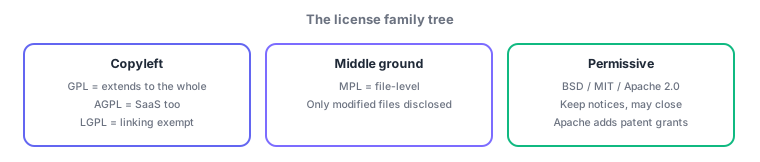
- Copyleft: derivatives you redistribute must carry the same license (source disclosed)—the "viral" condition. GPL (the flagship; extends to the linked whole), AGPL (extends disclosure to network service provision—the SaaS case), LGPL (the library relaxation—mere linking does not propagate).
- Permissive (non-copyleft): keep the copyright notice and you may close your modifications. BSD, MIT (minimal terms), Apache License 2.0 (adds explicit patent grants).
- MPL is the middle ground—file-level copyleft (only modified files must be disclosed). The public domain means no copyright claimed at all—not even a license, no conditions.
The family mapping appears verbatim: source-disclosure on modified redistribution = the GPL family (copyleft), keep notices and may close = BSD/MIT/Apache (permissive), disclosure even for SaaS = AGPL, library relaxation = LGPL, file-level = MPL. Inverted-definition distractors—"OSS has no copyright", "OSS comes with warranty"—are also standard.
Learn the families through the practical decision flow. "We will modify OSS and ship it as our product": if the component is MIT/BSD/Apache, keep the notices and your product may stay closed (Apache also covers patents). Under GPL the calculus changes—the whole product's source must be disclosed—which is precisely why companies vet licenses before embedding. If you modify but only use internally, never distributing, even GPL triggers no disclosure (the trigger is redistribution). AGPL closes the loophole of "we never distribute—we only run it as a web service", granting source rights to network users too. LGPL is the relaxation libraries adopt (glibc): linking alone requires nothing; modify the LGPL part and only that part must be shared. "What act triggers disclosure, and how far does it reach" is the exam's favorite question shape.
| License | Family | Key point |
|---|---|---|
| GPL / AGPL | Copyleft | Disclose the whole on redistribution; AGPL adds SaaS |
| LGPL | Weak copyleft | Mere linking does not propagate |
| MPL | File-level | Only modified files disclosed |
| BSD / MIT / Apache | Permissive | Keep notices, may close (Apache adds patents) |
Trap: "open source has no copyright—do whatever you like" is wrong: OSS is a copyrighted work whose license terms rest on copyright; violating them is infringement. And "GPL forces disclosure even for internal modified use" is wrong—the trigger is redistribution (AGPL's extension to network provision is the memorable contrast).
6.1.3Section summary
- OSS = published source + freedom to use/modify/redistribute, a copyrighted work (not abandoned), no warranty
- Families = GPL (whole), AGPL (+SaaS), LGPL (linking relaxed), MPL (per file), BSD/MIT/Apache (keep notices), public domain (no terms)
Sign in to track progress — Log in.
Quick check
(just a quick review)Q1. You modify GPL software and redistribute it as a product. What obligation arises?
Q2. Which set consists of permissive licenses that allow closed-source products if notices are kept?
Q3. Which license imposes source obligations even when the modified software is only offered as a web service, never distributed?
Keep track of your progress
The full study guide is free to read. Sign up free to practice with the question bank, track what you have read, review your mistakes, and highlight passages.