

What's changed: Added §4.4 "Microsoft Fabric (Unified Analytics Platform)" to fix the drift from the 2026 refresh that centers the analytics domain on Fabric/OneLake/lakehouse/Real-Time Intelligence/Data Activator. Adds Fabric alongside the existing Synapse-centric content
4.2Azure Analytics Services
Understand the Azure services behind the analytics pipeline—Azure Data Factory, Azure Synapse Analytics, Azure Databricks, and Azure Stream Analytics—and their roles.
Azure services cover stages of the analytics pipeline. Learning which stage each handles makes them easier to remember.
4.2.1Key services
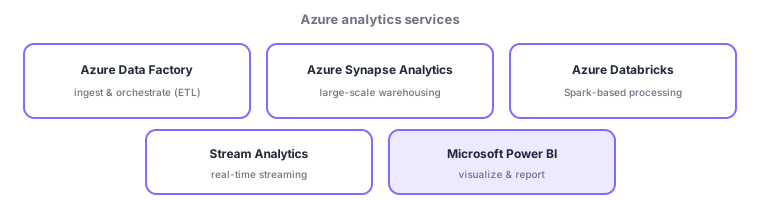
- Azure Data Factory: ingest, transform, and orchestrate data (ETL/ELT pipelines).
- Azure Synapse Analytics: an integrated platform for large-scale warehousing and analytics.
- Azure Databricks: an Apache Spark-based platform for big data processing and ML.
- Azure Stream Analytics: processes real-time streaming data.
| Service | Pipeline stage | Role |
|---|---|---|
| Azure Data Factory | Ingest / process | Build/run ETL/ELT pipelines |
| Azure Synapse Analytics | Store / analyze | Large-scale warehousing + analytics |
| Azure Databricks | Process / analyze | Spark big-data processing & ML |
| Azure Stream Analytics | Process (real time) | Streaming data processing |
| Microsoft Power BI | Visualize | Reports & dashboards |
Azure Synapse Analytics is not just a warehouse but an integrated platform spanning data integration, large-scale analytics, and visualization—SQL analytics, Spark processing, and integration pipelines in one place. Azure Databricks is an Apache Spark-optimized platform for processing and ML, widely used for data science. They overlap, but the exam maps "Spark = Databricks" and "large-scale warehouse / integrated analytics = Synapse."
Scenario: build a sales-analytics platform. Ingest/transform store DBs and CSVs with Data Factory (ETL/ELT) → store and aggregate at scale in a Synapse warehouse → visualize an executive dashboard in Power BI. For instantly detecting IoT sensor anomalies, use Stream Analytics for real-time processing. Each service owns a pipeline stage.
Q. Data Factory vs Synapse? Data Factory is mainly ingest/transform pipelines (ETL/ELT); Synapse is an integrated platform for store, large-scale analysis, and visualization (and includes pipeline features). Q. Synapse vs Databricks? Both handle large-scale processing; remember Databricks is strong in Spark/data science, Synapse in SQL warehousing and integrated analytics. Q. Real time? Processing continuously arriving data immediately is Stream Analytics.
Common mappings: ingest/ETL = Data Factory, large-scale warehouse/integrated analytics = Synapse, Spark = Databricks, real-time = Stream Analytics, visualization = Power BI.
4.2.2Section summary
- Data Factory (ingest/ETL) / Synapse (warehouse, integrated analytics)
- Databricks (Spark) / Stream Analytics (real-time)
Sign in to track progress — Log in.
Quick check
(just a quick review)Q1. Which Azure service builds and orchestrates ingestion/transformation (ETL/ELT) pipelines?
Q2. Which Azure platform integrates large-scale data warehousing and analytics?
Q3. Which Azure service fits processing real-time streaming data?
Keep track of your progress
The full study guide is free to read. Sign up free to practice with the question bank, track what you have read, review your mistakes, and highlight passages.