

What's changed: Deepened DP-300 Chapter 5 (ja figures; comparison tables/scenarios/FAQ/traps/deep paragraphs in all sections)
5.2High Availability and Disaster Recovery Strategies
Understand Azure SQL zone redundancy (in-region HA), active geo-replication and failover groups (cross-region DR), and Always On availability groups (VM). Design to RPO/RTO requirements.
High availability (HA) addresses in-region failures; disaster recovery (DR) addresses whole-region failures. Azure SQL provides mechanisms for both.
5.2.1HA and DR mechanisms
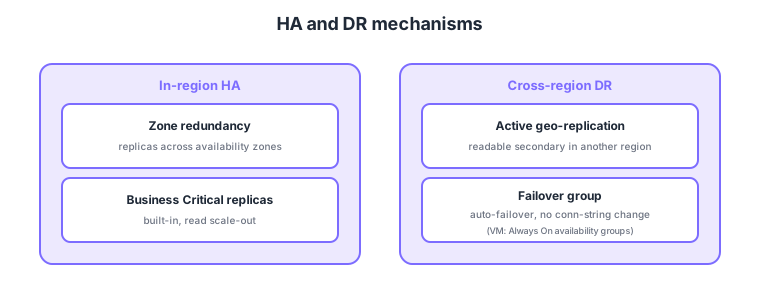
- Zone redundancy: place replicas across availability zones within a region to tolerate zone failure (HA).
- Active geo-replication: create a readable replica in another region (DR, read scale).
- Failover group: group DBs for automatic failover, switching without changing the connection string (DR).
- Always On availability groups: HA/DR for SQL on VM (self-configured).
Common on DP-300: in-region HA = zone redundancy, cross-region DR = active geo-replication/failover groups, automatic switch without changing connection string = failover group, VM HA/DR = Always On availability groups. Tighter RPO/RTO → combine zone redundancy + geo.
Failover groups provide listeners (read-write/read-only endpoints) so apps can follow a failover without changing the target.
Layer HA (in-region) and DR (cross-region). Zone redundancy places replicas across availability zones, continuing automatically through a zone failure (supported on General Purpose/Business Critical/Hyperscale, with cost/prerequisite caveats). Business Critical has synchronous replicas akin to an Always On availability group and supports read scale-out. For DR, active geo-replication creates readable secondaries (up to 4) in other regions asynchronously, promoted via manual failover. A failover group is the higher-level construct: group multiple DBs and auto-fail-over through read-write/read-only listeners without changing the connection string (MI supported too). On SQL on VM you self-configure Always On availability groups (sync/async replicas, automatic/manual failover). Synchronous replication gives RPO≈0 but is distance/latency-constrained; asynchronous (geo) covers distance but has larger RPO. The tighter the required RPO/RTO, the more you combine “zone redundancy (HA) + geo-replication/failover groups (DR).”
| Mechanism | Scope | Failover/connection |
|---|---|---|
| Zone redundancy | In-region (across AZs) | Automatic, transparent (HA) |
| Active geo-replication | Cross-region (readable secondary) | Manual promote, per-DB |
| Failover group | Cross-region (group of DBs) | Automatic, no conn-string change |
| Always On AG | VM (self-managed) | Sync/async, auto/manual |
Scenario: keep a core DB running through a zone failure and, on a whole-region failure, fail over to another region with no app config change. → Use zone redundancy to survive AZ failure (HA) and a failover group to auto-fail-over a group of DBs to another region (DR). The app connects to the read-write listener and follows the failover without changing the connection string.
FAQ: Q. Active geo-replication vs failover group? → A. Geo-replication is per-DB readable secondaries (manual promotion); a failover group auto-fails-over a group of DBs through listeners (no conn-string change). Q. To get RPO≈0? → A. Use synchronous replication (zone redundancy/Business Critical); geo (async) covers distance but has larger RPO.
Trap: “zone redundancy survives a whole-region failure” is wrong—zone redundancy is in-region HA; regional failure needs geo-replication/failover groups (DR). Also “you must rewrite the app connection string on failover” is wrong—the failover group’s listener keeps the target unchanged.
5.2.2Section summary
- HA = zone redundancy, DR = geo-replication/failover groups
- VM = Always On availability groups; design by RPO/RTO
Sign in to track progress — Log in.
Quick check
(just a quick review)Q1. You want to tolerate a single availability-zone failure within a region. What do you configure?
Q2. You want to auto-failover a group of databases to another region without changing the connection string. What do you use?
Q3. You want a readable replica in another region for both DR and read scale. What do you use?
Keep track of your progress
The full study guide is free to read. Sign up free to practice with the question bank, track what you have read, review your mistakes, and highlight passages.