

What's changed: Covered in-scope services: Elastic Disaster Recovery, Resilience Hub, Compute Optimizer, FSx (4 types), Aurora Serverless v2, DocumentDB, MemoryDB for Redis, Redshift, EKS Distro, ROSA, DMS, Transit Gateway, PrivateLink, Client VPN, Site-to-Site VPN
3.2High Availability and Self-Healing
Understand fault-tolerant design—Multi-AZ/Multi-Region, decoupling (SQS/SNS), self-healing (health checks + auto-replace), and Route 53 health checks/failover. Eliminate single points of failure.
The rule of HA is to eliminate single points of failure. Add redundancy across AZs, and contain faults with decoupling and self-healing.
3.2.1Means of HA and self-healing
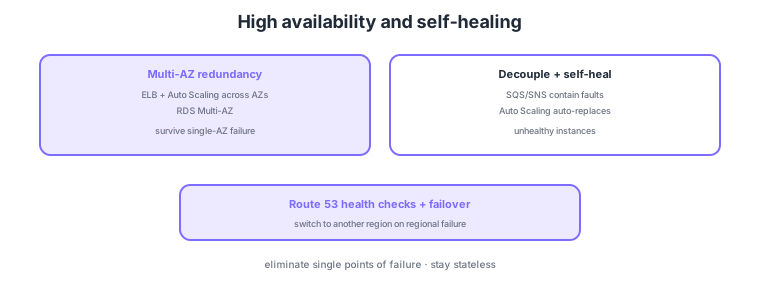
- Multi-AZ: redundancy across AZs to survive a single-AZ failure (e.g., RDS Multi-AZ).
- Decoupling: separate components with SQS/SNS to contain faults.
- Self-healing: Auto Scaling auto-replaces instances failing health checks.
- Route 53 failover: switch to another region on regional failure (health-check driven).
Common on DOP-C02: survive single-AZ failure = Multi-AZ, contain faults = decouple with SQS/SNS, auto-replace unhealthy = Auto Scaling self-healing, regional failover = Route 53. Stateless designs are easiest to self-heal.
Depending on a single AZ or instance creates a single point of failure. Keep state (e.g., sessions) off the instance (DynamoDB/ElastiCache) and stay stateless.
DOP-C02 availability design asks "against which failure domain, and how far you automate recovery." Multi-AZ is the basis for surviving a single-AZ failure: RDS Multi-AZ auto-fails over to a standby via synchronous replication, and Aurora spreads storage across 3 AZs / 6 copies. For decoupling, chains of synchronous calls cause cascading failures, so buffer with SQS to absorb consumer-side failures and fan out with SNS/EventBridge to separate publishers from subscribers; queue + Auto Scaling (scaling on queue depth) also follows backpressure. Self-healing adds, beyond auto-replacing health-check failures, EventBridge + Lambda/SSM Automation to automate "alarm → isolate → run recovery runbook." For region-scale failures, use Route 53 health checks + failover routing (active/passive) or latency/weighted routing for distribution, and keep the data tier in step with cross-region replication (S3 CRR, Aurora Global Database, DynamoDB global tables). To validate the design, evaluate RTO/RPO attainment against policy with AWS Resilience Hub and run chaos experiments with the Fault Injection Service (FIS) to confirm it self-heals as expected. Going stateless (state in DynamoDB/ElastiCache/external stores) is the prerequisite that makes all this automated recovery work.
| Failure scope | Measure | Key point |
|---|---|---|
| Single-instance failure | Auto Scaling self-healing | Auto-replace on health-check failure |
| Single-AZ failure | Multi-AZ redundancy | ELB + ASG; RDS Multi-AZ |
| Cascading via coupling | Decouple with SQS/SNS | Buffer + fan-out to contain |
| Whole-region outage | Route 53 + cross-region | Failover + data replication |
Scenario: Order processing gets dragged down by latency in a downstream inventory API, clogging everything at peak. Improve availability. → Insert SQS between order intake and inventory update to buffer, and scale consumers on queue depth. A transient inventory-API failure still retains messages, processed after recovery. For events needing multiple subscribers, fan out via SNS/EventBridge. This yields loose coupling where partial latency/failure no longer stalls the whole.
FAQ: Multi-AZ vs multi-region? Multi-AZ survives an AZ failure within one region and is the baseline for most workloads. Multi-region prepares for whole-region outages or wide-area disasters, adding cost and complexity. Decide by whether your availability target (RTO/RPO) requires continuity through a regional failure.
Exam trap: Scaling out / self-healing while keeping stateful sessions local to each instance loses sessions on replacement. Keep state off the instance (DynamoDB/ElastiCache). Also note Route 53 failover does not trigger without a health check configured.
3.2.2AWS Resilience Hub — resilience assessment and continuous tracking
Resilience Hub evaluates, visualizes, and continuously tracks your application's resilience—how well it meets its RTO/RPO objectives. First, register the application's resources (CloudFormation stacks, Terraform state, AppRegistry, etc.) and define a resiliency policy (target RTO and RPO). The service then analyzes the configuration to identify single points of failure, gaps, and improvement recommendations (e.g., make a component Multi-AZ). Recommendations are concrete actions ("distribute this target group across multiple AZs") that can be re-evaluated after remediation to confirm improvement. In continuous-assessment mode (CI/CD pipeline integration), the service automatically re-evaluates on every infrastructure change, detecting early when a change breaks the RTO/RPO target. Integration with AWS Fault Injection Service (FIS) allows combining chaos experiments with quantitative resilience assessment. In a DevOps context the typical use is "embed Resilience Hub in CI/CD as a quantitative gate instead of a design review"—continuous drift monitoring is what distinguishes it from a static architecture review.
- Policy definition: set target RTO/RPO, analyze configuration statically, surface single points of failure.
- Improvement recommendations: propose concrete actions (Multi-AZ, add backup, etc.) and re-evaluate after fixes.
- Continuous assessment (CI/CD): re-evaluate automatically on each deploy to detect policy-violation drift early.
- FIS integration: combine with chaos experiment results to empirically validate resilience.
On DOP-C02: "continuously evaluate and track RTO/RPO attainment," "auto-check resiliency policy on each deploy," "visualize SPOFs and improvement recommendations" = Resilience Hub. Keep separate: chaos experiments = FIS; transient failover routing control = Application Recovery Controller.
3.2.3Network connectivity — HA for multi-account and hybrid architectures
In multi-account and hybrid-cloud configurations, network connectivity design is the foundation of high availability. Transit Gateway centrally connects many VPCs and on-premises networks in a hub-and-spoke topology. VPC peering is point-to-point, so the wiring becomes a full mesh as account count grows, causing management cost to explode; aggregating into Transit Gateway centralizes route management and maintains redundancy without a single point of failure. PrivateLink connects privately from an endpoint (interface endpoint) inside a VPC to AWS or third-party services without traversing the internet. Traffic bypasses public IPs and internet gateways, establishing service connectivity while maintaining the security boundary. Client VPN establishes a TLS-based VPN from individual clients (laptops, etc.) to an AWS VPC—used for employee remote access in combination with client certificates or SAML authentication. Site-to-Site VPN IPsec-encrypts the connection between an on-premises site and an AWS VPC. Two tunnels are provisioned automatically, providing redundancy if one fails. When bandwidth requirements are high it is often combined with dedicated Direct Connect, with the VPN used for failover or supplemental connectivity.
| Service | Connection type | Main use case |
|---|---|---|
| Transit Gateway | Hub-and-spoke aggregation for many VPCs / on-prem | Centralize routing across multi-account |
| PrivateLink | Private from VPC endpoint to service | Use services without internet exposure |
| Client VPN | Client to VPC via TLS VPN | Remote worker access |
| Site-to-Site VPN | On-prem site to VPC via IPsec | Encrypted site-to-cloud; DR |
3.2.4Section summary
- HA = Multi-AZ + decoupling (SQS/SNS)
- Self-healing = health checks + auto-replace / failover = Route 53
- Resilience assessment = Resilience Hub (continuous RTO/RPO tracking; CI/CD integration)
- Network HA = Transit Gateway (multi-VPC hub) + PrivateLink (private connectivity) + Client/Site-to-Site VPN (hybrid)
Sign in to track progress — Log in.
Quick check
(just a quick review)Q1. You want a single-AZ failure in the web tier not to take down the whole service. Most basic measure?
Q2. When an instance fails health checks, you want it auto-replaced to recover. What does this?
Q3. When the primary region is fully down, auto-switch to another region. What?
Keep track of your progress
The full study guide is free to read. Sign up free to practice with the question bank, track what you have read, review your mistakes, and highlight passages.